

Vodacom South Africa takes major Please Call Me hit


Vodacom has seen its South African operations take a hit after settling with Kenneth Makate in the Please Call Me saga.
However, depite an R874 million knock—including the once-off settlement—the group still saw a strong overall performance.
Makate was previously an employee of Vodacom, who claimed to have conceived the “Please Call Me” service offered by the telco.
He started legal proceedings against the company in 2008, seeking compensation for the business idea.
In 2016, the Constitutional Court ruled that Vodacom was liable to pay Makate compensation. Vodacom then offered him R47 million.
This figure was rejected by Makate, who sought a much larger amount, and the matter then started making its way through the courts once again.
A major turning point was when the Supreme Court of Appeal (SCA) ruled that Makate was entitled to a compensation amount in the range of 5% to 7.5% of revenues earned by Vodacom from the service.
This would have amounted to a staggering R60 billion payout by some estimations. However, Makate’s legal team had argued that he was only seeking around R10 billion.
The matter ultimately ended up before the Constituional Court once again, which earlier this year delivered a scathing ruling against the SCA for ignoring Vodacom’s inputs, ordering that the case be heard again.
As the new trial date approached, Vodacom and Makate finally settled the matter out of court after almost two decades of litigation.
On 4 November 2025, the Vodacom board approved a settlement, with the final payout being accounted for in the group’s interim results for the six months ended September 2025.
As per the settlement process, a notice was sent to the SCA withdrawing Vodacom’s appeal, while another notice was sent to the High Court.
“The Please Call Me matter has been settled by the parties out of court. Both parties are glad that finality has been reached in this regard,” said Vodacom Group CEO Shameel Joosub.
The Vodacom Group admitted that the settlement with Makate impacted Vodacom South Africa’s financial performance, but refused to give the exact amount.
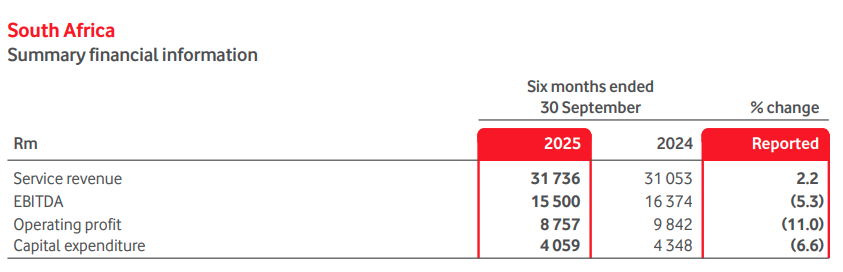
Instead, the settlement was buried somewhere in the South Africa segment’s results:
In South Africa, service grew by 2.2% to R31.7 billion, supported by the contract segment and beyond mobile services.
Beyond mobile services, which include financial and digital services, fixed and IoT were up 5.6% and contributed R5.8 billion, or 18.3% of service revenue.
However, service revenue growth of 1.4% in Q2 was impacted by pressure in the prepaid sector.
Vodacom’s EBITDA dropped by R874 million, which was attributed to the revenue performance and a one-off cost (the Please Call Me matter).
Ahead of the results, the difference between the companies’ expected earnings per share before and after the settlement showed that the Makate payout cost Vodacom between R353 million and R748 million.
With the results now published, it’s apparent that the settlement was likely closer to the higher end of that range.
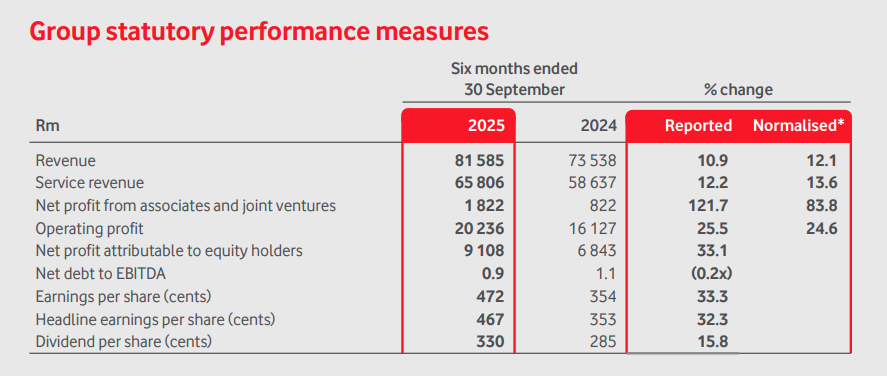
While the official figure for the settlement remains confidential, at 467 cents per share a new comparison of the impact shows that Makate likely earned around R700 million for the Please Call Me idea.
Group results
Vodacom decided to pay Makate during a period of strong financial performance for the group.
The group evidenced a 13.6% increase in group service revenue to R65.8 billion, which is tracking above its medium-term target.
Beyond mobile, including financial and digital services, fixed and IoT, contributed 21.8% of group service revenue.
Headline earnings per share jumped by 32.3% to 467 cents per share, which enabled the board to declare an interim dividend of 330 cents per share.
This aligned with the group’s dividend policy of paying at least 75% of headline earnings.
“Factoring in our diversified portfolio and disciplined execution, these results showcase the underlying health of the business, which has supported an improved return on capital and a healthy balance sheet,” said Joosub.
In terms of other regulatory wins, the group’s acquisition of a 30% stake in Maziv, which it is confident will enable the group to expand its network.
Maziv houses Vumatel and Vodacom’s acquisition of the 30% stake in the company, which faced significant challenges in the Competition Commission.
“We are confident the Maziv transaction will enable us to accelerate network expansion, help address the cost to communicate and contribute meaningfully to job creation in South Africa,” said Joosub.












 Loading ...