

R200 for a full tank of petrol in South Africa


In just over two decades, South Africans have seen the cost of a litre of petrol increase by over 406.37% due to the volatility in the Rand, global conflicts, and domestic taxation.
Historical data shows that this increase is double the inflation rate over the same period, which was recorded at 203.7%.
According to a Stats SA report, South Africans filling up with 93 petrol paid R200.80 for a full 40-litre tank in 2005. As of August 2026, this has now surged to R1,016.80.
The increase reflects a combination of factors that have repeatedly pushed prices higher over the years, including global conflicts, oil price swings, movements in the rand-dollar exchange rate, and rising domestic taxes and levies.
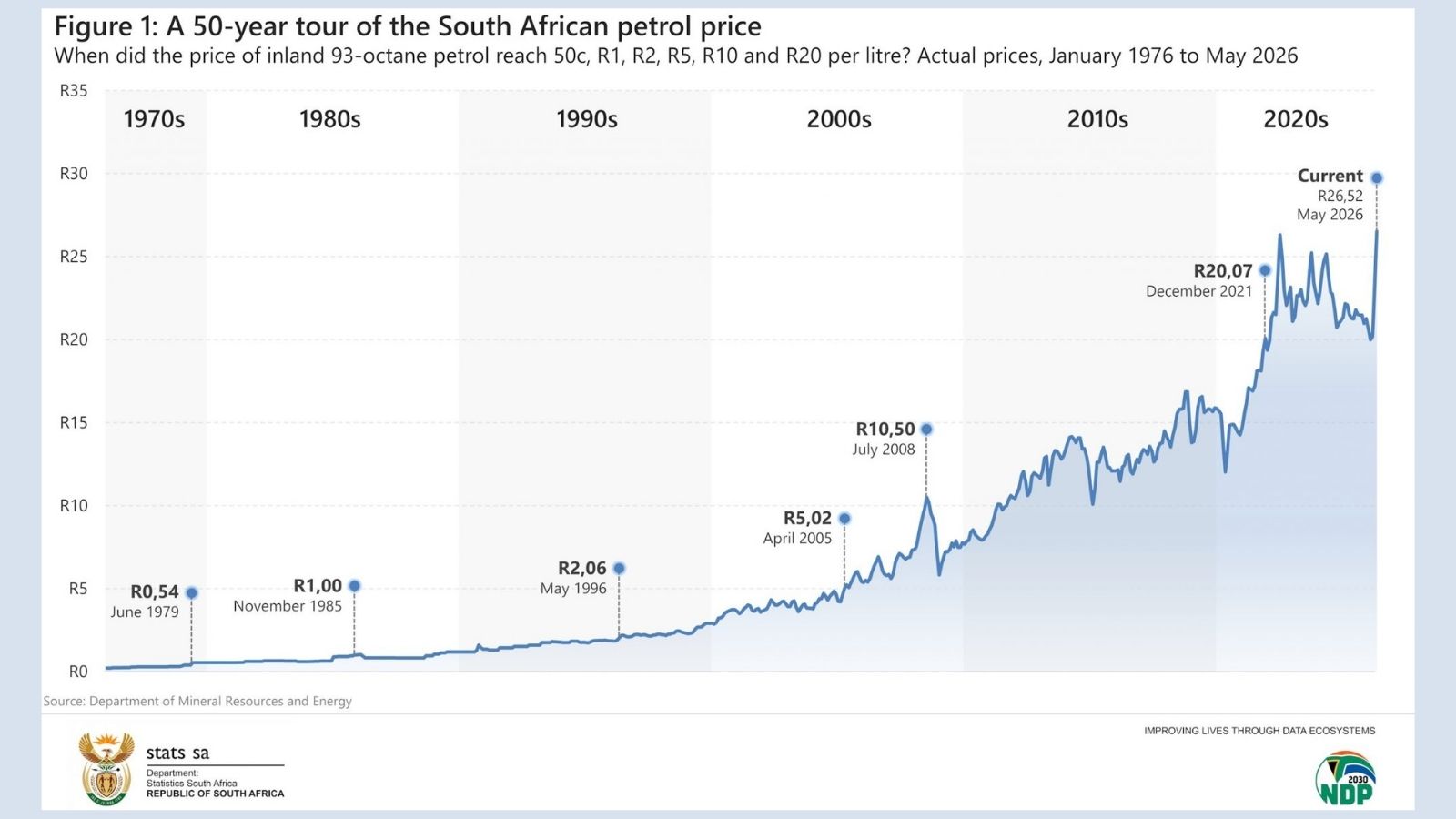
One of the biggest historical shocks came in January 1985, when the government announced an overnight fuel price increase of 39.4%, lifting the petrol price from 63.5 cents to 88.5 cents per litre.
In percentage terms, this remains “the single largest increase over the 50 years.” Stats SA noted that the impact spread well beyond motorists.
“Motorists and farmers felt the immediate pain, while commuters ultimately bore the brunt of higher taxi, bus, rail and air fares,” it said.
The weaker currency and fuel shock also contributed to rising food prices and broader economic instability.
Another major turning point came in 1990 after Iraq invaded Kuwait, disrupting global oil markets during the Gulf War.
South African motorists were hit with what has been described as a “double bruising” as petrol prices increased in both September and October.
By 2005, inland 93 petrol had crossed the R5-per-litre mark. Just three years later, the global commodities boom sent oil prices soaring to more than $145 a barrel.
The result was that petrol prices doubled in just three years, breaching the R10 level in 2008. Rather than one dramatic increase, motorists experienced six consecutive hikes that year.
The prolonged surge in fuel costs also fuelled public frustration. Stats SA noted that one of South Africa’s trade unions staged rolling strikes in response to escalating food and fuel prices.
How much more South Africans are paying today
Motorists first crossed the R20-per-litre threshold in December 2021, when “Christmas cheer was dampened” by another sharp increase.
Prices then reached R26.31 per litre in July 2022 before easing to R19.99 in February 2026. However, that relief was only temporary.
“The new price set in May 2026 is the highest on record for inland 93-octane,” with April and May 2026 ranking as the fifth- and sixth-largest monthly increases in the country’s 50-year fuel price history.
In July 2026, renewed conflict between the United States and Iran temporarily disrupted shipping through the Strait of Hormuz after ceasefire talks collapsed.
Oil prices, which had retreated towards $70 a barrel, briefly surged back to around $100 before settling near $83.
The Department of Mineral and Petroleum Resources said petrol prices were partly cushioned because international petrol prices declined during the review period.
However, diesel prices increased as supply shortages linked to the Russia-Ukraine conflict and reduced refinery output in the Middle East pushed costs higher.
The rand also weakened slightly against the US dollar, adding further pressure to local fuel prices.
Though inland motorists received a mild 52-cent reprieve in August 2026 (bringing the price down to R25.42), the price remains incredibly high.
This is exacerbated by domestic structures such as the R7.418 billion negative slate balance, which mandated a 61.38c/l slate levy, and the reality that motorists must pay over R500 in taxes alone just to fill a single tank.
The cost breakdown of filling up a 40-litre tank in 2005 vs 2026 is illustrated in the table below.
| Year | Petrol Type | Price per Litre (R) | Cost to Fill 40L Tank (R) |
|---|---|---|---|
| 2005 | Inland 93 Petrol | R5.02 | R200.80 |
| August 2026 (Inland) | Inland 93 Petrol | R25.42 | R1,016.80 |
| Increase | — | +R20.40 | +R816.00 |
| Change (%) | — | +406.37% | +406.37% |
















 Loading ...