

There are now two provinces in South Africa where more people are unemployed than working


South Africa’s latest Quarterly Labour Force Survey (QLFS) shows that the North West and Eastern Cape are the only two provinces where more people are unemployed than working.
According to Statistics South Africa (Stats SA), the country’s official unemployment rate dropped to 31.9% in the third quarter of 2025, down from 33.2% in the previous quarter.
This marks a 1.3 percentage point improvement and means about 248,000 more people found jobs, bringing the total number of employed South Africans to 17.1 million.
At the same time, the number of unemployed people fell by 360,000 to 8 million. However, despite this improvement, the total labour force—those who are either working or actively looking for work—actually decreased by 112,000 people.
Stats SA said this drop was partly due to more people giving up on finding jobs. The number of discouraged job seekers rose to 3.5 million, while others who were available but not actively looking for work increased to nearly 1 million.
Altogether, the “potential labour force” now stands at 4.5 million people. Stats SA also made changes to how it defines and measures unemployment, which affects how the data is interpreted.
The term “Not Economically Active,” used in previous surveys, has been replaced by “Outside the Labour Force,” with a new category called the “Potential Labour Force.”
These include people who are not working and not looking for work, as well as those who are available for work but not actively job-hunting.
Because of these changes, the new data on informal employment cannot be directly compared with earlier surveys.
However, when all groups are included (the unemployed, discouraged workers, and others on the fringes of the labour market), the broader unemployment picture still remains worrying.
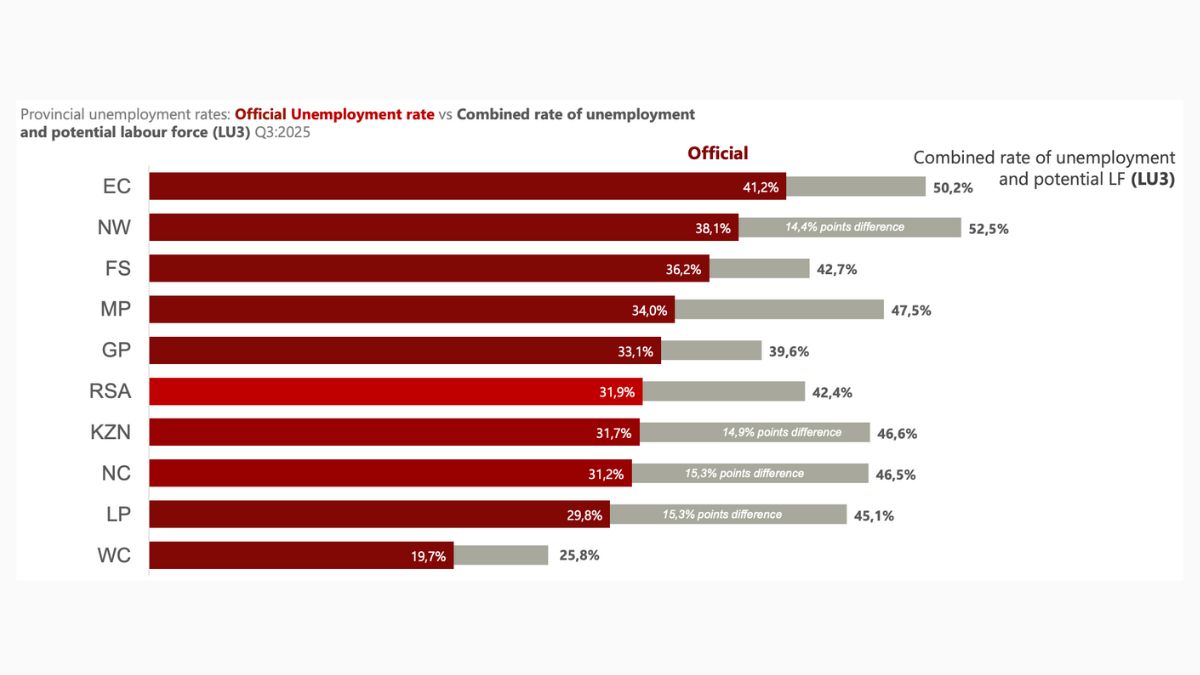
The combined measure of labour underutilisation (similar to the expanded unemployment rate) stood at 44.9% in the third quarter of 2025. The rate that most closely tracks the old expanded definition was 42.4%.
Two provinces in trouble
Across the provinces, the differences are striking. The Western Cape continues to have the lowest official unemployment rate in the country at 19.7%, maintaining its decade-long position as the best-performing province.
Limpopo follows at 29.8%, while the Northern Cape and KwaZulu-Natal recorded rates of 31.2% and 31.7% respectively.
However, the situation looks much worse in the Eastern Cape and North West. The Eastern Cape was the only province to record an increase in unemployment in the third quarter.
Under the new expanded definition, its unemployment rate now sits at 50.2%, meaning more than half of its adult population is unemployed.
The North West is in an even worse position, with an expanded unemployment rate of 52.5%.
By contrast, the Western Cape’s expanded unemployment rate is below 20%, showing that its economy remains relatively stable and better able to create jobs.
Still, the national picture shows that South Africa’s job market remains deeply uneven. Mpumalanga also faces major challenges, with an expanded unemployment rate of 47.5%, placing it just behind the North West and Eastern Cape.
Other provinces may have shown slight improvements, but millions of South Africans are still locked out of the job market.
The survey makes it clear that South Africa’s unemployment is still in crisis, with deep regional gaps showing who is benefiting from economic recovery and who is not.

















 Loading ...