

Three countries giving South African companies a massive headache



South Africa is one of the most difficult countries in the world in which to collect debt, but local creditors also struggle to get outstanding payments from Saudi Arabia, the UAE and China.
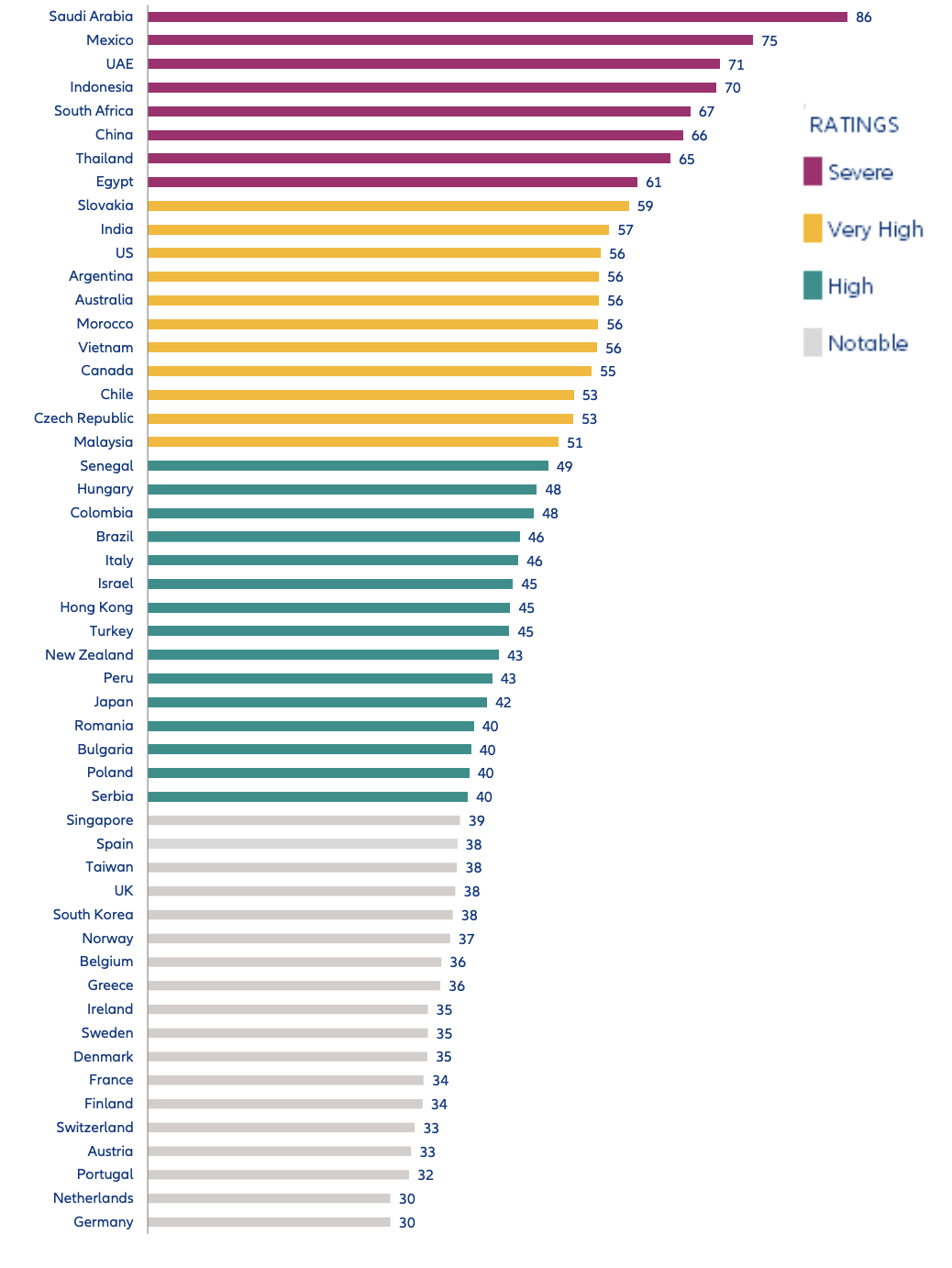
Allianz Trade has published the fourth edition of its Collection Complexity Score and Rating, which provides a clear assessment of the ease with which companies collect unpaid invoices across 52 economies.
According to the global player in trade credit insurance, global collection complexity stands at a ‘High’ level of 47.2 out of 100.
South Africa is one of the most challenging countries for debt collection in the Allianz Trade’s Collection Complexity Score and Rating report, with a score of 67, which has remained unchanged for the past four years.
This means South Africa is the fifth-worst economy in the study, with a score lower than that of the best country, Germany, which scored 30.
The score represents a severe level of collection complexity due to financial constraints and the slow-moving economy.
Most companies offer terms of up to 90 days, compared with the average 30- to 60-day terms, which are industry-driven.
In many cases, small- to medium-sized enterprises are taking 120 to 180 days to settle debts.
On the other hand, Allianz said that South African companies face debt-collection challenges across all international markets.
Across South Africa’s top 20 export destinations, the most difficult countries for recovering outstanding payments are Saudi Arabia, the UAE, and China, with the last being South Africa’s largest trading partner.
South Africa is not alone

Notably, South African businesses are not alone in their challenges with debt collection; Saudi Arabia and the UAE are among the most complex markets for debt recovery, along with Mexico.
Considering local payment practices, court proceedings and insolvency frameworks, Allianz Trade found that Germany, the Netherlands and Portugal are the easiest countries to recover debt.
“International debt collection is almost three times more complex in Saudi Arabia than in Germany… but the latter is not without complexities in terms of international collection,” said Pascal Personne, Head of Group Claims and Collections at Allianz Trade.
“In that context, the gap between advanced economies and emerging markets has been gradually reducing over time, notably in Asia, but it remains in place. Most advanced economies have a ‘notable’ level of collection complexity.
“On average, the Middle East and Africa are the top two most complex regions.”
While the global trade industry is undergoing a massive shift, Allianz warned that many new emerging hubs are complicated to do business with.
Many of these new trading hubs, which are also emerging manufacturing hubs, are appealing, but repaying their debt remains a challenge for exporters, adding to the country’s existing risks.
“In a world divided by geopolitics, protectionism and the effects of climate change, global trade is forging new paths,” said Maxime Lemerle, Lead Analyst for Insolvency Research at Allianz Trade.
‘Next Generation Trade Hubs’, including the UAE, Vietnam, and Malaysia, display a ‘Severe’ level of collection complexity, with an average score of 62.
These markets are increasingly critical in the current context, but Allianz warned that selectivity and close credit management were required when considering doing more business there.

















 Loading ...