

What Ramaphosa thinks about plan to give black businesses R55 million every day for five years


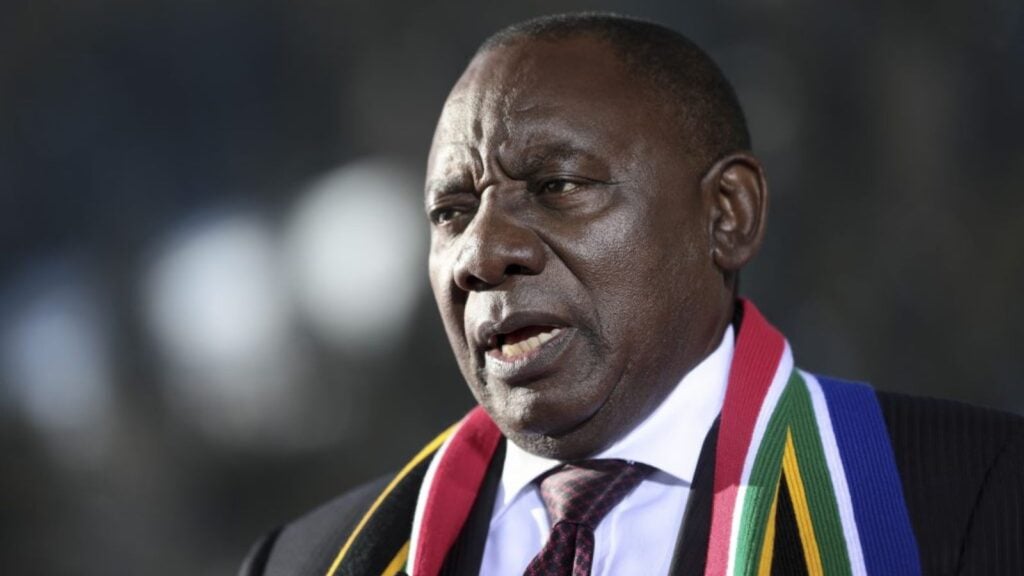
President Cyril Ramaphosa has thrown his support behind the proposed R100 billion Transformation Fund in South Africa.
He said it will help address longstanding inequalities in South Africa’s economy by expanding opportunities for black-owned businesses and broadening participation in key industries.
The proposed fund, which would be capitalised over five years, is expected to channel around R20 billion annually into majority black-owned and controlled enterprises.
This works out to roughly R55 million every day, or about R80 million per working day, to support businesses across various sectors.
Responding to questions in Parliament, Ramaphosa said the government remains committed to changing ownership patterns in the economy and reducing concentration in productive assets.
“A fundamental pillar of government’s economic programme is to open the economy to new players, give black and women South Africans opportunities in the economy and help to make the economy more dynamic, competitive and inclusive,” he said.
Ramaphosa argued that there is both a constitutional and economic imperative to correct the skewed patterns of ownership, control and participation in the economy.
He added that the government will continue to use policy tools such as competition laws, Broad-Based Black Economic Empowerment (B-BBEE) legislation, sector codes, and preferential procurement to achieve that goal.
He described the Transformation Fund as one of the latest interventions aimed at improving access to finance for majority black-owned businesses and helping them participate in value chains across key sectors.
According to Ramaphosa, an inclusive economy is one in which South Africans, regardless of race or gender, are able to participate as owners, managers, entrepreneurs and workers.
The proposal would consolidate enterprise and supplier development contributions that companies already make under the B-BBEE framework into a centralised fund, rather than requiring firms to identify and support individual beneficiaries themselves.
In May, Trade, Industry and Competition Minister Parks Tau said the fund will operate as an independent entity and include systems designed to improve accountability and transparency.
He explained that partnerships with financial institutions will support the creation of a digital platform capable of real-time monitoring of investments, job creation and other impact measures.
“The Transformation Fund is structured to reduce over-reliance on credit for black MSMEs by adopting a blended finance approach,” Tau said.
The end of BEE

He added that embedded technical support, performance-based governance, strengthened underwriting, and continuous monitoring are intended to improve repayment rates and reduce financial risk.
For smaller businesses, grants would be combined with credit to avoid excessive debt burdens, while larger industrial projects could receive early-stage equity financing before moving to more conventional funding structures.
Despite the government’s support, the proposal has attracted criticism from opposition parties and some economists.
National Assembly member Toby Chance warned that the fund could become “a bottomless pit for taxpayers’ money” with limited oversight and questioned whether it would deliver meaningful economic benefits.
He argued that the majority of funding misses the mark in stimulating high-growth enterprises and said South Africa already has many entrepreneurs who simply need opportunities to succeed.
Chance also cautioned that the initiative could perpetuate the same cycle of mismanagement that has led to poor economic growth and risk financial waste and political cronyism rather than true economic empowerment.
The Freedom Front Plus has also criticised the proposal, arguing that black economic empowerment policies have often benefited a relatively small group of individuals rather than delivering broad-based gains.
Efficient Group chief economist Dawie Roodt believes the Transformation Fund could signal a significant shift in South Africa’s empowerment framework.
He said the proposal suggests the government is beginning a process of redefining BEE and potentially replacing aspects of the current system.
“This shows that BEE is probably going to be redefined, and I think this is probably the beginning of the end of BEE as we know it,” Roodt said.
According to Roodt, the existing model could gradually give way to one in which companies earn BEE recognition by contributing to the centralised Transformation Fund rather than administering their own enterprise and supplier development initiatives.
“This will probably be the end of BEE when this process is followed through to its conclusion,” he said.
Earlier this year, Finance Minister Enoch Godongwana called for an “honest debate” about whether the policy is achieving its objectives and urged stakeholders to assess its effectiveness and unintended consequences.
However, Ramaphosa believes that the Transformation Fund remains an important instrument for promoting broader participation in the economy.
He said the government’s objective is to build “a more dynamic, competitive and inclusive” economy while ensuring that more South Africans can participate as entrepreneurs, owners and workers.

















 Loading ...