

Another nice surprise for South Africa


Annual consumer price inflation came in much lower than expected in May 2026, despite record fuel price hikes driven by the United States’ war in Iran.
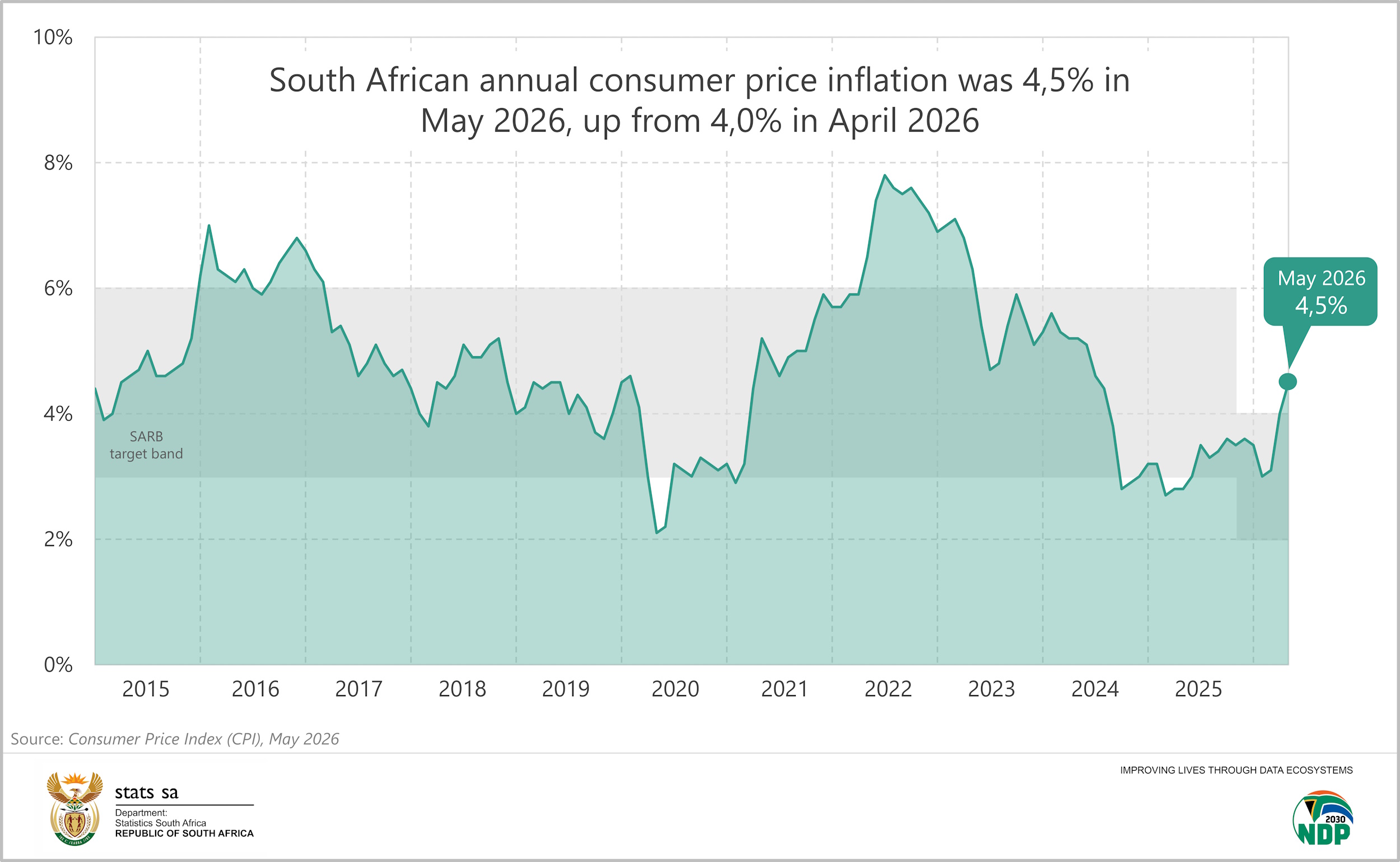
Inflation increased to 4.5% year-on-year in May 2026, up from 4.0% in April 2026. CPI increased by 0.7% month-on-month.
Core inflation, excluding food and non-alcoholic beverages (NAB), fuel and energy, was at 3.8%, up from 3.6% in April.
However, the number surprised on the downside, coming in cooler than the market consensus. Separate economist surveys anticipated a reading of at least 4.7%, and some expected the worst at over 5%.
The cooler inflation figure follows other economic numbers that came in better than expected this month, including Q1 GDP growth of 0.5% (against expectations of 0.3%) and a higher-than-anticipated primary budget surplus.
Inflation ticked higher across most sectors, driven by higher fuel prices and utility costs.
The main contributors to the 4.5% annual inflation rate were housing and utilities (5.3%, contributing 1.3 percentage points) and transport (9.4%, contributing 1.3 percentage points).
Insurance and financial services were also higher (5.7%) and contributed 0.6 of a percentage point.
In May 2026, the annual inflation rate for goods was 4.4%, up from 3.4% in April 2026, and services was 4.7%, up from 4.6% in April 2026.
The escalation works against the South African Reserve Bank’s (SARB’s) 3% inflation target and now sits outside its one-percentage-point range.
However, this was not unexpected, given the fuel crisis driven by the war.
May saw a massive hike in fuel prices, where petrol prices rose by R3.27 per litre, and diesel prices surged by R5.27 per litre.
After huge hikes in April, which pushed headline inflation to 4.0%, another spike for May was inevitable.
The fuel index recorded a second large monthly increase, leaping by 14.3% to reach an annual rise of 28.7%.
Over the past 12 months, prices for petrol increased by 24.8% and diesel by 53.8%.
It must also be noted that, even with a better-than-expected outcome, inflation remains higher and is heading in the wrong direction, which will affect the SARB’s interest rate decisions.
The central bank hiked rates in May in anticipation of an upward inflation trend as second-round effects of the Iran War and subsequent energy crisis fed into the economy.
The decision to hike rates has been criticised by the South African Chamber of Commerce and Industry as the historically hawkish central bank raising too soon—but the move was widely expected by markets.
Nevertheless, the cooler-than-expected inflation in May is a positive outcome.
The path ahead will hinge on whether or not a reported deal between the US and Iran will be signed and held, ending the conflict.
Already, markets have gained on the news, and interest rate expectations have shifted, moving from another possible hike in July and again later in the year, to just the one hike later in the year.
Fuel prices also appear to be turning positive.
Petrol prices rose sharply again in June as the National Treasury reinstated half of the fuel levy, but diesel—used by industry and transport—still saw a decent cut.
A sizeable cut for both petrol and diesel, even with the fuel levy relief terminating completely, is now building for July. This should help curb inflation readings for both months.
However, the second-round effects of the war may still be filtering through to the economy, with current expectations for inflation to cool sustainably only at the end of the year.











 Loading ...