

5 days away from disaster


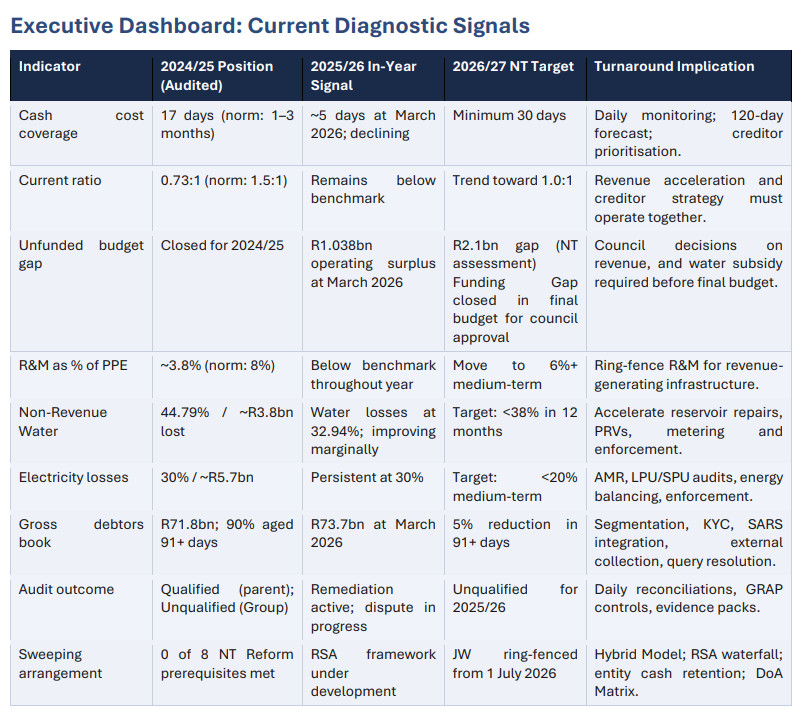
The City of Johannesburg’s cash coverage has slipped to around 5 days—and declining—against the National Treasury’s norm of one to three months (30 to 90 days).
Broadly, cash coverage in budgeting measures financial resilience, indicating how many days operations can be funded using only available cash and investments.
In 2024/25, the city was already falling behind at 17 days.
By March 2026, this had deteriorated even further to approximately 5 days, with the city indicating that this was still declining.
The information was flagged in the city’s Financial Turnaround Framework, which the city council has prioritised and fast-tracked to address various issues flagged by the National Treasury.
In the document’s summary of the city’s financial position, it laid bare the realities facing South Africa’s richest city—including a R2.1 billion unfunded gap in its budget flagged by Treasury for 2026/27.
While the city has highlighted “headline” progress on its finances over the years, it conceded that this comes with a long list of caveats.
The 2024/25 financial year showed that the city recorded a net surplus of R1.643 billion and total revenue of R81.1 billion, reflecting 10% year-on-year growth.
This came with a collection rate of 85.9%, and cash and cash equivalents improved to approximately R4.0 billion from R2.2 billion in the prior year.
These results showed that the city has a significant revenue base, and that “targeted intervention can produce measurable fiscal improvement within a single financial year,” it said.
However, the report added that the surplus was achieved in part through the drawdown of a R2.5 billion short-term facility from the Development Bank of Southern Africa and a R412.7 million deferred tax credit.
Neither of these is sustainable cash generation, it said.
In 2024/25, repairs and maintenance remained at approximately 4% of property, plant and equipment—half the 8% norm.
The gross consumer debtors’ book grew by R10.2 billion in a single year to R71.8 billion, with 90% aged beyond 91 days.
Non-revenue water stood at 45%, representing approximately R3.8 billion in lost water revenue annually. Electricity losses remain at approximately 30%, representing approximately R5.7 billion in lost value.
In the 2025/26 financial year, the situation continued to decline.
“By February 2026, the city was carrying an operating deficit of R418 million against a budgeted surplus of R1.1 billion,” it said.
“Total expenditure [is] running R2.3 billion above budget and cash declining from R1.8 billion to approximately R1.4 billion,” it said.
Notably, the National Treasury’s formal assessment of the 2026/27 Draft MTREF identified a R2.1 billion unfunded budget gap.
The national finance department has now placed the city under formal corrective scrutiny—and rating agency Moody’s has placed the city’s Ba3 rating under review for possible downgrade.
The city is at risk of losing billions of rands in national grants if it does not turn things around.
Rush to comply
During its 24-25 June Council meeting, the city prioritised the adoption of several documents requested by National Treasury, to avoid being cut off.
These include:
- A revised strategy to reduce unauthorised, irregular, fruitless and wasteful expenditure (UIFWE);
- The regularisation of almost R920 million in historical irregular and unauthorised expenditure;
- The Financial Turnaround Framework for 2026/27 to 2028/29; and
- Governance reforms required under Treasury’s Metro Trading Services Reform Programme.
However, according to civil action groups, Joburg Crisis Alliance (JCA), WaterCAN and JoburgCAN, the fast-tracking of policies to assuage National Treasury is not the same as actually turning things around.
“The City has already declared R3.636 billion in new unauthorised, irregular, fruitless and wasteful expenditure during the current financial year,” the groups said.
“Simply regularising past expenditure does not improve governance or remove the obligation to hold those responsible accountable.”
Business Leadership South Africa (BLSA) chief executive, Busi Mavuso, has also cast doubt on the city’s seriousness in addressing its growing crisis.
Mavuso noted that business groups, including BLSA and BUSA, reached out to the city’s executive and the provincial government, looking for ways to support Joburg’s turnaround.
However, this was not acknowledged, nor any response given.
“I have raised the alarm directly. Sadly, there wasn’t even the basic decency to acknowledge my letter, let alone respond to it,” she said.
“BUSA reached out to Johannesburg mayor Dada Morero, and that effort was also not successful.”
Mavuso stressed that the city is a “national economic asset of the first order”, and that its collapse would constitute a national emergency.
“The city is home to 70% of South African company head offices and produces 16% of national GDP. When Johannesburg falters, the whole economy feels it,” she said.
She added that the city is not poor—it is poorly managed.
Fixing it requires stable and honest leadership, a focused effort to root out criminal syndicates, the restoration of water and electricity services, and a credible financial recovery plan, she said.
“It can be done. Johannesburg has faced crises before and emerged from them. Business is ready to support that turnaround. What we need now is a government partner willing to show up.”
The full Financial Turnaround Framework can be read below:














 Loading ...