

No shortage of multi-million rand home buyers in South Africa


Data published by FNB shows that the luxury homes market in South Africa outperformed all other sectors, bar one, in the first quarter of 2017.
The bank’s Property Barometer for the first quarter showed the low income area house price index to be the strongest performer in terms of average house price growth, recording 12.7% growth year-on-year.
FNB’s 5 indices include:
- Luxury Area House Price Index – (Average Price = R2.276 million)
- Upper Income Area House Price Index – (Average Price = R1.204 million)
- Middle Income Area House Price Index – (Average Price = R872,391)
- Lower Middle Income Area House Price Index – (Average Price = R572,458)
- Low Income Area House Price Index – (Average Price = R353,934)
According to household and property sector strategist at FNB Home Loans, John Loos, it is possible that this low income area segment is a genuine “outperformer” in recent times, given a weak economy causing a financially constrained household sector, and a resultant search for home affordability.
“However, this segment’s house price inflation performance can be skewed by the original registration of low cost subsidized homes at values not related to true market value, while the selling of council owned rental stock over the years at values not always related to market value may also distort the picture in this segment.”
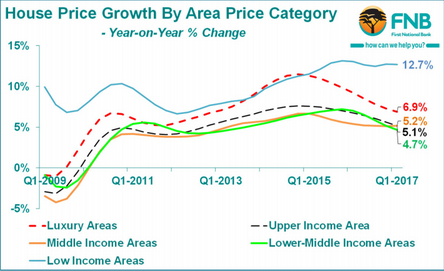
FNB noted that the luxury area house price index inflated year-on-year by 6.9% in the 1st quarter of 2017, beating the inflation rates of 5.1% for upper income areas, 5.2% in the case of middle income Areas, and 4.7% for lower middle income areas.
“We believe that this out-performance has much to do with the heavy weighting that the now expensive City of Cape Town, and broader Western Cape, receives in this luxury area index, and the fact that that region’s house price growth has been very strong in recent years,” Loos said.
FNB said that the City of Cape Town Metro accounts for a large 34.44% of total repeat sales transactions in the luxury area index (compared to a lesser 28.42% for Joburg and 10.35% in the case of Tshwane Metro).
Going down the area value bands, Cape Town’s weight diminished to 15.52% in the case of the upper income areas, and 10.42% in the middle income area value band.
Loos pointed out that the Western Cape has been a major “semi-gration” destination for repeat home buyers from other South African regions for some years now, as well has normally having the highest percentage of foreign buyers of its homes compared with other major South African regions.
“In recent times, we have begun to see signs of slowing house price growth in Cape Town and the Western Cape, but the rate of increase still far exceeds the rest of the country’s major regions.”
















 Loading ...