

How much you would have if you invested R1,000 in Capitec when it listed on the JSE


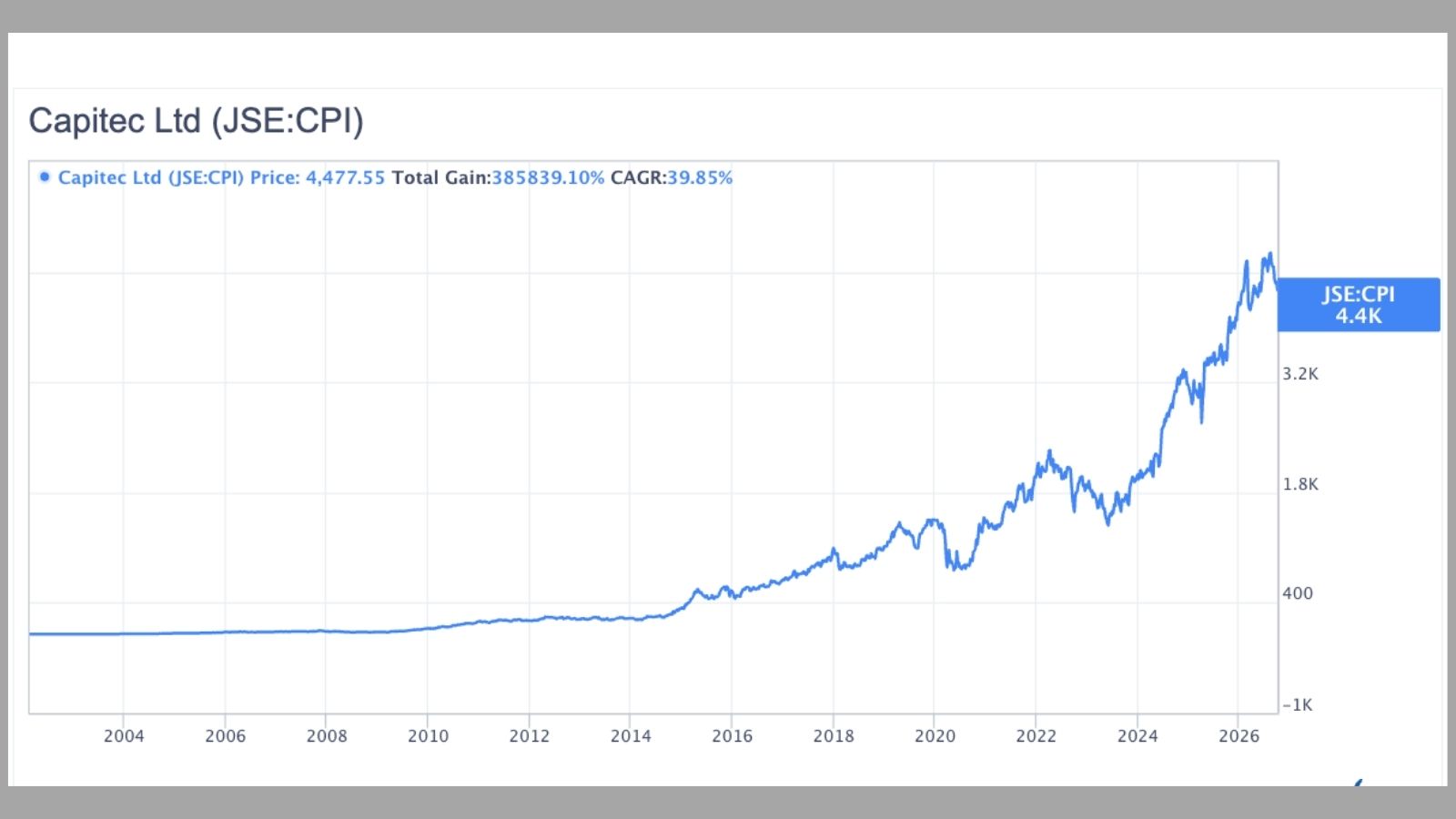
Capitec’s share price has delivered one of the strongest long-term performances on the Johannesburg Stock Exchange, turning a R1,000 investment at its listing into almost R4 million today.
The bank listed on the JSE on 18 February 2002, after its founding company, PSG, had acquired several micro-lending businesses, including Smartfin and Finai, in 1997.
At the time, the micro-lending industry was fragmented, with about 2,500 players, and PSG wanted to establish a stronger market position.
Capitec was registered as a bank on 1 March 2001, before listing almost a year later. Its early years were challenging, with strict regulations, significant capital requirements, and competition from much larger established banks.
Despite this, Capitec continued to expand, focusing on customers who were underserved by traditional banks.
Its model was built around four principles that remain central to the business today: accessibility, simplicity, affordability, and personalised service. This strategy has produced extraordinary returns for long-term shareholders.
Since its JSE listing in February 2002, Capitec’s share price has increased by about 385,839%. Based on this growth, an initial R1,000 investment would now be worth approximately R3.86 million.
This means that the original R1,000 would have increased to almost 3,860 times its value over roughly 24 years.
Capitec’s transformation is particularly notable because its business was far smaller and more narrowly focused when it listed.
In its 2003 report, Capitec said that “all our profits for the year are derived from loans: mostly small, short-term loans. During the year, we granted 2.4 million loans of an average size of R618.”
The bank has since developed into a much broader financial services group. In its 2026 interim results, 70% of operating income after credit impairments was attributable to non-interest income.
This included transaction fees, value-added services, insurance and telecommunications.
The group processed 3.7 billion card and digital payments in six months, while its insurance business generated R1.8 billion in funeral and life cover income.
Capitec Connect, its mobile virtual network operator, generated R284 million in net income, while business banking serves 545,000 business clients.
Massive growth and farewell to the old guard
In 2003, Capitec said that it “remained on track to build something unique: a low-cost, full-service mass market bank.”
More than two decades later, Capitec said it wants to “be the bank for 95% of South Africans”, and described its culture as being built around “simplicity, affordability, accessibility, and personalised experience.”
Technology has become another major part of the transformation. Capitec introduced internet banking in 2008, cellphone banking in 2009, and its banking app in 2014. It now has 16.5 million active app clients.
The bank’s massive growth is also reflected in its customer base, which reached 26.6 million in 2026. Its latest results also showed headline earnings of R9.5 billion for six months and a return on equity of 31%.
The journey has also entered a new phase, as several founding and long-serving executives retire.
Former CEO Gerrie Fourie retired in July 2025, while longtime board member Dr Chris Otto announced his retirement in 2026.
Henk Lourens, another long-serving executive who joined the group at its inception, will retire at the end of November 2026 after 27 years.
Capitec said Lourens “has made a lasting contribution to the growth of the group, helping to shape both the business and its culture.”

















 Loading ...