

Positive turn for businesses in South Africa – but the ‘big three’ problems still stand in the way


Sentiment within the South African private sector has improved – but the widespread problems at the nation’s ports, continued load shedding and crime and corruption continue to put a damper on things.
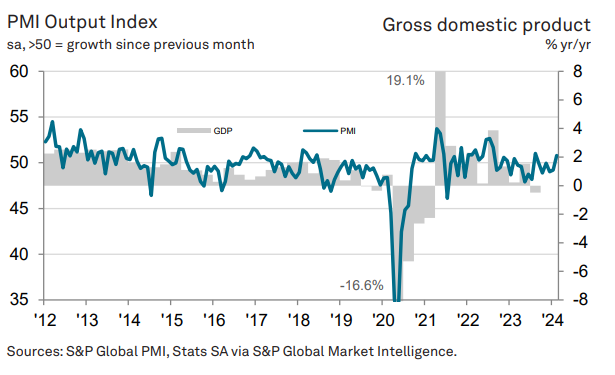
The S&P Global South Africa Purchasing Managers’ Index (PMI) – a snapshot of operating conditions in the private sector economy – climbed from 49.2 in January to 50.8 in February.
This was the first time the index broke the neutral 50.0 level since August 2023.
“The upturn in operating conditions came alongside a near stabilisation of new business volumes, following notable falls in each of the previous four months,” said S&P Global.
“Some firms monitored by the survey signalled a pick-up in customer demand, although others commented that market activity was still subdued.”
Sector data showed that service firms recorded growth, while there was a decline in industry, construction and wholesale & retail.
A stabler demand environment came amid a minor increase in selling prices, with the rate of inflation slowing down since December 2020.
While firms generally passed the increased costs to consumers, others said that they were offering discounts due to excess stocks and to stimulate sales.
There were also more positive trends in activity, employment, and inventories.
Although total business activity may have fallen for the sixth month straight, the rate of contraction softened from January and was only slight.
Anecdotal evidence did, however, show that greater load shedding and ongoing supply issues hindered output.
The major public-private partnership led by President Cyril Ramaphosa and over 100 CEOs from South Africa’s biggest companies named load shedding and logistic issues as two of the three problem areas that need addressing to improve the economy, along with crime and corruption.
The Durban port crisis led to additional setbacks over February, with the impact helf on the supply-side performance, as delivery times lengthed sharply – even if it was at a softer pace for the second consecutive month.
Some companies also faced higher material and transport fees, which led to the first quickening of purchase price inflation in seven months.
“As well as delays to imported goods, some businesses encountered challenges when exporting goods to clients.”
“This contributed to a seventh successive drop in exports, which was the sharpest seen since the end of 2021.”
Nevertheless, surveyed firms reported the strongest output projection for seven months in February.
Almost half of all respondents said that they expect activity to increase over the next year, with improving demand conditions and hopes of relaxed supply-side pressures supporting optimism.
















 Loading ...