

Bonitas announces medical aid price hikes for 2026


Medical scheme Bonitas has announced price increases for 2026, averaging 8.8% across its plans.
According to Lee Callakoppen, principal officer of Bonitas Medical Fund, certain “strategic options” will see increases below this level to improve accessibility.
“Every benefit adjustment in the 2026 range was guided by the data we see daily from our members’ health needs,” said Callakoppen.
“We looked at the current utilisation patterns of members and claims data and are confident that our offerings are aligned to the care our members need.”
Bonitas is the second largest open medical scheme in the country after Discovery and supports over 730,000 beneficiaries.
The group said that it has expanded preventative care and digital access across plans, as this is most beneficial in providing immediate care and lowering out-of-pocket expenses.
Early screening also reduces the long-term burden of chronic conditions, it said.
For 2026, the group is offering two new plans for the year; namely, BonCore and BonPrime.
BonCore is a digitally enabled hospital plan with day-to-day funding for GP consultations. It is designed to improve access to quality healthcare for a younger, price-sensitive market, the group said.
This option will combine unlimited hospital cover at a defined network of hospitals – with virtual-first primary care, a limited number of face-to-face GP visits, comprehensive preventative screening benefits and a R1 000 Benefit Booster.
The booster can be used to fund anything from basic dentistry and acute medicine, to basic radiology and pathology.
Bonitas said the BonCore plan is designed to attract digitally-savvy professionals aged between 22 and 35, who are entering their peak earning years. It is priced at R1,275 per beneficiary.
“The equal contribution rate for principal members, adult dependants and child dependants makes the plan especially attractive to single members, young couples without children, as well as small households who value cost predictability,” it said.
BonPrime, meanwhile, is the conversion of the group’s Primary Select option. This carries a new savings plan with a 16% medical savings account, while retaining the existing hospital network structure.
Medical aid price increases incoming
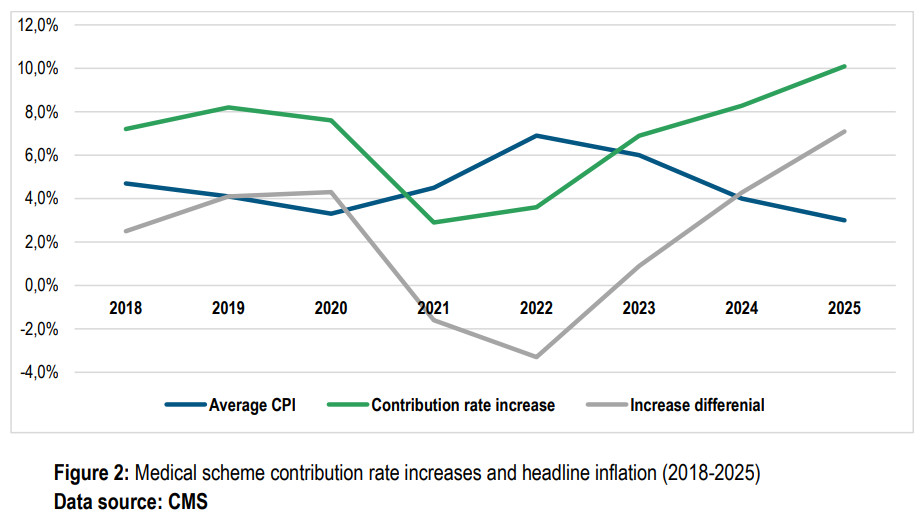
The average 8.8% increase for Bonitas packages comes in much higher than the recommended increases from the Council of Medical Schemes (CMS).
The CMS published a circular last month recommending that medical schemes limit their contribution increases for 2026 to inflation.
Broadly, the CMS recommended that medical schemes limit their 2026 price hikes to 3.3% plus “reasonable utilisation estimates”.
In previous years, the council said its historical data points to “reasonable utilisation estimates”, adding around 3.5 percentage points to the hikes.
In its latest circular, the council noted that private medical inflation usually exceeds CPI by 2 to 3 percentage points.
Thus, the “reasonable” increase for 2026 would be anywhere between 5.4% and 6.8%.
The CMS has urged medical aids to keep as close to inflation as possible, noting that contribution increases outpaced inflation by 7.1 percentage points in 2025.
Medical aid contribution increases in 2025 averaged 10.1%, against inflation of 3%. This was up from an already high 10.3% average increase in 2024.
Year after year, medical aids justify the huge increases to packages by blaming medical care inflation—which outpaces headline inflation—as well as other contributing factors.
This includes declining membership numbers, particularly among young people, placing the burden of rising costs on fewer people who are more likely to also claim.
Medical inflation was recently flagged by the Competition Commission’s Cost of Living Report as one of the biggest sectors starting to outstrip headline inflation.
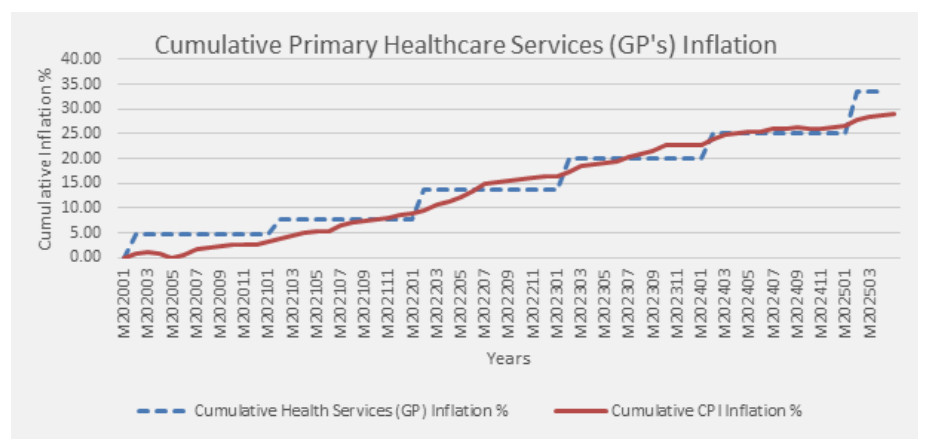
The commission’s data showed that the total increase in GP costs between 2020 and 2025 was 33%.
While this has largely remained in line with overall inflation, the most recent increase of 6.6% is substantially higher than previous increases of around 4-5%.
This is in the context of slowing general inflation. As a result, it looks likely that primary care inflation will start to outstrip general inflation moving forward.


















 Loading ...