

South Africa’s junk upgrade is already happening



South Africa is focused on hitting budget targets rather than pleasing credit-rating firms, according to the government’s top finance official—and the reward is a bond market that’s already pricing the country’s debt as investment grade.
Africa’s largest economy was cut to junk in 2017 after years of institutional erosion, fiscal deterioration, and rampant corruption known as “state capture.”
The government has now reversed spending overruns into surpluses, with debt ratios set to decline from the current fiscal year.
Ratings companies have started rewarding the improvement in state finances.
But while Fitch Ratings and S&P Global Ratings have made positive changes to their credit assessments, they remain at BB, two steps below investment level.
The nation’s dollar debt spreads, however, have tightened in recent months to levels comparable to emerging-market peers with investment-grade ratings.
That’s a vote of confidence from those who count: bond investors, said Treasury Director-General Duncan Pieterse.
“Ratings actions are a lagging indicator of fiscal strength,” he said in an interview in Cape Town this week. “The market tells you what your fiscal strength is, not rating agencies.”
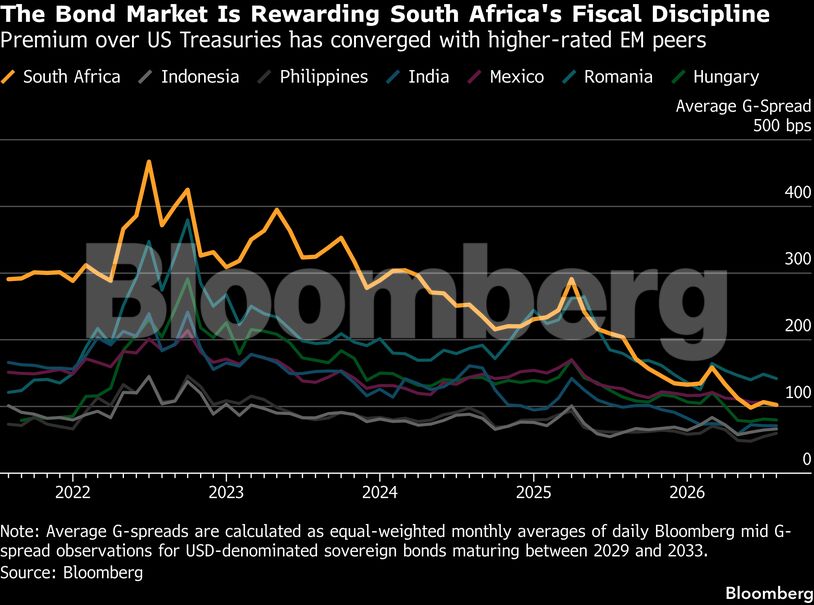
A measure of the nation’s yield premium over risk-free assets has tightened to about 102 basis points, in line with Mexico (BBB, or two steps above junk) and lower than Romania (BBB-, the lowest investment-grade level).
They’ve fallen from a peak above 467 basis points in July 2022, amid an aggressive US Federal Reserve hiking cycle that sparked a selloff of emerging-market bonds.
In another sign of growing investor confidence, the cost of insuring the nation’s debt against default, as measured by five-year credit-default swaps, has dropped to a 15-year low of around 120 basis points, compared with Romania’s 141.
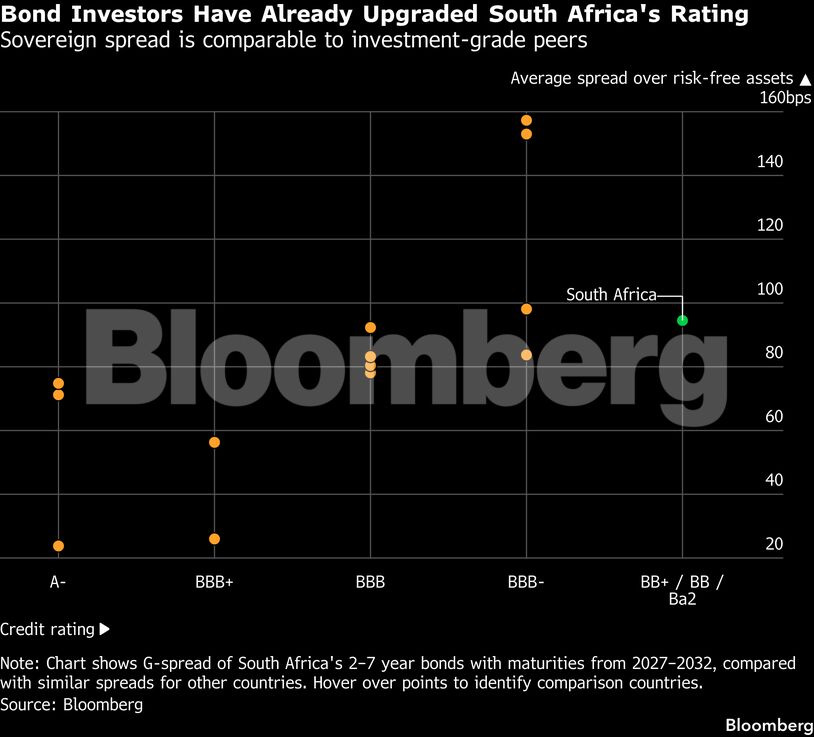
South Africa moving up
South Africa is still on track to lower its debt-to-gross domestic product ratio, despite disruptions caused by the war in Iran, Pieterse said.
A sustained drop would mark the first time in 17 years. The Treasury projects the measure will peak at 77.3% in the current fiscal year.
Not everyone is convinced. The International Monetary Fund forecast in April that the ratio would continue to rise to 79.7% of GDP next year.
“There are some definitional differences which matter less now,” Pieterse said.
“Basically, they are saying that debt is not going to stabilise, and so I guess we’ll settle that debate in February,” he said, referring to the annual budget statement scheduled for release that month.
To ensure fiscal sustainability, the government plans to introduce a “principles-based” fiscal rule with spending targets enshrined in law.
Yet even without such an anchor, the current administration has managed to grow the primary budget surplus—which excludes interest costs—and stabilise debt.
The country has already reached its foreign-currency borrowing target for the year through a mix of bonds and loans from multilateral institutions.
While lower borrowing costs may look like a good time to take on more debt, the government won’t issue foreign bonds opportunistically, Pieterse said.
“The only reason you would do that is if you don’t believe that next year you’re going to be in an even better position, which we believe,” he said.
“That’s the point of how fiscal credibility works: as you continuously execute on it, your borrowing possibilities improve over time.”
Pieterse declined to predict when South Africa might regain its investment-grade status, but said the Treasury had been proactive about communicating with the ratings companies, while building a track record of fiscal consolidation.
Bond investors are “very good at assessing” sovereign risk in real time, he said.
While borrowing costs rose steeply after the outbreak of the Iran war, the benchmark 10-year government yield has been falling since the end of March and is now more than a percentage point lower than a year ago.
“Our interest is not in when exactly rating agencies would respond,” Pieterse said.
“Our interest is in delivering on our fiscal targets because we know the response to that is immediate, and the benefits of that are immediate.”


















 Loading ...