

‘Large-scale destruction’ hits South African industries


The latest Tariff Barometer report compiled by trade union Solidarity and the Solidarity Research Institute (SRI) shows that key export industries in South Africa have experienced “large-scale destruction” from the 30% US tariff.
The report was launched last month to track the impact of the US tariffs on local industries. The latest report covers the impact of the tariffs in August.
This is notable as the 30% tariff only took effect on 7 August, with the previous report—covering data from July—only showed the impact of global tariffs that had been in effect from earlier in the year.
US President Donald Trump announced a flurry of tariffs between February and April, including a 25% tariff on all vehicle exports to the US, a 25% tariff on steel, and a 10% universal tariff as countries negotiated around a higher “reciprocal” tariff.
For South Africa, this reciprocal tariff amounted to 30%, which the government failed to convince the Trump administration to lower.
Almost four months after the tariff was announced, it took effect on 7 August.
The inaugural Tariff Barometer report covering July export data noted that, even without the 30% tariff, certain industries in South Africa were showing strain.
The impact of tariffs on steel was already evident in the steel industry after general tariffs on steel from all countries were imposed in February.
Steel exports have been relatively consistent over the past few years, but they showed a sharp decline in the second and especially the third quarter.
However, Solidarity noted that the July data would serve as a benchmark for the data covering August, which has now shown the material impact of the tariffs on various industries.
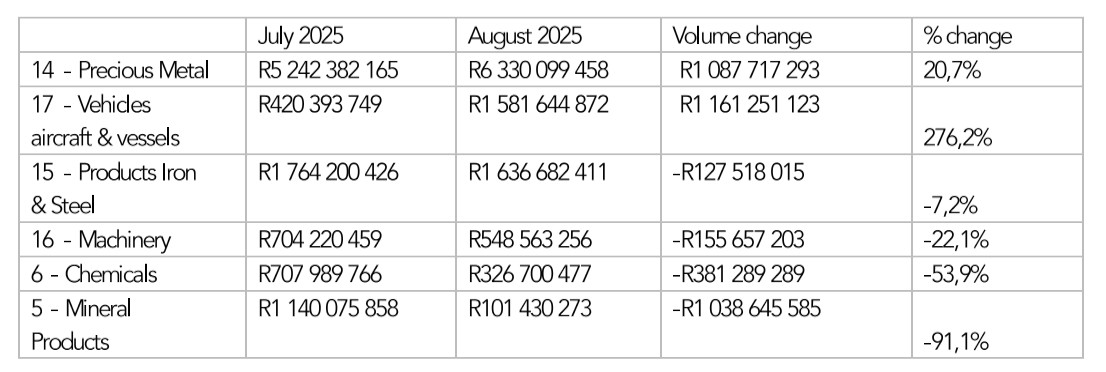
This includes a 53.9% drop in exports for the chemical industry and a disturbing 91.1% for mineral products, the group said.
“This shows how the US’s 30% trade tariff on South African imports has already wreaked havoc in August,” it said.
Industries hit hard
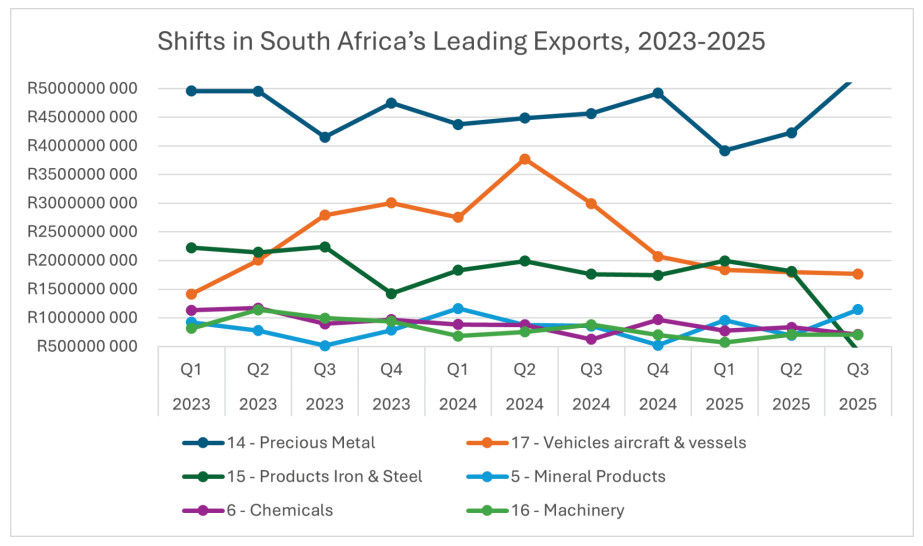
Compared to exports in July, the US tariffs have had a crippling impact on various industries, with the chemical and mineral products industries being hit the hardest.
Solidarity conceded that the minerals sector is inherently volatile, but posited that a decline of 91.1% cannot simply be explained by volatility.
“Tariffs clearly play a role herein. Particularly worrying, however, are the figures for the chemical industry, which traditionally delivers many perennial exports to the US. A decline of approximately 54% indicates large-scale destruction,” said Theuns du Buisson, economic researcher at the SRI.
Surprisingly, exports of vehicles, vessels and aircraft increased sharply month-on-month in August. This runs counter to expectations, given that the sector would have seen a compounding tariff of almost 60%.
However, Du Buisson said this spike could be attributed to the industry anticipating the August tariff.
“Role players in the industry and the larger manufacturing sector drastically increased their production in July and early August to get their exports on board before 10 August to escape these tariffs,” he said
“These are probably the desperate last moves of an anxious industry,” Du Buisson said, adding that the barometer will likely indicate the pressures on these sectors going forward.
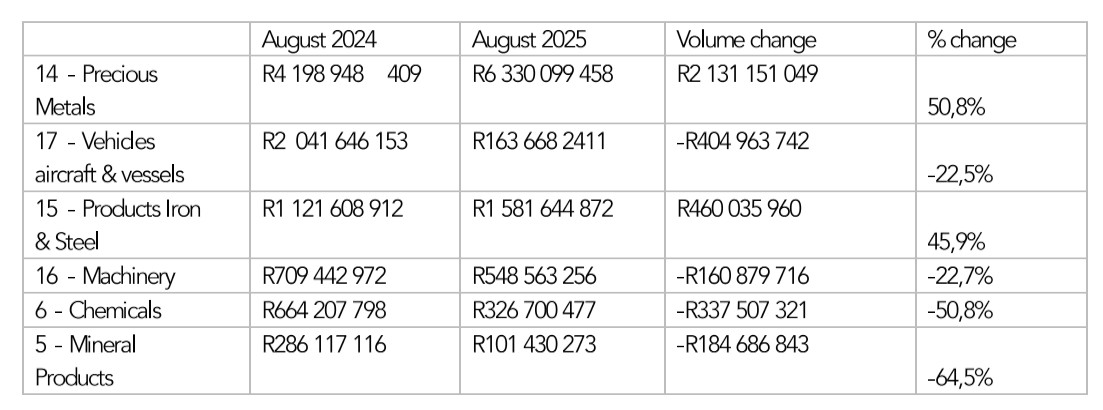
Looking at the year-on-year figures, the vehicle sector was down 22.5%.
Month on month
Year on year

















 Loading ...