

China coming to South Africa’s rescue


After months of anxiety among South African fruit producers over US tariffs, China has stepped in to provide a much-needed lifeline for the country’s farmers.
According to Thabile Nkunjana, Senior Agricultural Economist at the National Agricultural Marketing Council, there was panic after US President Donald Trump announced reciprocal tariffs in April.
Currently, there’s great uncertainty about what the increased tariffs for South Africa—which are currently at 30%—mean for certain sectors of our economy.
While some items, such as critical minerals, were exempt, Nkunjana said citrus growers in the Western Province have been highly concerned about their relationship with the US. It comes at a cost of potential job losses and a lack of new markets to explore.
That’s starting to change. China has come to the rescue, especially for the stone fruit industry.
“Next time you eat and enjoy a South African prune, plum, peach, apricot, or even a cherry, bear in mind that these could soon be making their way to a market like China,” said Nkunjana.
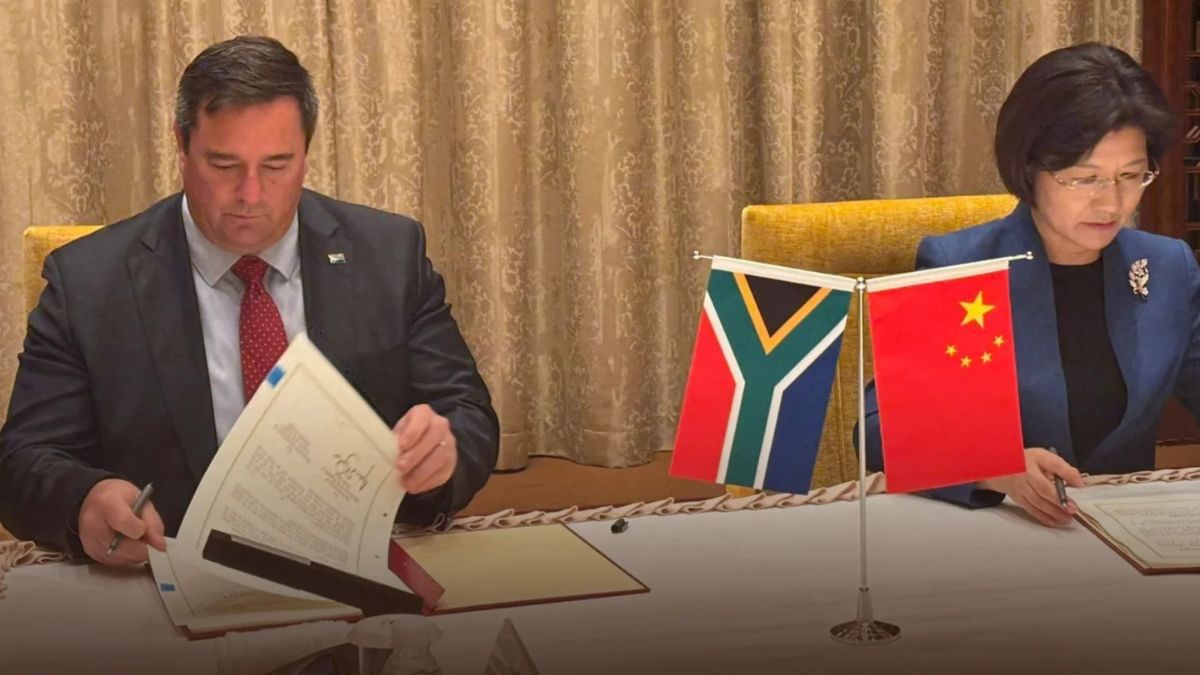
This shift follows a new stone fruit trade agreement signed in Shanghai between South Africa’s Minister of Agriculture, John Steenhuisen, and China’s Minister of the General Administration of Customs, Sun Meijun.
The deal opens the Chinese market to five types of South African stone fruit—apricots, peaches, nectarines, plums, and prunes—for the first time.
This marks the first instance in which China has allowed access for multiple fruit types from a single country under a single agreement.
Minister Steenhuisen added that it forms part of a broader strategy to make South African agriculture less dependent on traditional buyers and more responsive to new consumption patterns such as China’s growing middle class.
The potential is significant. The opening of the Chinese market could unlock approximately R400 million for us over the next five years, a figure which is projected to double over the next ten years.
“We expect the inaugural 2025/26 export season to generate about R28 million, and R54 million in 2026/27,” said Steenhuisen.
The deal could not have come at a better time
China’s demand for fruit is enormous. Last year, it imported over 21 million cartons of peaches and nectarines and 20 million cartons of plums—more than South Africa’s total annual export volume.
“The projections being communicated—that this could contribute as much as R400 million to the economy over the next three to five years—are encouraging,” said Nkunjana.
“But to put it in perspective, China imported peaches and plums worth about $4.4 billion last year, or roughly R70 billion. That means there’s still huge room for growth.”
However, competition will be tough. “We’ll have to compete with our counterparts from Chile, Argentina, Australia, and the USA,” he said.
“But South African products are well regarded around the world. Consumers recognise their quality, so in any fair market, our products can compete.”
Nkunjana believes the agreement will do more than boost exports. It will also support jobs and investment. Projections suggest it could create around 350 new direct jobs on farms and in packhouses, and about 600 in total when including transport and packaging.
“A market like this stimulates production. The more demand there is, the more incentive farmers have to expand,” he said.
“If we perform well in the Chinese market, we’re likely to see increased production across all the regions that produce stone fruit.”
South Africa is already the largest stone fruit producer in Africa, with major operations in the Western Cape, Limpopo, Northern Cape, and Eastern Cape.
“There is definitely room for growth. However, he noted that the stone fruit industry is still smaller than the citrus industry. “With this market access, that will likely change,” Nkunjana said.
He also said infrastructure improvements are making a difference. “There are positive reports about efficiency at the Cape Town ports.”
“If our logistics systems work properly, from packing houses to shipping, we can move products efficiently, which gives us an edge over competitors.”
Beyond stone fruit, the partnership with China is growing. During discussions with Minister Meijun, Steenhuisen raised the resumption of beef trade from certain South African regions and invited a Chinese inspection team to visit cherry and blueberry farms.
“China has been South Africa’s largest trading partner for more than a decade, and our bilateral trade continues to deepen,” Steenhuisen said.
“We value China’s ongoing cooperation and the shared commitment to exploring opportunities within our agriculture sector.”
For Nkunjana, the new deal brings relief and optimism. “When President Trump first announced those tariffs, things looked horrible,” he said.
“Now, with China opening up and other regions like the Middle East showing promise, we’re optimistic. This deal could not have come at a better time.”

















 Loading ...