

Another 145 businesses shut down in South Africa


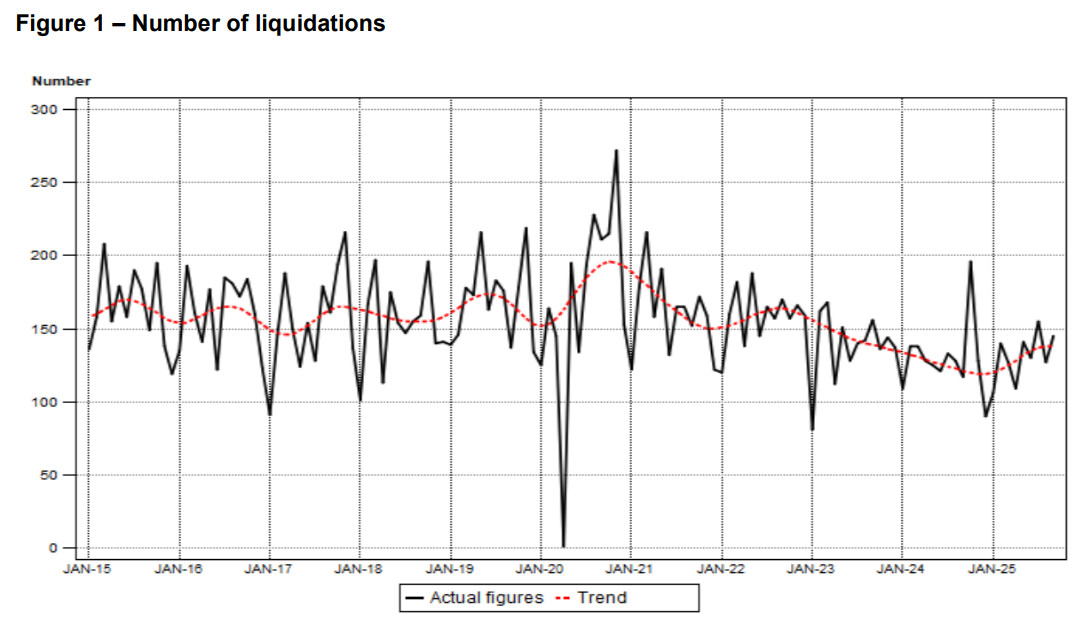
South Africa experienced another spike in business liquidations in September, with another 145 companies added to the pile of closures, taking the running total to 1,180 in 2025 so far.
Stats SA’s liquidations data showed that the numbers spiked significantly year-on-year, with liquidations shooting up 23.9% compared to the same time in 2024.
Year-to-date, liquidation numbers are also higher than they were in 2024, with the 1,180 total between January and September up 3.8% from the same period last year.
Comparing the three-month running total, the number of liquidations between July and September 2025 is 13.0% higher than the same period in 2024.
Following the longer-term trend line, 2025 is reflecting a troubling turn for companies in South Africa, with liquidation figures trending upwards after being on a declining path since mid-2022.
While the overall number of liquidations is still much lower than what was seen in the Covid-19 pandemic and lockdown years (2020-2022), this does not necessarily reflect an improved business environment.
Given that South Africa’s economic growth has stagnated over the last decade, the lower liquidations may in fact reflect that there are simply fewer businesses around to shut down.
2025 has also been an incredibly strained year for businesses, with economists and analysts pointing to global and local constraints.
Locally, businesses have to contend with collapsing infrastructure, rising electricity costs, anti-business government policy and red tape, and a lack of skills in the workforce.
Globally, the United States’ tariffs and trade war have fundamentally shifted market dynamics, impacting imports and exports and the wider global economy.
In this environment, businesses, including decades-old companies and established brands, have been forced to shut down or enter into business rescue.
Notably, business rescue data is not covered by Stats SA’s liquidation data, with the latter providing just one data point in the larger picture of South Africa’s business environment.

Uncertainty ahead
According to Stats SA’s data, the businesses hardest hit by liquidations remain those in the finance, insurance, real estate and business services sector.
This is followed by those in trade, catering and accommodation. Breaking from the annual data, September hit the construction industry hard.
The third-hardest-hit is typically the community, social and personal services sector, but the construction sector saw more liquidations in September.
A notable liquidation in that sector is Murray & Roberts Holdings, which was given a final liquidation order by the High Court this month.
The 123-year-old company will begin winding up; however, its subsidiary, Murray & Roberts Limited, is unaffected and is going through business rescue.
This again highlights the different paths for businesses and how the data only tells part of the story.
Despite the apparent pressure South African businesses are under, sentiment in the country is one of resilience.
The South African Chamber of Commerce and Industry (Sacci) Business Confidence Index for September climbed 1.1 points to hit 121.1 for the month. This is up 10.9 points from September last year.
According to the chamber, this reflects a general rebound for the index, though it remains lower than February’s reading of 125.8 before the US tariff and trade war was initiated.
The onset of tariffs and sociopolitical attacks on South Africa, amid budget troubles, saw the index drop to 113.2 in June, which improved to 120.0 in August.
General feedback has been that South Africa remained resilient in the face of the tariffs and the economy was not hit as hard as expected.
However, while economic activity has been relatively stable, Sacci noted that uncertainty persists, especially related to future trade and exports.
This includes AGOA, which ended in September, and whether or not the South African government can reduce the US’s 30% tariff.
















 Loading ...