

Four South Africans turned 32-hectares of farmland into Africa’s richest square mile


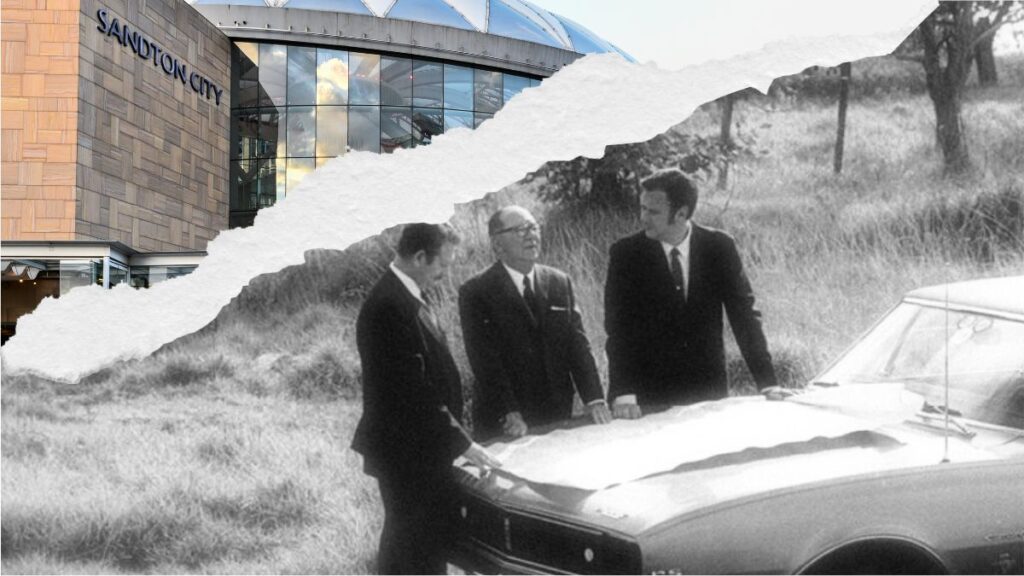
Just over 50 years ago, the land now known as Africa’s richest square mile was originally built and owned by property development company Rapp and Maister, in partnership with brothers Hilliard and Eli Leibowitz.
The area now known as Sandton was rural and sparsely developed, far removed from the financial hub it is today.
Between 1967 and 1969 developers Michael Rapp and brothers Hilliard and Eli Leibowitz acquired 32 hectares in Sandhurst, which was mostly made up of farmland, quiet estates and horse trails.
Their initial plan was to build a small number of luxury homes, some flats, and a modest shopping centre.
At the same time, Johannesburg was struggling with a congested and increasingly inconvenient central business district
Parking shortages and restrictions were frustrating residents and businesses. To relieve this pressure, the Johannesburg Town Council created a new municipality in 1969.
The name “Sandton” came from the suburbs Sandhurst and Bryanston, which the new municipality incorporated.
The proclamation of Sandton changed the developers’ calculations. Their land now lay adjacent to what was planned as the new town’s business centre.
Author Ken Romain wrote in his book, Larger than Life: Donald Gordon and the Liberty Life Story, that Rapp quickly realised the strategic importance of the land he had assembled and shifted the project away from residential housing toward a large commercial complex.
This was a significant change, as construction on four of the original 12 planned homes had already reached roof height.
Newspaper reports at the time reflected the scale of what was being proposed. In November 1969, The Star wrote that a “massive new ‘city’ would be built in Sandton,” adding that the development would be “larger than Johannesburg’s business centre” and effectively a “city in itself.”
However, the changes were not welcomed by everyone. Local residents were upset to learn that the developers had applied for additional rights allowing for offices, shops, and a 20-storey tower.
Against all odds

Gavin Main, a director at Rapp and Maister, recalled that all hell broke loose once people saw the plans.
Public hearings were heated, but the developers had followed the correct procedures. Eventually, in 1973, approval was granted.
The process was complicated further by infrastructure concerns, especially traffic. For the development to be approved, Rapp and Maister had to fund upgrades, including widening Sandton Drive and creating a link to Katherine Street.
There were also land ownership challenges. Two stands on the south-east corner of the development site were privately owned.
One was bought at the going rate of R40,000, but the other owner refused to sell until he was offered R100,000—far above market value—allowing the project to proceed.
Financing the development was another major hurdle. A R20 million debenture was needed for what was one of the largest ever for a project of this nature in South Africa at the time.
David Rapp, the company’s founder and Michael’s father, strongly opposed the scale of the borrowing and worried that it could ruin the company.
He had built Rapp and Maister cautiously over many years, beginning with small projects, but his son believed the opportunity justified the risk.
Michael Rapp’s confidence had been shaped by exposure to new international trends. He had visited modern, enclosed shopping centres overseas, including the Centre Commercial Parly 2 in France and the Yorkdale Shopping Centre in Canada.
Yorkdale, in particular, influenced Sandton City’s eventual design, including its underground road for delivery vehicles — a system still used today.
Construction on Sandton City began in 1970. The final location was chosen mainly because of its access to the newly built highway between Johannesburg and Pretoria.
When Sandton City opened on 12 September 1973, many predicted that it would fail. The Johannesburg CBD was still the dominant commercial centre, and Sandton remained semi-rural.
Quickly become a hub for economic and wealth

However, the development quickly defied expectations. The office tower was fully occupied soon after opening, and the shopping centre attracted steady foot traffic.
The presence of Sandton City became a central driver of growth in the area. Businesses increasingly looked to move out of the Johannesburg CBD—and Sandton, with its open space, modern buildings, and better parking, was an attractive alternative.
Over time, significant financial, consulting, and banking firms moved into the district. Today, an estimated 7% to 10% of JSE-listed companies have Sandton addresses.
The Johannesburg Stock Exchange itself eventually relocated to Sandton, reinforcing the area’s growing role as a financial centre.
Ownership of Sandton City evolved as well. The centre is now owned by Liberty Holdings, which holds a 75% stake, and Pareto Limited, which owns the remaining 25%. Liberty Properties manages the centre.
As Sandton grew, the shopping centre also expanded. From its original 50,000 sqm footprint, Sandton City underwent a major R1.77 billion expansion in 2011.
This added the Protea Court and increased its total retail and leisure space to over 146,000 sqm. Further upgrades between 2015 and the present have modernised several sections.
It now includes the Diamond Walk, the Fun District, the Food District, the Checkers Court, and adjoining office components such as the Sandton City Office Tower.
Today, the centre houses more than 300 retailers and attracts millions of visitors each year. By 2024, it ranked as the second-busiest shopping centre in South Africa.
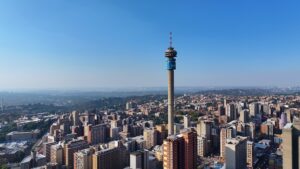
The surrounding suburbs—Sandhurst, Hyde Park, and Inanda—now contain some of the highest concentrations of wealth in the country.
This, combined with the presence of the JSE and major multinational companies, led to Sandton being widely referred to as Africa’s richest square mile.
Sandton City









 Loading ...