

South Africa bleeds 121,000 jobs


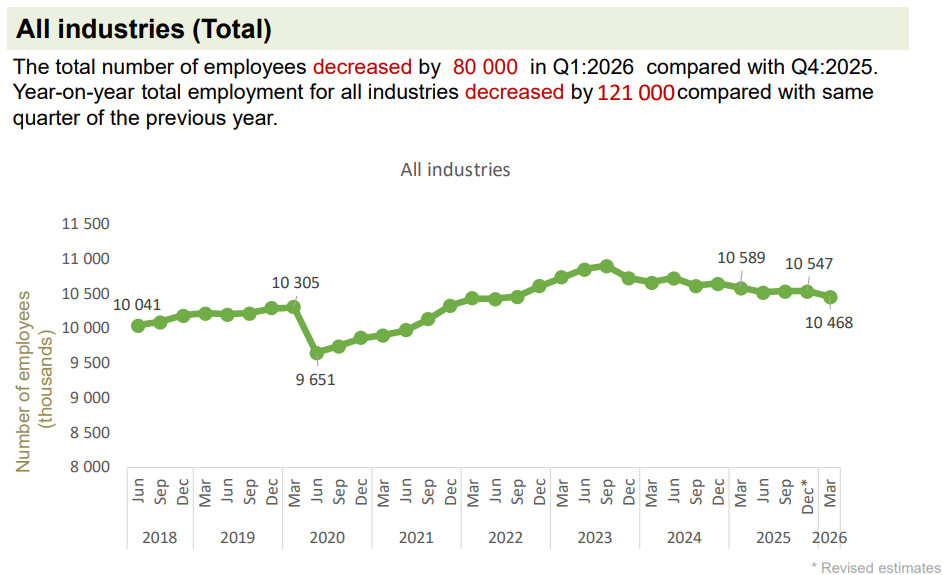
South Africa has lost 121,000 jobs over the past 12 months, with the latest Quarterly Employment Survey from Stats SA painting a bleak picture for workers and consumers.
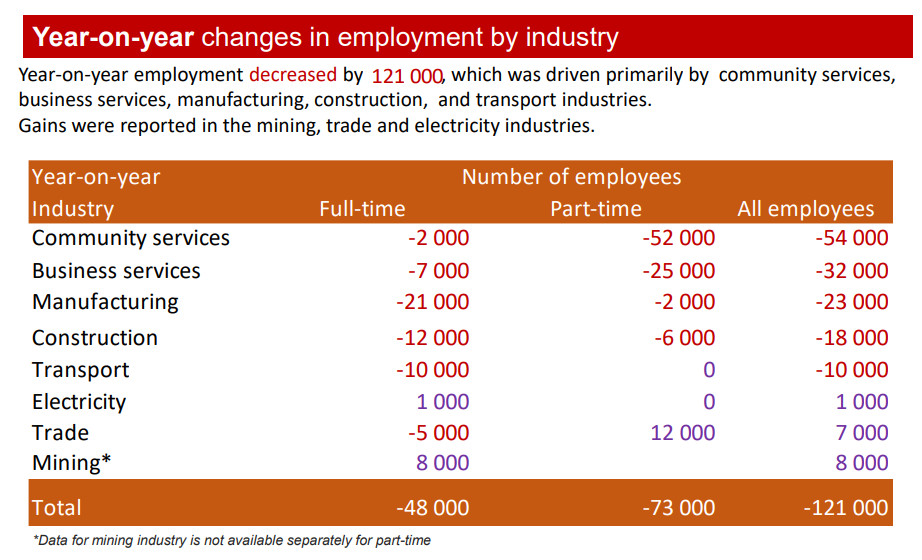
According to Stats SA, total employment decreased by 121,000 or 1.1% year-on-year between March 2025 and March 2026.
Employment decreased by 80,000 or 0.8% quarter-on-quarter, from 10,548,000 in December 2025 to 10,468,000 in March 2026.
This was due to decreases in community services (-53,000 or -1.9%), trade (-40,000 or -1.7%), transport (-3,000 or -0.6%), and electricity (-1,000 or -1.5%).
However, increases were reported in manufacturing (7,000 or 0.6%), business services (7,000 or 0.3%), mining (2,000 or 0.4%), and construction (1,000 or 0.2%).
Full-time employment decreased by 24,000 or 0.3% quarter-on-quarter, from 9,433,000 in December 2025 to 9,409,000 in March 2026.
Full-time employment decreased by 48,000 or 0.5% year-on-year between March 2025 and March 2026.
Part-time employment decreased by 56,000 or 5.0% quarter-on-quarter, from 1,115,000 in December 2025 to 1,059,000 in March 2026.
Part-time employment decreased by 73,000 or 6.4% year-on-year between March 2025 and March 2026.
The QES data follows a dismal Quarterly Labour Force Survey (QLFS) in May 2026, which revealed that the country’s unemployment rate had spiked to 32.7% in the first quarter of 2026.
That survey showed that 301,000 people lost their jobs.
The QES and QLFS differ in that the QES is an enterprise-based survey that draws data from private, non-agricultural businesses (eg, factories, offices, stores).
As the name implies, the QLFS is a worker survey that samples the wider labour force and reflects job numbers in the economy as a whole, including agriculture and the informal sectors.
Dr Elna Moolman, Standard Bank Group Head of South Africa Macroeconomic Research, said that the loss of jobs in the private sector, in particular, paints a “reasonably bleak picture” for South African consumers.
This is because the losses were felt in wholesale and hotels and accommodation, where consumer pressure is most evident.
“In the first quarter of this year, the credit bureau data that we track shows an increase in financial pressure on consumers,” Moolman said.
This was specifically a broad-based rise in non-performing loans and the proportion of consumers with overdue debt.
“In the second quarter, we saw a significant spike in the cost of living, and the SARB increased rates by a quarter of a percentage point. We expect consumers to remain under pressure for the rest of this year,” she said.

















 Loading ...