

Eskom tariff hikes undone



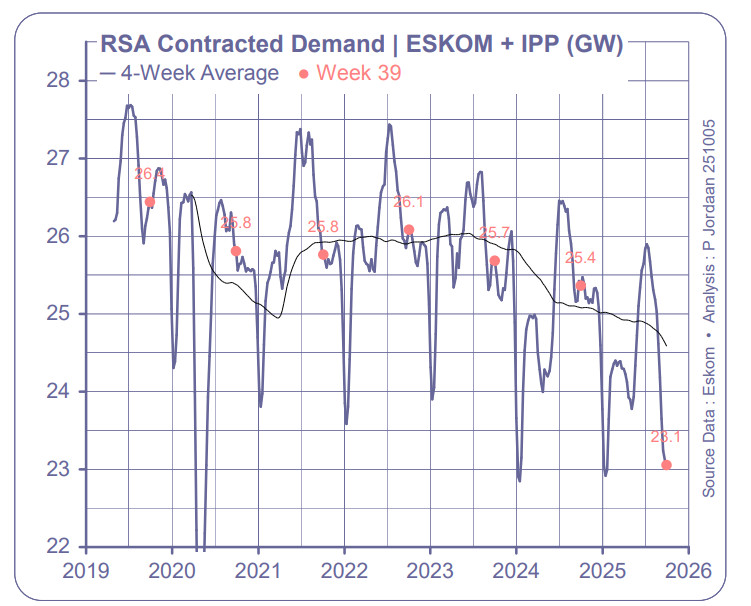
A new analysis of Eskom’s demand profiles shows that the power utility’s steep tariff increases in 2025 are being undone by a concomitant drop in demand, as customers flee to find alternatives.
According to independent energy analyst Pieter Jordaan, an analysis of Eskom’s diurnal demand profile between June and September 2025 shows that the utility’s price hikes have changed customer behaviour.
A diurnal demand profile looks at night and day demand, or over 24 hours, and typically forms a ‘duck’ curve. This shows climbing demand in the morning, a trough in the afternoon, and a peak in the evening.
While this shape has been holding over the years, the analysis shows that the ‘duck’ is getting smaller as user demand drops.
The June 2025 profile shows a drop in demand compared to 2023 and 2024, driven primarily by the introduction of Eskom’s direct price increases from 1 April 2025.
The vast majority of Eskom’s domestic customers are low-level pre-paid consumers who enjoy lower tariff increases.
Additionally, most South African households are served by municipal power and would not yet have seen the tariff increases that were to be implemented on 1 July 2025.
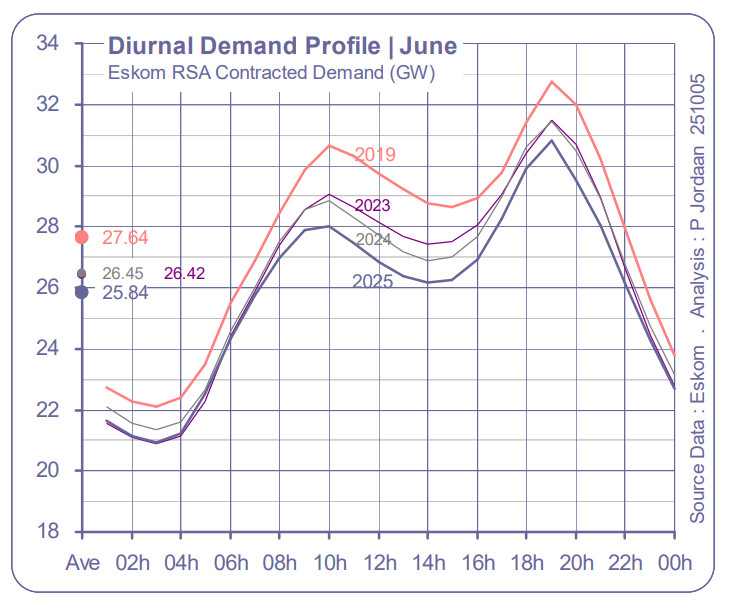
However, the demand profile shifted sharply in August and September 2025, due to the introduction of Eskom’s Retail Tariff Plan and higher municipal tariffs.
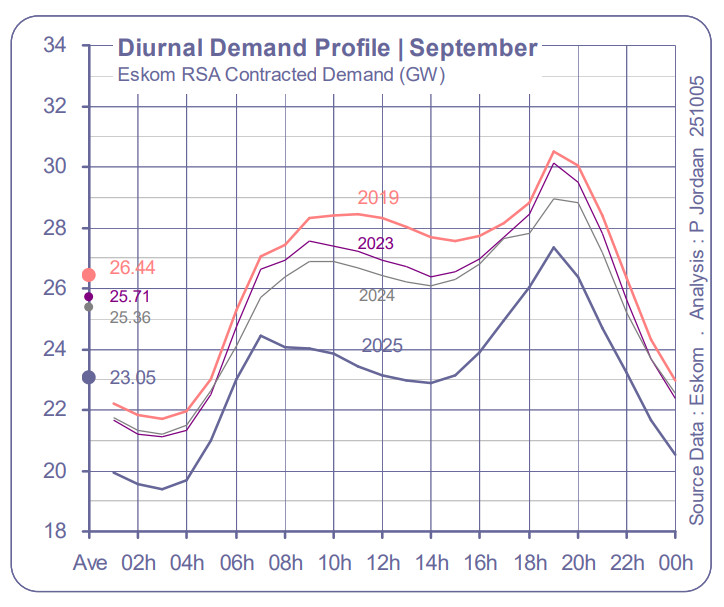
Compared to three months earlier, the September demand reflected a rapid acceleration in the drop in average demand, Jordaan said.
The change was down 1.3% between 2023 and 2024. Over the past year, however, September’s average demand plummeted by 9.1% from 25.36 GW in 2024 to 23.05 GW in 2025.
“The high winter tariffs are lowered on 1 September. Normally, by the second week in September, we would see a marked increase in demand as the industrial and agricultural sectors restart production for the festive season,” Jordaan said.
“This demand surge was absent in 2025 and could indicate lower industrial activity.”
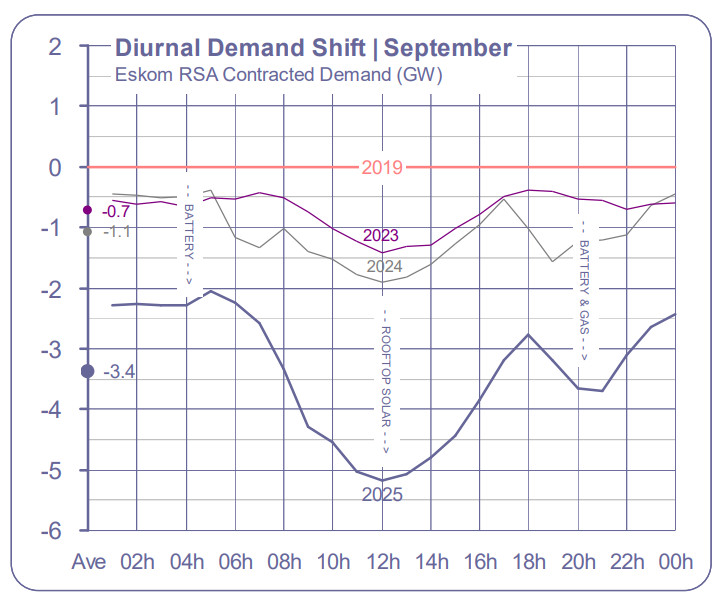
When using 2019 as a baseline, it is clear that demand for Eskom power has been declining, and that 2025 reflects a significant departure.
By June 2025, noon demand shifted lower by 10% (2.9 GW) from the pre-pandemic baseline of 29.75 GW. This compares to a 5.5% drop for 2023 and a 6.7% drop for 2024.
By September 2025, the noon demand had shifted lower by 18.4% (5.2 GW) from the pre-pandemic baseline of 28.32 GW. This compares to a 4.9% drop by 2023 and a 6.7% drop by 2024.
Jordaan said that the overall average shift of -3.4 GW represents a decrease in demand of 12.9% for September 2025 over 2019 and a -8.7% year-on-year drop.
“The analysis shows that Eskom’s restructuring of its Retail Tariffs has cost it 8.7% in demand destruction in September 2025,” he said.
“Should one add inflation at 4.5%, it means Eskom’s tariff increase of 12.7% has now been more than nixed, in real terms.”
South Africans are looking for alternatives
A notable change in the demand profiles is the emergence of a second ‘drop’ in the evenings.
Normally, a diurnal demand shift would be represented by a single even trough from 07h00 to 17h00 on any given day with level flanks from 01h00 to 07h00 and 17h00 to 00h00.
This reflects a fairly typical demand profile where Eskom would experience a morning and evening ‘peak’ as power users wake up and get ready for work, or return home and settle in for the evening.
During the day, while people are at work, energy demand dips low, creating a trough.
In recent years, however, a second, smaller trough has been observed from 18h00 to 00h00.
Jordaan said this is likely due to households shifting to gas for cooking and heating, and battery power stored during the day from solar to use for less demanding applications.
Eskom demand tanking after electricity price hikes
Renewable energy is trending upwards

















 Loading ...