

Sanral disregards R1.8 billion in e-tolls as unlikely to be collected


Sanral has disregarded over R1.8 billion in outstanding e-toll fees, as the roads agency struggles to quantify how much money it can reasonably expect to collect from motorists who have rejected the failed e-tolling system.
This is one of the more alarming notes contained within the group’s integrated annual report published this week.
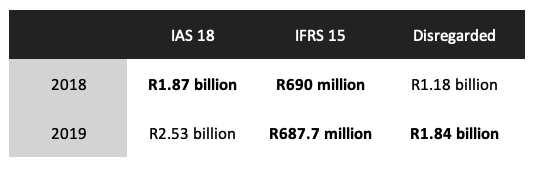
According to Sanral, the amount of e-toll revenue recognised in the current year to March 2019 was R687.7 million – down significantly (63%) from R1.87 billion recognised in the prior period.
The massive reduction in revenue isn’t necessarily reflective of fewer road users paying for the system, but rather a glaring oversight in how Sanral previously recognised revenue from the scheme.
For the 2019 financial year, Sanral adopted IFRS 15 accounting practices, replacing the IAS 18 method used before. IFRS 15 specifically looks at how revenue is recognised by companies that have contracts with customers.
IFRS 15 introduced a more specific requirement for the probability assessment on how e-toll revenue was determined – which now requires the public entity to consider both the ability and intention of customers to pay the amount due.
According to the Auditor General, Thembekile Kimi Makwetu, the probability assessment on e-toll revenue is a matter that requires significant judgement.
“There is a high degree of complexity involved in the application of the IFRS 15 to determine whether a contract exists with a road user before revenue is recognised,” he said.
Toll revenue is measured at a point of time, and previously Sanral’s measure recognised all the monies owed to it as part of the e-tolling project, as it treated the monies owed as part of a contract with customers.
However, implementing IFRS 15 – which includes a five-step assessment of revenues owed, including customers’ intention to pay – has resulted in e-toll revenue of R1.84 billion to be disregarded as it could not meet the new probability criteria.
For the year to March 2019, R687.7 million was recognised using this new method; however, Sanral noted that the comparable figure for 2018 (using the same IFRS 15 method) would have been R690 million – meaning the ‘real’ decrease is only around 0.4%.
While the comparable revenue drop in e-tolling is smaller than initially presented, the 56% increase in the bills being disregarded tells the real story – Sanral is disregarding a massive portion of money owed to it as unlikely to ever be collected.
It should be noted that this amount is not explicitly written-off – with Sanral’s expectation on motorists that they must still pay their e-toll bills – but it does reflect the degree of uncertainty the agency has that it will ever collect the money.
The table below outlines the comparable figures:
Compliance and bailouts
However, despite this, the roads agency says it has not seen much movement in its compliance levels.
“Even though the issuing of summons have been temporarily stopped, as announced to the public on 27 March 2019, and the final decision on the future of e-tolling has not been taken at national level, there has been no significant impact on the overall collection rate in subsequent month compared to prior periods,” it said.
Its management has also assumed that registered and paying road users will continue to comply and take advantage of the applicable discounts.
Sanral, civil group and society at large are waiting on the national government to present a resolution to the impasse presented by motorists’ rejection of e-tolls. Transport minister Fikile Mbalula met with stakeholders at the end of August, and has committed to resolving the issue.
In the meantime, Sanral said it will continue to be supported by government bailouts.
“Even though a significant portion of Sanral’s debt is guaranteed by government, government has elected on several occasions to avert a default by providing funding to Sanral, pending the outcome of the e-toll decision by the Presidency. It is therefore fair to assume that government will continue to do so in the foreseeable future,” it said.
Government issued guarantees for R31.91 billion and R6 billion (R37.91 billion in total), of which R24.30 billion and R5.2 billion respectively had been utilised as at 31 March 2019.
Taking into account the expected R2.53 billion per annum government allocation budgeted for the toll portfolio and current funding requirements, it is forecast that these guarantees will be fully utilised by March 2021.
A request to increase the total guarantee to R48 billion and the borrowing limit to R68 billion (from R47.91 billion) was submitted in May 2019. A previous request had been placed on hold pending resolution of the GFIP funding model.
Read: New e-toll proposals will just make things worse: Outa
















 Loading ...