

What to expect for salary increases in South Africa in 2026


South Africans can expect a modest salary increase in 2026, with remuneration and benefits consulting firm Axiomatic forecasting an average increase of around 5% for the financial year.
While the figure may appear straightforward, the firm said it is the product of a structured and scientific process that balances inflation expectations with real wage growth and broader economic realities.
Axiomatic noted that salary forecasting is a phased approach that begins with an initial estimate and is refined over time as economic data becomes clearer.
This process combines hard data with qualitative considerations to arrive at a fair and sustainable salary increase recommendation for both employers and employees.
The starting point for the salary forecast is inflation. Salary increases are closely linked to inflation because workers aim, at a minimum, to preserve their purchasing power from one year to the next.
If wages fail to keep pace with rising prices, employees are effectively worse off, even if their nominal salaries increase.
In line with its methodology, Axiomatic uses a forward-looking approach to inflation when forecasting salary increases
Rather than relying on the previous year’s inflation rate, which is already “sunk” and no longer affects future purchasing power, the firm forecasts inflation for the year ahead and bases salary recommendations on that outlook.
This allows companies to estimate how much of a salary increase will be absorbed by inflation and how much will translate into real gains for employees.
The inflation outlook for 2026 is lower than many South Africans may expect, largely due to a significant policy shift by the South African Reserve Bank (SARB).
At the November 2025 meeting of the Monetary Policy Committee, SARB Governor Lesetja Kganyago announced a move away from the long-standing 3% to 6% inflation target range.
The revised framework now targets inflation of 3%, with a tolerance band of one percentage point on either side.
Kganyago made it clear that this does not mean the Reserve Bank is indifferent to inflation anywhere between 2% and 4%.
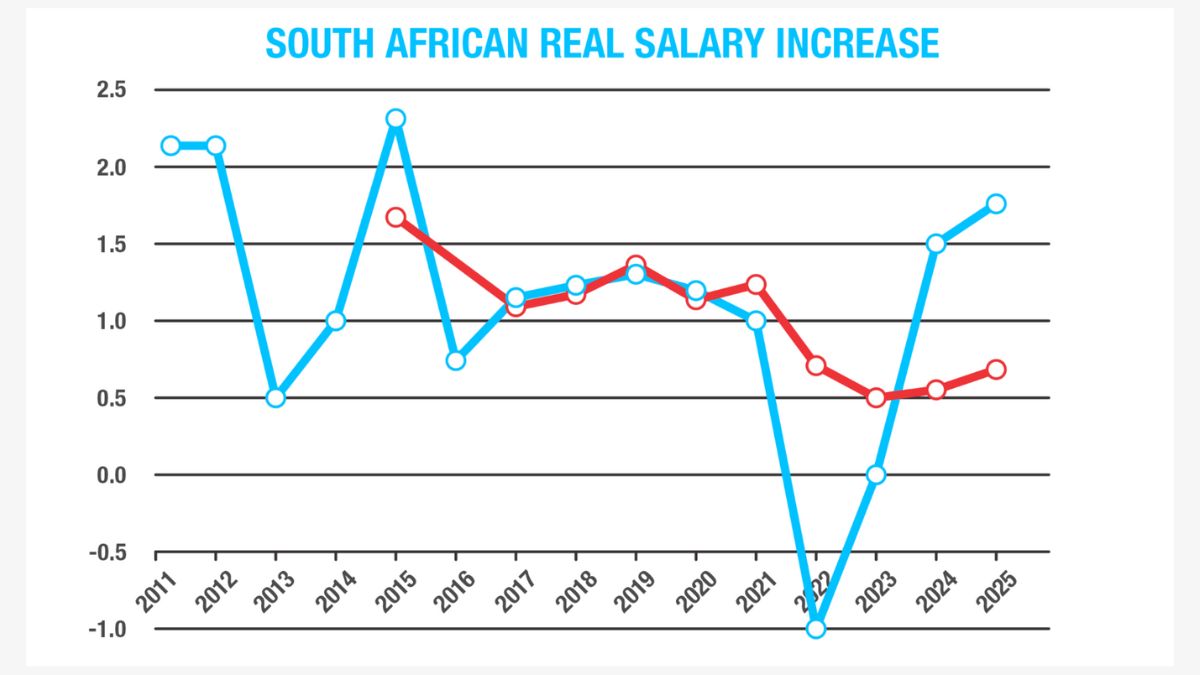
Real salary increases
Instead, the central bank aims to keep inflation as close to 3% as possible most of the time, allowing breaches of the band only in the event of severe economic shocks.
This shift signals tighter and more disciplined monetary policy, which should help anchor inflation expectations firmly around the 3% mark in the years ahead.
Once expected inflation is established, the next step is determining the real salary increase.
This is the portion of a pay rise that exceeds inflation and actually improves employees’ standard of living. For example, if salaries increase by 5% and inflation averages 3%, the real increase is 2%.
Historically, many South African companies aimed to provide real increases of around 2% on top of inflation.
However, this has changed in recent years. Elevated and unexpected inflation in 2022 and 2023 significantly eroded real wage gains, resulting in a decline in the five-year moving average for real salary increases.
According to Axiomatic, the current “new normal” is closer to a 1% real increase. In fact, when the past five years are averaged, the real increase comes in at just 0.6%, largely because of the inflation shocks experienced earlier in the decade.
As a result, a 5% salary increase in 2026, assuming inflation of about 3%, would deliver a real increase of roughly 1.3%.
Even then, the five-year average real increase would only rise slightly to around 0.7%, underscoring how constrained wage growth has been.
Axiomatic stressed that its 5% forecast is not the final word. The estimate excludes several important factors that should be considered closer to implementation, including economic growth prospects, union wage demands, sector-specific compensation trends, and the financial health of individual companies.
As more data becomes available over the coming months, the firm plans to refine its recommendation to reflect evolving conditions.
















 Loading ...