

Irregular spending by municipalities jumps 50% to R17 billion


Auditor-General Kimi Makwetu has released his report for the the 2015-2016 year, highlighting limited improvements in the audit results of South Africa’s municipalities.
The report, which compiles the audits of 263 municipalities and 51 municipal entities across South Africa, found that 15% of municipalities showed signs of improving, 13% showed signs of regressing and 67% remained unchanged.
Clean audit opinions represented only 19% of the total local government expenditure budget.
In total, the number of municipalities with clean audit opinions decreased, which included two metros that lost their clean audit status.
Irregular expenditure increased by just over 50% since the previous year to R16.81 billion – the highest since the AG started tracking the values.
However, the report noted that the amount could be even higher, as a third of the municipalities disclosed that the full amount was not known, and 24% were qualified as the amount they disclosed was incomplete.
“The irregular expenditure does not necessarily represent wastage or mean that fraud has been committed,” said AG Makwetu.
“This needs to be confirmed through investigations to be done by the council – but losses could already have arisen or may still arise if follow-up investigations are not undertaken.”
“The year-end balance of irregular expenditure that had accumulated over many years and had not been dealt with (through recovery, condonement or write-off) was R41.7 billion.”
The poor follow-up was not limited to irregular expenditure – 54% of the municipalities that incurred unauthorised, irregular and/or fruitless and wasteful expenditure in 2014-15 had still not completed all investigations by the end of 2015-16.
The significant increase can be attributed overall to a weakening in supply-chain management at municipalities, particularly in the areas of competitive bidding (46%) and obtaining three quotations (56%), which led to irregular expenditure, stated the report.
How the provinces stack up
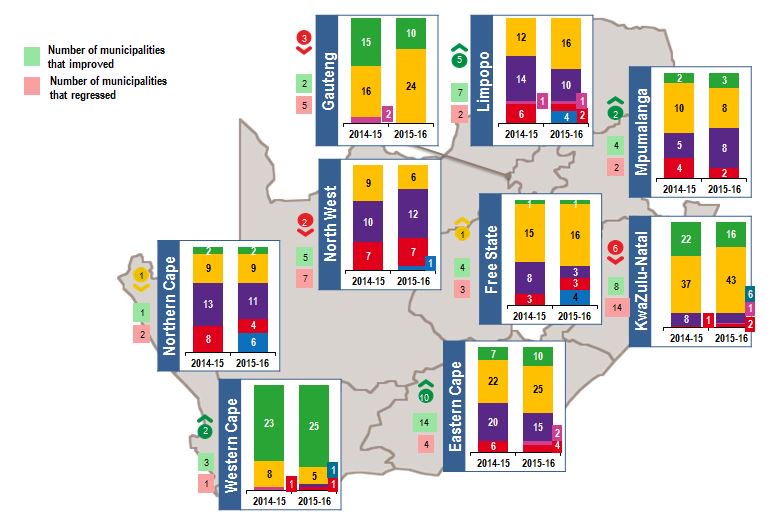
Clean audits (unqualified with no findings)
- Western Cape – 80%
- KwaZulu Natal – 18%
- Eastern Cape – 16%
- Mpumalanga – 14%
- Gauteng – 8%
- Northern Cape – 6%
- Free State – 4%
- North West – 0%
- Limpopo – 0%
According to the report, 80% of municipalities in the Western Cape returned clean audits, followed by KZN with 18% and Eastern Cape with 16%.
“The Western Cape continued with setting the pace by increasing their clean audit opinions to 80% of their municipalities,” said Makwetu.
“The focused interventions and support by the provincial leadership through the premier’s coordinating forum, operation clean audit and the municipal governance review and outlook process continued to bear fruit.”
“In comparison Gauteng also continued to perform well and was the only province where 100% of the municipalities received unqualified audit opinions on their financial statements,” said Makwetu.
“However only Midvaal could hold on to its clean audit status”.
The report notes further that the Eastern Cape, Limpopo and Mpumalanga showed momentum in the right direction, with the Eastern Cape showing the greatest improvement.
According to the report, the improvements in the Eastern Cape can be attributed to improved record keeping, the support provided by the provincial treasury and the provincial department responsible for cooperative governance (provincial Cogta), the leadership attending to audit recommendations, the implementation of the minimum competency levels, and the use of consultants.
In comparison KZN showed significant regression compared to the previous year as a result of Instability and vacancies in key positions, coupled with the lack of accountability, internal control failures related to compliance with key legislation that were not adequately monitored.
The provinces with the poorest outcomes (based on the number of municipalities with disclaimed and adverse opinions or outstanding audits) were North West (35%), the Northern Cape (31%) and the Free State (29%).
There was little improvement in these provinces and they require focused political will and a considerable investment in ensuring that the basics are done right are required to create a baseline from which accountability can be restored and strengthened.
Read: One area where Joburg beats Cape Town in the property market














 Loading ...