

Serious water problems across South Africa


The Department of Cooperative Governance and Traditional Affairs (CoGTA) is taking over from 21 municipalities that have failed to adequately supply water to implement nearly R500 million worth of water service projects.
CoGTA Minister Velenkosini Hlabisa revealed this in a Parliamentary response to questions from IFP MP Inkosi Buthelezi.
Hlabisa said that the department has identified 21 municipalities “with severe technical deficiencies in water provision,” as exhibited by the Drop Reports and directives issued by the Department of Water and Sanitation (DWS).
These identified municipalities’ normal schedule 5B 2025/26 Municipal Infrastructure Grant (MIG) allocations, amounting to R494 million, have been converted to an indirect schedule 6B.
This gives CoGTA the mandate to implement water services projects on their behalf.
“The focus will be on improving expenditure performance and prioritising water services projects in these 21 identified municipalities by 31 March 2026,” said Hlabisa.
The strategy of converting portions of the normal schedule 5B MIG to an indirect schedule 6B grant will continue in subsequent years to target poor expenditure in receiving municipalities, said the Minister.
Going forward, normal schedule 5B MIG allocations will continue to be provided, but further qualifying municipalities for the CoGTA intervention will be included and prioritised.
According to Hlabisa, part of this intervention by CoGTA is providing “capacity-building enhancement initiatives” to targeted municipalities so that municipal officials can perform their functions efficiently.
Through this, the Department “seeks to improve planning and prioritisation of projects to have a long-lasting effect to secure the sustainability of water services and other infrastructure services in the municipalities.”
Additionally, the Department said that it has ensured that municipalities can utilise a portion of their MIG allocations to repair and refurbish their water services infrastructure.
South Africa’s ailing water services
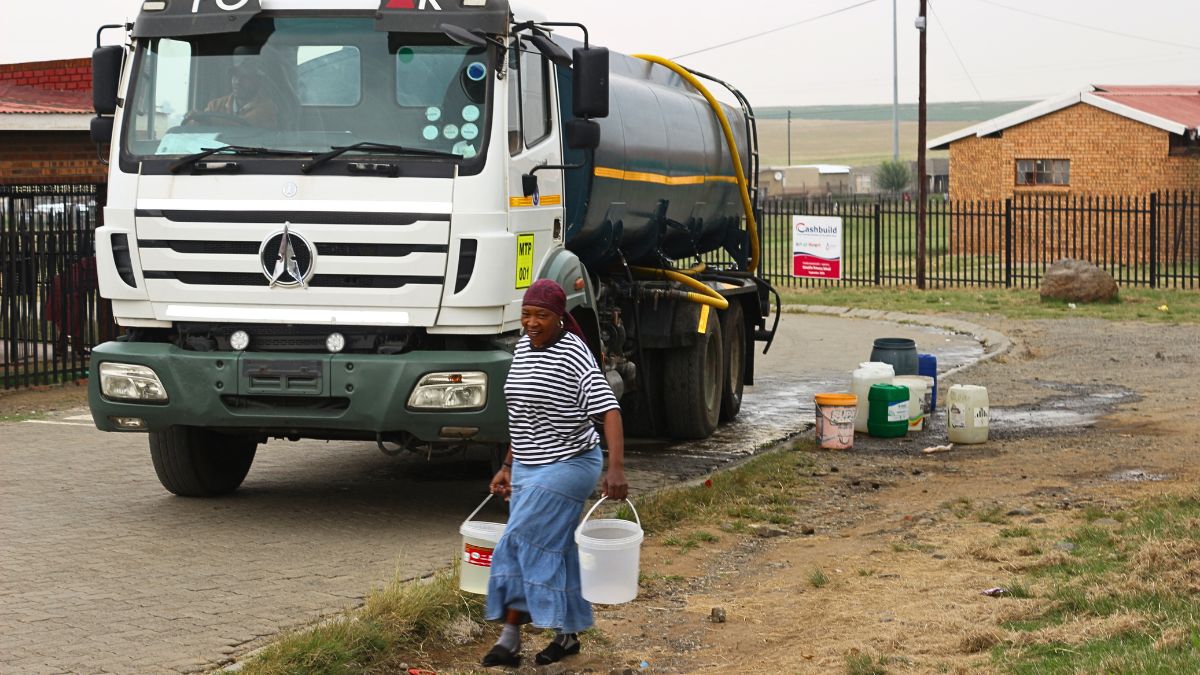
The effective provision of water in many cities and towns across South Africa has deteriorated, with the crisis leaving millions without water for days, weeks, months, and sometimes years.
“Load shedding has been supplanted by the water security crisis, which poses a similar if not greater threat to the quality of life and economic prospects of all South Africans,” said President Cyril Ramaphosa in his 2025 January 8th statement.
Water and Sanitation Minister Pemmy Majodina stated that this is largely a result of self-inflicted issues, including municipal mismanagement, poor maintenance, illegal connections, and a lack of planning and investment.
Almost a decade after the government declared a nationwide “war on leaks” campaign, much of the potable water is lost through leaks, leading to severe shortages.
Countrywide, non-revenue water losses account for 47.4%, with pipe leaks contributing 40.8%.
Water expert Professor Anthony Turton uses the metaphor of a leaking bucket to describe the relationship between bulk water suppliers and many municipalities.
Bulk water suppliers are like hoses and municipal infrastructure, leaking buckets. Irrespective of how much suppliers pour into leaking buckets, they will never be full.
Water Service Authorities (WSAs), which are essentially municipalities, deliver water services to communities within their jurisdictions. Essentially, the DWS sets the framework, and WSAs provide the services.
Through legislation, WSAs are required to measure and monitor performance related to water use targets, Non-Revenue Water (NRW), water losses, and water use efficiency.
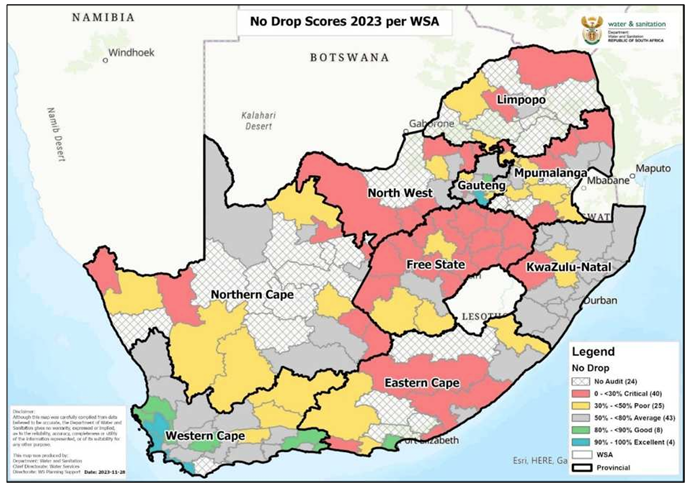
The DWS regulates the WSA’s performance through the No Drop Report, which shows that South Africa’s water infrastructure is in a dire state:
- Only 4 WSAs scored above 90% (Excellent);
- 8 WSAs achieved a score between 80% and 90% (Good);
- 65 WSAs scored below 50% (Critical to poor);
- 24 failed to submit any relevant information for the audit.
Nationally, 40 WSAs scored below 30% and an additional 24 WSAs scored 0% due to non-submission, all considered critical.
Overall, more than half of all WSAs either failed to respond or achieved poor or critical scores across all audited criteria.
















 Loading ...