

Cape Town’s ‘dirty secret’


Cape Town’s is known as a top global tourist destination with wold-class beaches and coastlines, but this is being threatened by sewage runnning off the city’s beaches.
This is according to Professor Leslie Petrik, renowned water scientist at the University of the Western Cape.
Speaking to BizNews, she noted that the city isn’t communicating the seriousness of the problem adequately enough, referring the issue as the city’s “dirty secret”.
While the city markets pristine beaches and unspoiled coastlines, it is simultaneously discharging millions of litres of untreated human waste into the sea every single day.
“We have a serious problem of sewage right throughout the country, but in Cape Town, we’ve got the unique situation,” Petrik said.
She explained that the city pumps raw sewage from Salt River all the way to Hout Bay into the marine environment through three marine outfalls.
These outfalls release waste less than a kilometre offshore, with the assumption that tides and currents will dilute it.
“The problem is that although it’s designed to diffuse and dilute in the ocean, the weather doesn’t always play along,” she said.
“Very often the wind or the tides or just the currents move the plume of sewage right onto the shore.”
Petrik stressed that a massive amount of sewage is discharged 24/7, 365 days of the year. “Every time you flush the toilet or use your bathroom, that water all the way from Salt River to Hout Bay is going directly out to the ocean.”
While the city argues that these outfalls account for only 5% of the sewage produced daily, Petrik said this is misleading.
“These are impacting our touristic beaches the most, so it is actually quite a big problem.” She also warned that the health risks are far-reaching.
“Every disease-causing organism from the whole area from Salt River to Hout Bay is going out with that sewage.
“We typically just check for E. coli and enterococcus, which tell us sewage is in the water, but the disease organisms themselves are not measured.”
This means swimmers could unknowingly be exposed to cholera, TB, stomach bugs, eye infections, parasites, and even flesh-eating bacteria.
Chemical pollution is also a growing problem in South Africa
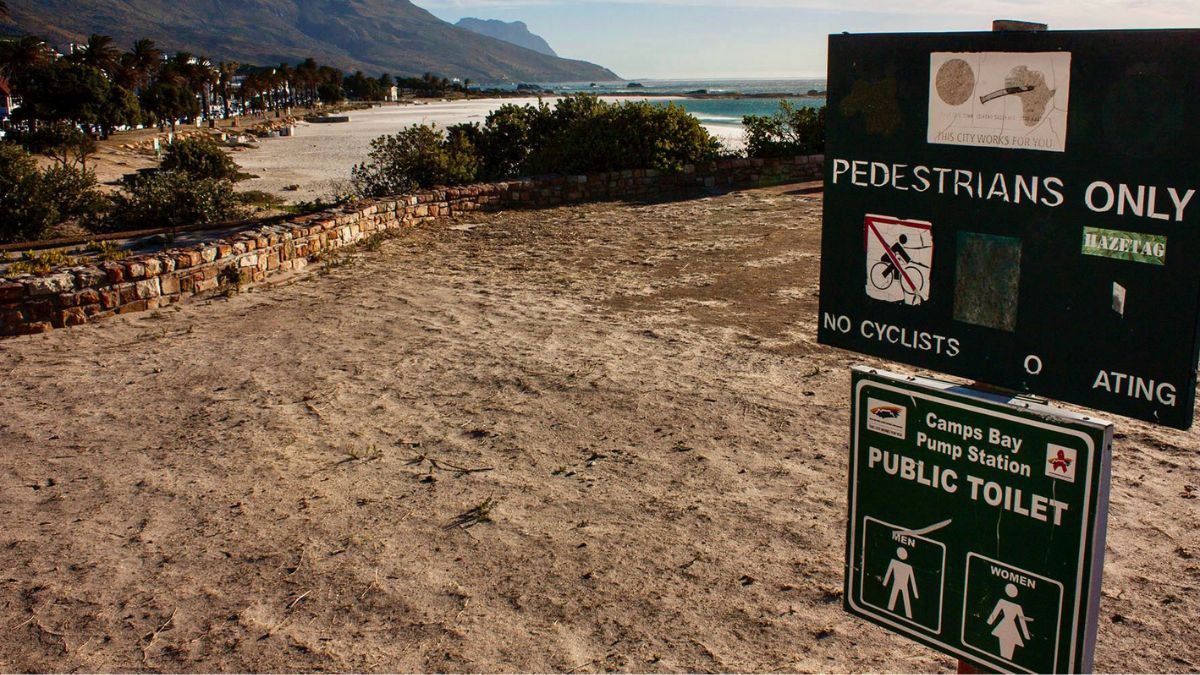
This issue threatens not only public health but also Cape Town’s tourism economy. “A lot of people come to Cape Town for a wonderful beach holiday, and they expect to find pristine environments,” Petrik noted.
“Yet there’s this dirty secret that’s underlying the city’s marketing, which is not communicated adequately. If tourists knew they might be swimming in poo, they might not be coming that often.”
The contamination goes beyond sewage. As a chemist, Petrik has studied the presence of pharmaceuticals, pesticides, detergents, and other chemicals in marine organisms.
“None of our wastewater treatment plants are designed to take these compounds out because the technology was developed 50 or 60 years ago when these compounds didn’t even exist,” she said.
Her team has found traces of persistent contaminants in almost every marine organism tested, from sea urchins, starfish, mussels, seaweed, fish, and even penguins.
Many of these pollutants, she added, can impair reproduction and fertility in marine life. She warned that antimicrobial resistance is another growing danger.
“We found that the microbes were resistant to about 16 of our frontline antibiotics,” Petrik explained. This is fuelled by pharmaceuticals flushed into wastewater systems that treatment plants cannot remove.
“The chemical pollution in South Africa is gross. I really want to say that we have a huge failure here, our country is polluted from one side to the other.”
Looking at way sto fix the issue, Petrik believes upgrading wastewater treatment plants is the first and most urgent step.
“There are technologies out there to treat water to drinking-water quality, but cost is really the big issue. Most cities don’t want to spend money on treating the effluent properly.”
She acknowledged that Cape Town has made some progress, with Mayor Geordin Hill-Lewis elevating sewage treatment to a priority project.
“There’s no quick fix here. Realistically, you’re looking at long-term investment, probably by about 2050 to properly deal with the marine outfalls.”
In the meantime, she urged residents to take individual responsibility. “We as people have to start thinking what are we throwing into the drain,” Petrik said.
“Don’t buy over-the-counter medicine unless you really have to, don’t go on antibiotics if you can avoid it, and think twice before spraying pesticides that just wash into the ocean.”
While Cape Town’s tap water is still considered safe, Petrik’s latest studies show trace amounts of forever or man-made chemicals are already filtering into the drinking supply. “They are in very low quantities, but they are there.”
City of Cape Town responds

The City of Cape Town has defended its approach to managing marine sewage outfalls following renewed criticism over the sewage flows and allegations that it has not communicated the seriousness of the problem to residents and tourists.
Deputy Mayor and Mayoral Committee Member for Spatial Planning and Environment, Eddie Andrews, said the challenge of removing pharmaceutical and personal care products (PPCPs) from wastewater is not unique to Cape Town.
“Wastewater treatment works globally do not generally effectively remove contaminants of emerging concern from sewage, irrespective of the level of treatment,” he explained.
Advanced technologies such as ozonation and reverse osmosis could improve removal, but these are costly, energy-intensive, and not yet practical at scale.
Andrews stressed that even the City’s most sophisticated treatment plants cannot eliminate all traces of pharmaceuticals.
However, the municipality has undertaken feasibility studies on replacing outfall pipelines with new treatment works and has reported these findings in public forums, though no decision has been made on when this would take place.
The city also noted that Cape Town has many underserved areas requiring the provision and upgrading of basic services, and must weigh up the prioritisation of limited funding in this context.
Andrews added that a new Environmental Monitoring Programme, approved in 2024, tracks hundreds of parameters, including pharmaceuticals, microplastics, metals, and bioaccumulation in marine species. The results are presented quarterly at a public Permit Advisory Forum.
The City has also signposted health warnings at beaches, advising against swimming near river mouths or stormwater outlets, especially after rainfall.
According to Andrews, ongoing monitoring has not demonstrated significant negative impacts from the marine outfall system, but the city remains committed to building knowledge on long-term risks.
“The city does not dispute the presence of contaminants, but we do request that researchers take more responsibility in their analysis before drawing sweeping conclusions about public health risks,” he said.
Zahid Badroodien, Mayoral Committee Member for Water and Sanitation, emphasised that Cape Town is committed to continually improving its wastewater systems.
“While the marine outfall currently operates within the design parameters and complies with national discharge regulations, we recognise that contaminants of emerging concern pose new challenges globally,” he said.
Research into better treatment options is ongoing, and the city is evaluating long-term upgrades depending on feasibility, environmental processes, and funding.
Badroodien highlighted that structural and behavioural challenges in areas like Hout Bay, including unplanned densification, sewer misuse, and cross-connections, exacerbate spills into the river and marine environment.
He noted, however, that a dedicated team has introduced short-term interventions such as proactive cleaning, enforcement, and community education.
Medium-term plans also include diverting flows at pump stations and investigating inline treatment. A long-term upgrade to a major sewer line is being planned, with feasibility studies expected in 2028/29.
The city has also committed significant investment into sanitation, with R1.25 billion allocated this year, including R355 million for sewer pipe replacements and R241 million for pump station upgrades.
“Through this combined infrastructure and behaviour-change approach, the city aims to significantly reduce sewer spills and associated pollution into areas like the Hout Bay River and adjacent marine environment,” Badroodien said.
Both Andrews and Badroodien insisted that the City is transparent about the issue, with water quality data published online and regular public forums allowing for engagement and scrutiny.
While acknowledging the scale of the challenge, they maintain that Cape Town is addressing the problem through scientific monitoring, infrastructure investment, and community involvement.














 Loading ...