

Important court ruling for certain marriages in South Africa with no prenup


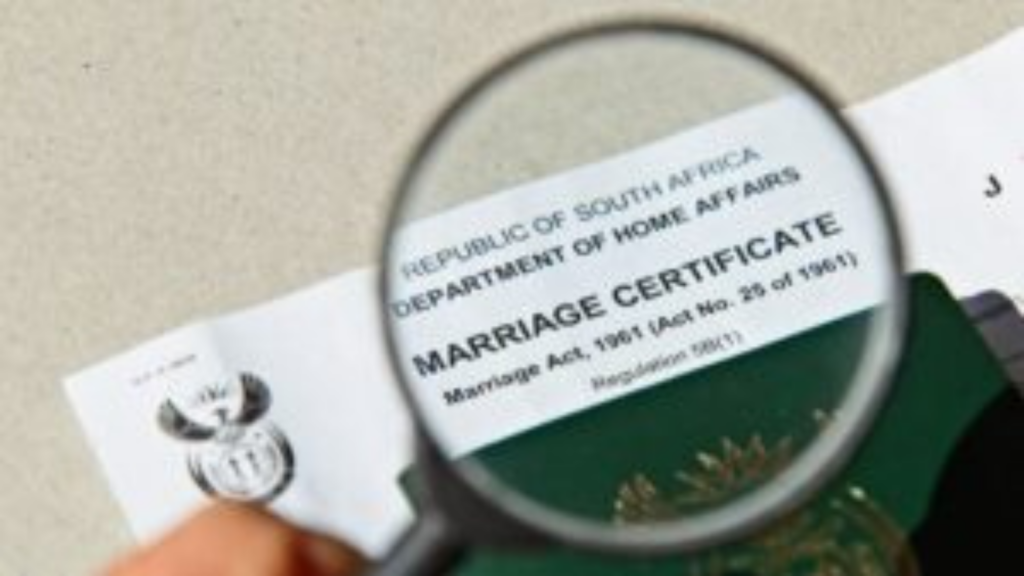
In a 2026 decision, the Constitutional Court ruled that both customary and civil marriages receive equal legal recognition, making it difficult for individuals in customary marriages to enter into antenuptial agreements after marriage.
The law says that spouses in customary marriages cannot enter into an antenuptial agreement after attempting to convert to a civil marriage in South Africa; they would need an antenuptial agreement from the start of the arrangement.
A civil marriage is a legally recognised union between one man and one woman, excluding all others. It is governed by the Marriage Act in South Africa.
Customary marriages are recognised under the Recognition of Customary Marriages Act in South Africa.
These marriages are celebrated according to African customary traditions and can be either monogamous or polygamous.
Earlier this year, the Court addressed the constitutionality of section 10(2) of the Recognition of Customary Marriages Act, which the Gauteng High Court had previously declared unconstitutional.
Under section 10(1), individuals who are in a valid customary marriage can enter into a civil marriage with each other, provided that neither party is currently married to a third person under customary law.
According to section 10(2), when a civil marriage is established, it is automatically considered to be in community of property unless the spouses have executed an antenuptial contract prior to the marriage.
Customary marriage is fully legally binding, which means that antenuptial contracts cannot be signed after the customary marriage.
Section 21 of the Matrimonial Property Act 88 of 1984 outlines the process for changing the matrimonial property regime after marriage.
Spouses can jointly petition the court for approval to modify their property arrangement, subject to the following conditions:
- There must be justifiable reasons for the change.
- All creditors must be duly notified.
- No parties should be adversely affected by the change.
- Only after receiving court approval can the spouses execute a notarial contract to implement the alterations to their matrimonial property system.
This means that once a joint estate is created, it cannot be undone through private agreements and requires court approval.
The marriages recognised in South Africa

In South Africa, three types of marriages are recognised by law: civil marriages, customary marriages, and civil unions.
According to the government, “the solemnisation and registration of these marriages are managed by the Department of Home Affairs.”
When you enter into a civil marriage or civil union, the marriage officer will issue a handwritten marriage certificate free of charge at the ceremony.
The Civil Union Act (Act No. 17 of 2006) is legislation passed by the Parliament of South Africa that permits same-sex couples to marry or enter into a civil partnership.
If you have been married in South Africa and your marriage is registered, you can apply for a copy of your marriage certificate from the Department of Home Affairs.
The first issue of an abridged marriage certificate is free; however, you will need to pay for any subsequent issues or for an unabridged certificate.
If one partner has passed away and you need to provide proof of marriage, an unabridged marriage certificate will be issued.
A customary marriage is defined as one that is “negotiated, celebrated, or concluded according to any of the systems of indigenous African customary law which exist in South Africa.”
To ensure a customary marriage is legally recognised, it must be registered within three months of the date of the celebration or commencement of the marriage.
Those in a customary marriage should register at any Department of Home Affairs office or, in areas without Home Affairs offices, through a designated traditional leader.


















 Loading ...