

South Africa becoming a ‘cartel capital’ rivalling Mexico and El Salvador


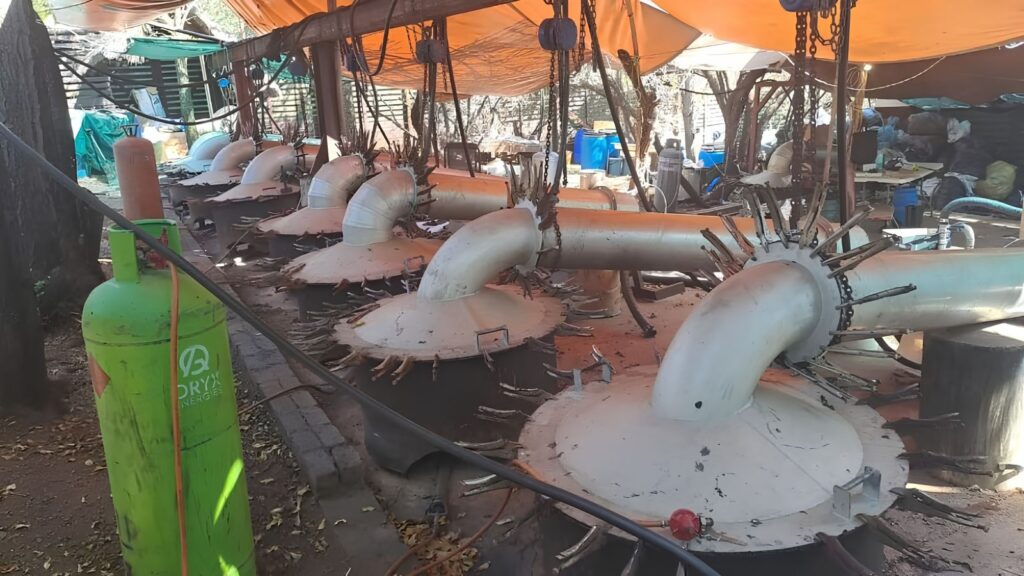
Crime experts are warning that South Africa is becoming increasingly vulnerable to organised crime and drug cartels.
South Africa has created conditions that allow criminal syndicates to operate with virtual impunity, with internationally feared cartels sending their cooks to set up shop in the country.
This is the feedback from Institute for Security Studies (ISS) researcher Willem Els, who voiced his concerns in an interview with BizNews after several major drug busts, including the recent seizure of drugs worth around R1 billion.
Els said concerns raised by KwaZulu-Natal Police Commissioner Lieutenant General Nhlanhla Mkhwanazi about the growing influence of drug cartels should be taken seriously.
Els noted that law enforcement authorities have access to intelligence and information that is not available to the public.
According to Els, evidence gathered over the past two years points to an expanding drug manufacturing industry in South Africa.
This includes multiple clandestine laboratories uncovered in places such as Groblersdal, Standerton and near Rustenburg.
“What we didn’t experience previously was the presence of foreign cooks linked to Mexican cartels. The Mexican cartels are sending their chemists here to come and prepare the drugs,” he said.
He explained that these operations are primarily involved in producing methamphetamine, commonly known as tik, as well as substances used in the manufacture of nyaope, a highly addictive street drug.
Els also highlighted the continued popularity of Mandrax in South Africa, particularly in the Western Cape, despite the drug largely disappearing from most other markets around the world.
“We are currently one of, if not the only, country in the world where there is still a very strong market for Mandrax,” he said.
He attributed this to the relative ease with which the drug can be manufactured and the ready availability of precursor chemicals.
Mandrax tablets are also inexpensive and can be shared among several users, making them attractive in poorer communities.
A tip of the iceberg

The ISS researcher said Mandrax remains especially prevalent in areas with entrenched gang activity, including the Western Cape’s Cape Flats.
“What we see, especially in the Western Cape on the Flats, in the Northern Cape, parts of Gauteng and the Eastern Cape, is that gang culture is very strong,” Els said.
He explained that users often combine stimulant drugs such as methamphetamine with Mandrax because it acts as a depressant that helps counter the effects of stimulants.
The discovery of multiple clandestine laboratories suggests that drug production is occurring on a significant scale. Els noted that authorities generally intercept only a fraction of illicit shipments.
“The rule of thumb is about 30% is intercepted, so 70% is still out there,” he said.
Els argued that South Africa has increasingly become an attractive hub for international drug trafficking networks as criminal organisations search for routes with weaker enforcement.
“When they started to make it more difficult to use the traditional routes, they took the route of least resistance. That is why we see South Africa becoming a transit hub,” he said.
He warned that high crime levels, governance failures and tolerance of organised crime have created an environment in which major cartels can flourish.
“We created conditions due to the criminality levels and the failure of good governance against it,” Els said.
“We created conditions that are extremely conducive for these big cartels to operate within South Africa with virtual impunity.”
While he welcomed efforts by authorities to strengthen organised crime investigations, Els stressed that policing alone cannot solve the problem.
He also called for renewed investment in police intelligence, operational capacity and mentoring programmes to ensure experienced investigators can pass on their skills to future generations.
“We need a short-, medium- and long-term plan. But we have to start with the infrastructure and investing in this capability,” Els said.

















 Loading ...