

R52,800 per person per year for 8.2 million people in South Africa


A proposal has been put forward to increase South Africa’s social grants to at least R4,400 per month, which would cost R52,800 per person each year.
However, economist Dawie Roodt and the National Treasury have warned that the country’s tax base could not afford such a system.
Economic Freedom Fighters (EFF) leader Julius Malema has called for social grants to be increased to a minimum of R4,400 per month, funded by taxpayers.
Speaking at the EFF’s Mpumalanga Provincial Manifesto Rally, Malema said the higher grant should form part of a broader basic income grant (BIG) for South Africa.
Efficient Group chief economist Roodt said the proposal was economically unsustainable, and described the suggested amount as “cheap politics”.
“If we increase the grants to R4,400, then that’s going to break the bank without any doubt,” he said in an interview with Truth Report.
“It’s going to break the bank because the fiscal account simply will not be able to support this, and the tax base in South Africa is just too small to support this.”
Roodt said South Africa already has about 28 million social grant recipients, including around 8.2 million people receiving the Social Relief of Distress (SRD) grant, which government plans to use as the basis for a more permanent BIG.
At R4,400 per month, providing that amount to 8.2 million people would cost about R36.1 billion per month, or R433.0 billion per year, before considering administrative costs or any expansion of eligibility.
“It is impossible for the tax base to carry that kind of support, especially given the weak state of the South African economy,” Roodt said.
He has previously raised concerns about the country’s narrow tax base, noting that around 7.7 million taxpayers support 28 million grant recipients.
Roodt said the burden is particularly concentrated among higher-income earners, with 2.4% of South Africans accounting for 77% of personal income tax.
He argued that South Africa had already reached the peak of the Laffer Curve for personal income tax, meaning further tax increases could reduce compliance and ultimately limit additional revenue.
BIG could work

National Treasury has also warned about the potential cost of significantly expanding the SRD grant.
It has estimated that removing exclusionary checks following a High Court ruling could increase eligible beneficiaries from about 8.3 million to as many as 18 million.
Treasury said that accommodating the expanded access, while also increasing the grant just in line with inflation, could require an additional R93.5 billion to R139 billion per year.
However, Roodt said this did not mean South Africa should abandon the idea of a BIG.
He proposed replacing the country’s existing specialised welfare grants with a single grant, including a portion that recipients could spend freely and another portion provided through vouchers for services such as education and healthcare.
“If you approach it like that, we can get rid of all these other grants and combine them all into one single basic income grant,” he said.
The Department of Social Development said in June 2026 that it had made progress towards developing a BIG modelled on the SRD grant, which was introduced during the Covid-19 pandemic and has been extended annually.
The department said it had drafted a policy, with the legislative process expected to begin in the 2027/28 financial year.
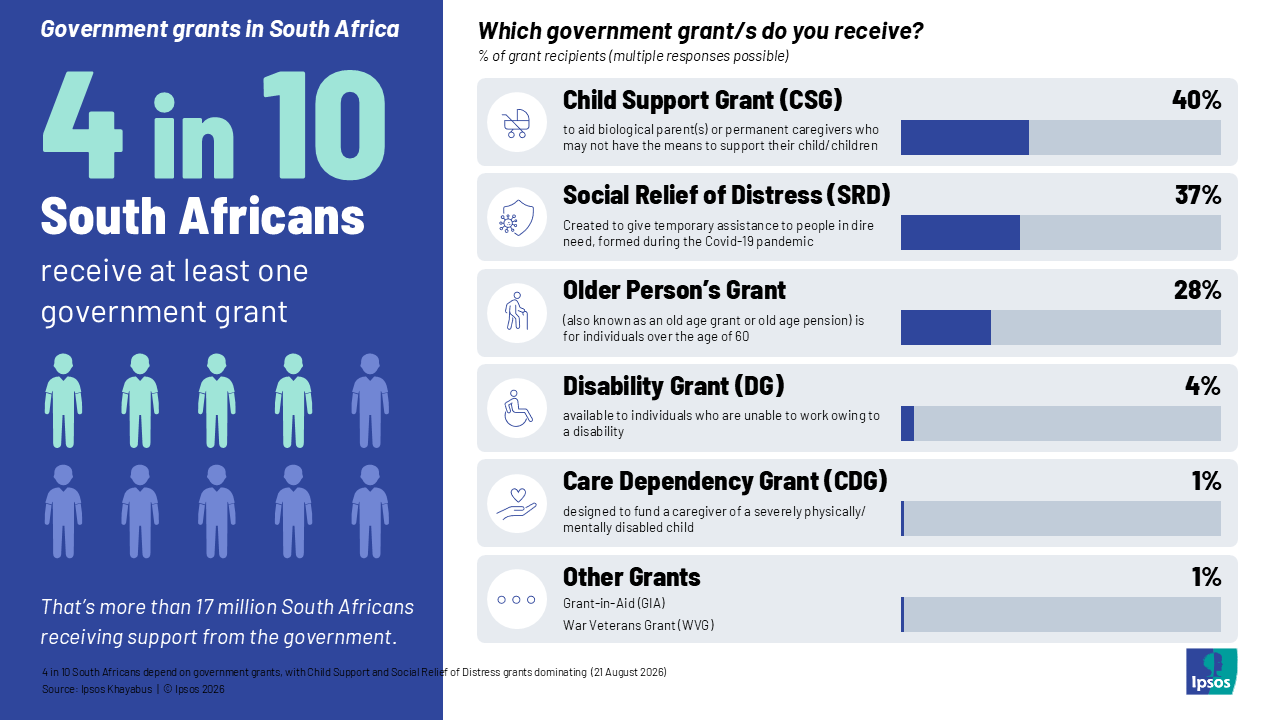
Ipsos data shows that four in 10 South Africans depend on social grants, while 52% of households have either one income earner or no income earner.
Among 18- to 24-year-olds, 34% receive a social grant, with 73% of these recipients relying on the SRD as their main or only source of income.
Grant dependence is also higher in rural areas, at 50%, compared with 34% in metropolitan areas, highlighting the growing tension between rising demand for social assistance and South Africa’s limited tax base.










 Loading ...