

Eskom says South Africans can forget electricity price cuts after R30 billion profit


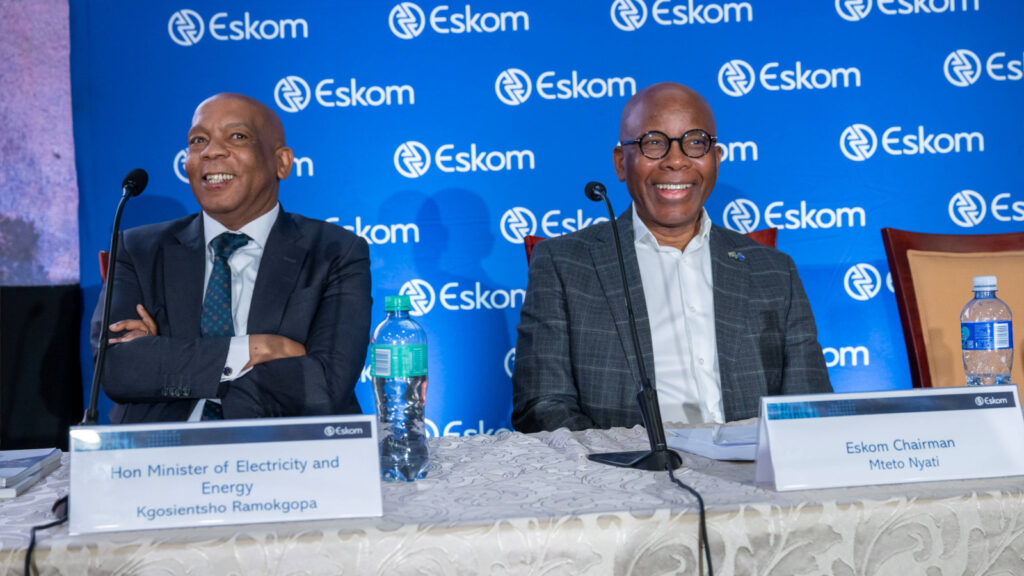
Eskom chair Mteto Nyati says the company won’t be “paying dividends” from its bumper profits, opting instead to invest in its growth and future relevance.
Responding to questions about whether Eskom will cut prices for customers after the group reported R30 billion in profit, Nyati said this was not on the cards.
He said that the national power utility has instead chosen to invest its profits in expanding its operations—particularly in renewables—and through that, hopefully drive down prices over the longer term.
“We need to have an Eskom that is profitable, and that should be something that we all celebrate,” he said.
“And when you have an organisation that is able to deliver profits, you can do one of two things: you can retain that income to do things that will help you to grow in the future, or you can declare a dividend if you have no plans for what to do with the money.”
In Eskom’s case, Nyati said the utility has big ambitions to participate in renewables, deliver energy, and invest in ways that support the growth of data centres.
“All of that requires money. We have decided not to declare a dividend; we are going to put the money to good use…so that we never go back to the situation we had a few years ago,” he said.
Nyati said that Eskom needs to remain relevant in the energy market, which means having a clear strategy for renewables.
However, doing this requires significant investment.
“We want to make sure there is local beneficiation, which requires investment in transmission lines and interconnectors that will help us,” he said.
“So the profits we have been able to get are actually securing our future. In the medium to long term, they are helping us to drive down the cost of electricity.”
Nyati said that as Eskom moves into renewables and gains scale, the group will then be able to take its costs and spread them across a larger number of clients.
“So the investment we are making in the medium to long term is going to be driving down the cost of electricity. That is what we have chosen to do.”
Revenue up, but sales are down
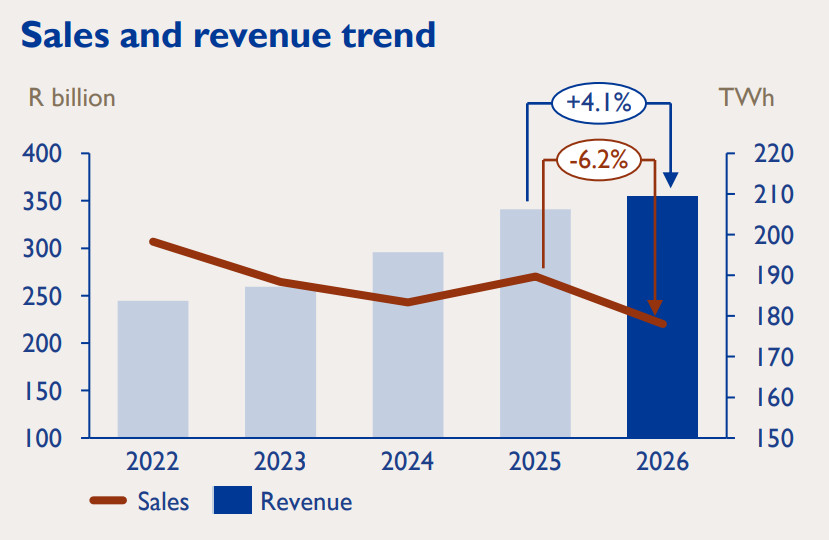
While Eskom achieved roughly R30.35 billion in profit for the 2026 financial year, the headline figure hides troubling numbers.
Most notably, a 4% rise in revenue and a 116% jump in profits came despite lower sales, suggesting that fewer customers were paying more, creating inverse trends in sales and revenue.
Eskom itself acknowledged that this was not sustainable.
In its financial report, Eskom flagged the rise of self-generation (solar) and wheeling activity as a threat to its future cash flows.
To combat this, it explicitly stated that it would lean on network charges, customer wheeling and revised tariff structures to secure revenue.
This means that those who are turning away from Eskom but remain connected to its grid face higher fees and tariffs as the group tries to protect its revenue.
And while Eskom reiterated its commitment to ending double-digit price hikes, it does not mean tariffs are coming down.
The group is still factoring in future price hikes that are at least double the South African Reserve Bank’s inflation target of 3%.
In an assessment of the group’s cash-generating unit (CGU), the group noted that the CGU’s recoverable amount may be lower than its carrying amount if the long-term price path after 2028 is limited to inflationary increases.
Because of this, the current path in its forecast sees price increases averaging 6% from 2029 through to 2050.
However, the group noted that the long-term price path remains a “significant source of estimation uncertainty.”
This is considering future tariff increases, RCA decisions, the ability to liquidate in the future, revenue recovery mechanisms, and the extent to which tariffs become cost-reflective.
These are also subject to regulatory approval and future market developments, it said.










 Loading ...