

Driving circular impact: How the ROSE Foundation is powering South Africa’s used oil revolution


In a world where environmental sustainability has become a cornerstone of modern business, the ROSE Foundation (Recycling Oil Saves the Environment) stands as one of South Africa’s most effective yet often unseen champions of circular economy leadership.
For more than 30 years, the organisation has quietly built one of the country’s most successful post-consumer collection and recycling systems, turning used oil, a hazardous waste product into a valuable resource and protecting millions of litres of water, soil, and air in the process.
As conversations around ESG, compliance, and responsible operations intensify, the ROSE Foundation’s work is not simply admirable; it is essential, serving as a blueprint for how industry-led stewardship can deliver national impact at scale.
South Africa generates an estimated 120 million litres of used lubricating oil every year, much of it from workshops, trucking depots, mines, agriculture, and industrial operations.
Without proper collection and processing, this oil becomes a toxic pollutant; just one litre can contaminate one million litres of water.
The ROSE Foundation exists to ensure this never happens.
Through a robust network of licensed collectors, processors, refiners, and environmental partners, ROSE coordinates the safe recovery of used lubricating oil countrywide.
This voluntary industry stewardship model supported by major oil companies and lubricant marketers has helped South Africa achieve some of the highest collection rates in the developing world.
What makes ROSE unique is its ability to operate at the intersection of industry, regulation, and community, ensuring that environmental responsibility is not only legislated but actively practiced on the ground.
From Waste to Circular Value
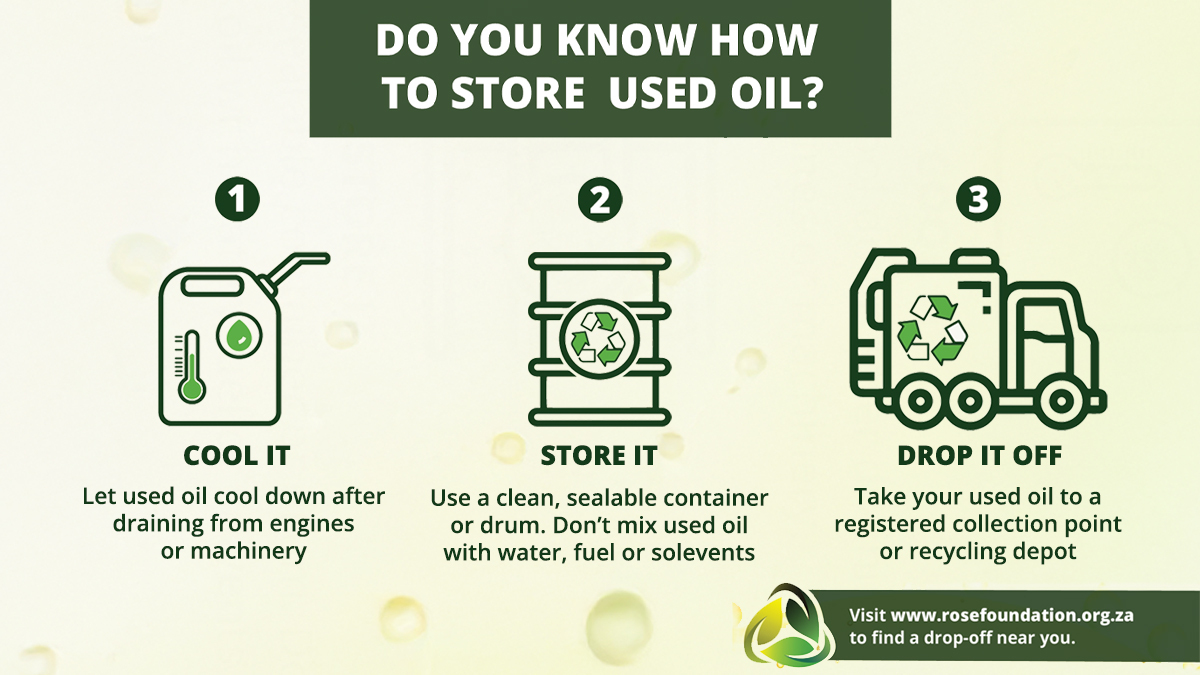
Used oil collected through the ROSE network does not end its life in a landfill. Instead, it becomes part of a circular process for reuse:
- Energy recovery — used oil is reprocessed into fuel for industrial applications.
- Re-refining — some used oil is refined into base oil once again, starting a new life cycle.
- Cleaner production — processors ensure harmful contaminants are removed before any secondary use.
This circular model reduces reliance on virgin crude oil, lowers greenhouse gas emissions, and strengthens local green economies.
In a business landscape under increasing pressure to adopt sustainable practices, ROSE provides an accessible, compliant pathway that benefits companies across sectors.
Empowering Small Collectors and Local Entrepreneurs
One of ROSE’s most profound impacts lies in its support of small and emerging collectors, many of whom operate in informal or rural environments.
Through training, incentives, compliance support, and safety programmes, ROSE helps build long-term enterprise development and job creation.
These collectors play a critical role in recovering used oil from places where larger companies may struggle to reach.
The result is a more inclusive, locally driven ecosystem that uplifts businesses while safeguarding the environment.
A Pillar of ESG and Regulatory Compliance
As South African businesses align with global trends — including ISO standards, sustainability reporting, and extended producer responsibility — ROSE provides the infrastructure necessary to meet environmental obligations efficiently.
For companies looking to strengthen their ESG scorecards, ROSE offers:
- a transparent collection system
- compliance documentation and audits
- licensed recovery and processing partners
- environmental risk-reduction
- measurable sustainability indicators
By partnering with ROSE, businesses not only meet regulatory requirements but also demonstrate integrity, environmental stewardship, and national commitment.
Click here to learn more about ROSE Foundation.

















 Loading ...