

Why Most South African Business Surveys Are Lying to You


There’s a quiet data crisis running through South African boardrooms. Every quarter, companies commission customer satisfaction surveys.
Every quarter, they receive tidy reports full of star ratings, NPS scores, and percentage breakdowns.
And every quarter, business leaders make decisions based on data that is, at best, incomplete — and at worst, meaningfully misleading.
The problem isn’t that South African customers don’t have opinions. They have plenty. The problem is how we’ve been asking for them.
The checkbox is a blunt instrument
Traditional survey tools — the kind that have dominated corporate feedback programmes for two decades — were built for a pre-smartphone, pre-AI era.
They present respondents with a list of pre-written questions and pre-defined answer options.
The respondent clicks boxes. A database fills up. A report gets generated. What gets lost is everything in between.
When a customer rates your service 3 out of 5, what does that actually mean? Frustration with a specific touchpoint? A bad day? A systemic failure in your onboarding process?
The checkbox doesn’t know, and it isn’t built to find out.
The result is what researchers call satisficing — respondents giving the quickest acceptable answer rather than the honest one.
Studies consistently show that traditional surveys overestimate satisfaction, underrepresent negative experiences, and entirely miss the nuanced middle ground where most of the actionable intelligence lives.
For banks, mobile networks, retailers, and government service providers operating in a competitive and rapidly evolving market, this isn’t just a methodological inconvenience. It’s a strategic blind spot.
What AI changes about the conversation
The emergence of conversational AI has done something genuinely useful for the feedback industry: it has made it possible for a survey to listen.
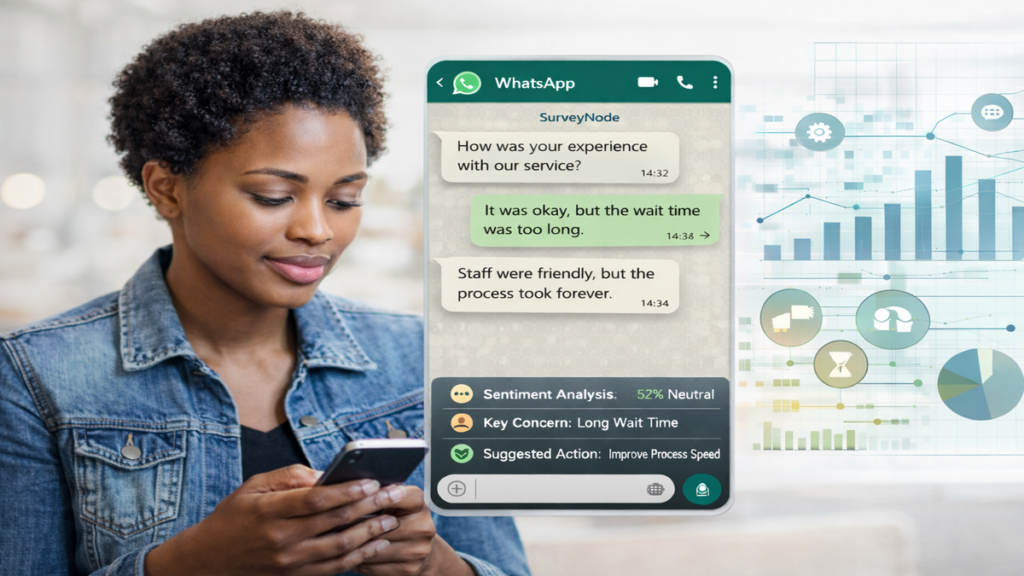
Rather than presenting a fixed questionnaire, AI-powered platforms like SurveyNode conduct what amounts to a structured conversation.
When a respondent gives a vague or ambiguous answer, the system probes deeper — automatically, in real time, at scale.
When sentiment shifts mid-response, the platform detects it and adjusts.
The result is qualitative depth with quantitative reach: the kind of insight that previously required an expensive focus group or a team of researchers, delivered instantly across thousands of respondents simultaneously.
For South African organisations managing large customer bases — whether in retail banking, telecommunications, insurance, or public sector service delivery — this represents a meaningful step change in what feedback can actually tell you.
The practical case
Consider a bank running its annual customer satisfaction audit.
A traditional survey might tell them that 67% of customers are “satisfied” with branch service.
An AI-driven conversational survey asks why — and discovers that satisfaction scores mask a sharp divide between customers who resolved their query on the first visit and those who didn’t.
That distinction, invisible in the checkbox data, becomes the basis for a targeted branch operations improvement that actually moves the needle.
Or a mobile network running churn research. Instead of asking customers to rate their likelihood to switch providers on a scale of 1 to 10, a conversational survey explores what would need to change for them to stay — surfacing pricing concerns, coverage frustrations, and service experience gaps that a standard NPS instrument would never surface.
This is the shift from measuring sentiment to understanding it.
The language gap nobody is measuring
There is another dimension to the South African feedback problem that rarely gets discussed in boardrooms — and it may be the most significant of all.
South Africa has twelve official languages. Most corporate survey programmes operate in one.
When a Zulu-speaking customer in KwaZulu-Natal completes a satisfaction survey written in English, they are not just answering your questions — they are translating their experience first, then finding the closest available English approximation, then selecting from your pre-defined answer options.
At every step, something is lost. The emotional nuance, the specific frustration, the precise compliment — all of it filtered through a language that isn’t theirs.
This isn’t a diversity issue. It’s a data quality issue.
SurveyNode addresses this directly. Surveys can be deployed in Afrikaans, Zulu, and Xhosa — as well as English — across Web, SMS, and WhatsApp.
For South African organisations, that last channel is particularly significant. WhatsApp is where your customers already are, communicating naturally in their own language.
Meeting them there, in a conversational survey that probes and listens in Zulu or Xhosa, produces a fundamentally different quality of insight than anything a traditional English-language form can deliver.
For banks serving township markets, mobile networks managing rural subscriber bases, or government departments measuring service delivery across provinces, this isn’t a nice-to-have.
It’s the difference between knowing what your customers think and assuming you do.
Click here to try a live demo with SurveyNode today.
Getting started doesn’t require a budget conversation
SurveyNode is an AI-powered conversational survey platform built for organisations that want richer insight from every customer interaction.
It requires no lengthy implementation, no enterprise procurement process, and no technical team to get started.
Surveys are created in minutes using plain-language descriptions of your research objective — the AI handles question design, flow logic, and real-time probing automatically.
New accounts unlock the full Professional experience for 7 days — including AI-powered surveys, WhatsApp delivery, and multilingual support across Afrikaans, Zulu, and Xhosa.
No credit card required to start.
Paid plans are priced in South African Rand, scaling from R2,275/month for growing teams to Enterprise for large organisations.
Full API access is available for integration with existing CRM and analytics workflows.
For South African businesses serious about turning customer feedback into a genuine competitive advantage, the conversation starts at www.surveynode.com
SurveyNode is an AI-powered feedback platform helping organisations across Africa and beyond gather deeper customer insight through conversational surveys. Visit www.surveynode.com to try a live demo or create your free account today.

















 Loading ...