

Why South African investors should not give up on growth assets



By Kim Zietsman, Laurium Capital
For many South African investors, the past few years have reinforced a familiar instinct: when the world feels uncertain, hold more cash, send more money offshore, and wait for local assets to prove themselves.
It is an understandable response. South Africa has had to contend with weak economic growth, electricity constraints, fragile confidence and a long period in which local headlines often felt more discouraging than encouraging.
But investment decisions should be based on evidence, not sentiment alone.
The data tells a more balanced story than the prevailing narrative suggests.
Over long periods, South African equities and bonds have delivered meaningful real returns for local investors and have also held up well when measured in US dollars.
That matters because South Africans are not only trying to preserve capital; they are trying to grow wealth ahead of inflation over decades.
The danger of investing by headline
Headlines are powerful because they are immediate.
Inflation scares, geopolitical tension, oil-price shocks, election uncertainty, fiscal concerns and currency moves all demand attention.
Yet markets discount the future, not the front page. By the time uncertainty feels resolved, asset prices have often already adjusted.
This is especially important in South Africa, where pessimism can become self-reinforcing.
Investors who only see weak growth and political risk, and conclude that local assets should be avoided, then miss periods when valuations, yields and improving fundamentals combine to produce attractive returns.
At Laurium Capital, we believe investors should separate the country’s challenges from the opportunity set available in its markets.
South Africa is not without risk, but risk and return are linked.
When expectations are low and valuations are undemanding, investors can be paid for taking carefully selected exposure.
South African assets have done better than many investors realise
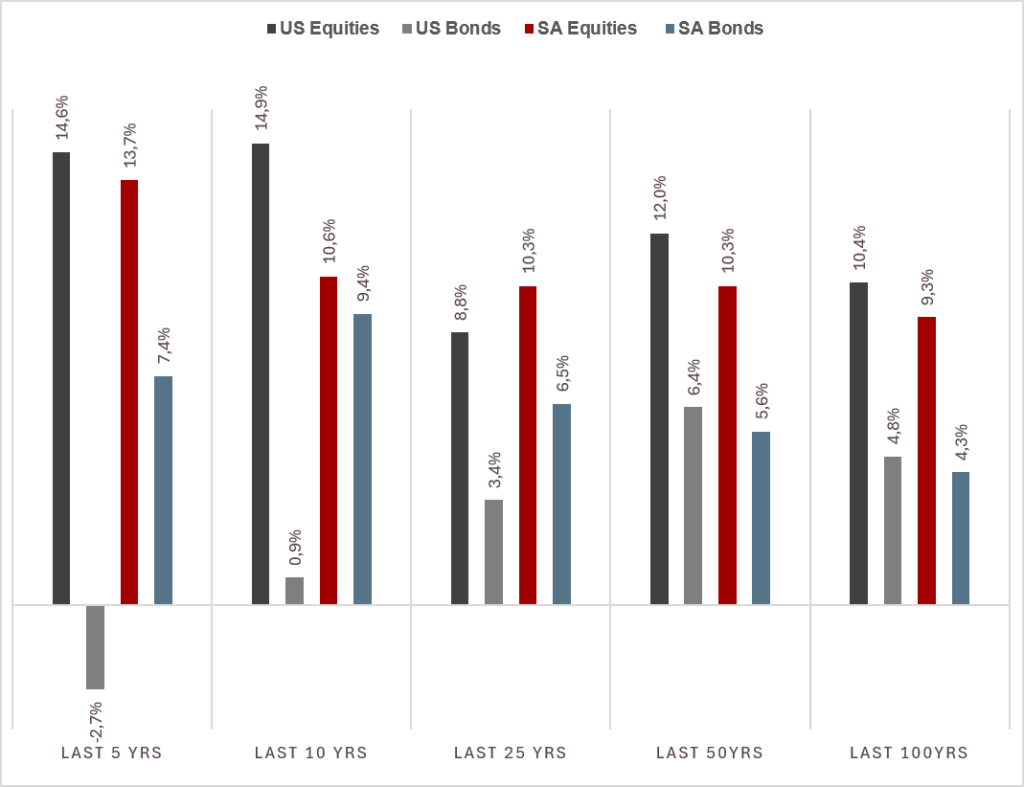
One of the most important points for long-term investors is that South African equities and bonds have not been the poor performers many assume them to be.
Over 25 years, South African equities delivered annualised nominal returns in US dollars ahead of US equities, while South African bonds have produced materially stronger returns than US bonds over the last 5, 10 and 25 years in USD terms.
That outcome may surprise investors who focus only on rand weakness or domestic economic disappointments.
Currency matters, and South Africa has certainly experienced significant volatility.
But long-term total returns are driven by more than the exchange rate. Dividends, earnings growth, starting valuations, real yields and compounding all play a role.
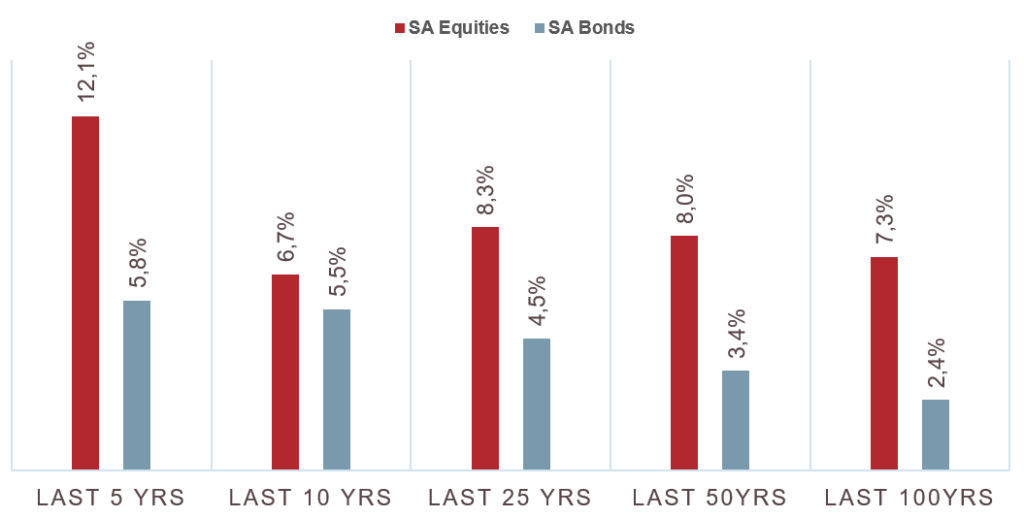
The same is true in real rand terms. South African equities have historically helped investors beat inflation, while local bonds have offered attractive real yields.
This does not mean every period is rewarding, or that past returns should be extrapolated blindly. It does mean that writing off local assets altogether can be a costly mistake.
Figure 1: Nominal Returns Over Time (Annualised in USD)
Inflation is the real opponent
For investors saving for retirement, education, intergenerational wealth or long-term financial independence, the objective is not simply to avoid short-term losses.
The objective is to grow purchasing power.
Inflation quietly erodes wealth, and portfolios that are too conservative for too long can fail to meet objectives even if they feel safe along the way.
Cash has an important role. It provides liquidity, optionality and psychological comfort during market stress.
But cash is not designed to be the engine of long-term wealth creation.
After tax and inflation, the real return from cash can be modest, particularly over multi-decade horizons.
Equities remain one of the most important tools for beating inflation over time because they give investors exposure to businesses that can grow earnings in real terms, reinvest capital, raise dividends and adapt to changing conditions.
They are volatile, but volatility is the price investors often have to accept for the possibility of superior long-term real returns.
Figure 2: Real Returns over Time (Annualised in ZAR)
The answer is not local or offshore — it is both
South African investors have become far more aware of the benefits of offshore diversification.
That is a positive development.
Global exposure provides access to industries and companies that are underrepresented on the JSE, including technology, healthcare, luxury goods, industrial automation and global consumer platforms.
However, offshore diversification should not become offshore concentration.
Many investors who are frustrated with South Africa assume that more offshore exposure automatically means less risk.
In reality, global markets carry their own risks, including elevated valuations in parts of the US market, currency timing risk, sector concentration and sensitivity to global interest-rate expectations.
A more robust approach is to diversify across both onshore and offshore markets.
Local assets can provide exposure to attractive valuations, high real yields and companies positioned to benefit from improving domestic conditions.
Offshore assets can provide exposure to global growth, hard-currency earnings and broader sector opportunities. The combination is more powerful than either extreme.
Why bonds still matter
While equities are essential for long-term growth, bonds also deserve attention.
South African bonds have historically offered attractive real yields and, in recent periods, have delivered strong returns as inflation moderated and investor confidence improved.
The JSE describes the FTSE/JSE All Bond Index as a broad measure of the movement of the local bond market, made up of liquid vanilla bonds across the maturity spectrum.
For investors, this market can offer income, diversification and potential capital gains when yields fall.
It also carries risks, particularly around fiscal credibility, inflation and currency confidence, which is why active assessment remains important.
Used appropriately, bonds can complement equities rather than replace them.
They can help smooth portfolio outcomes and provide real income, but they are unlikely to deliver the same long-term growth potential as equities.
The correct balance depends on an investor’s time horizon, risk tolerance and need for liquidity.
Long-term investing requires accepting discomfort
The difficulty with equities is that their long-term benefits are not delivered in a straight line.
There will be drawdowns, disappointing years, valuation resets and periods when patience feels unrewarded.
That discomfort is not a design flaw; it is part of the asset class.
Investors who try to avoid every uncomfortable period often end up buying after strong returns and selling after weak returns.
That behaviour can do more damage than market volatility itself.
A sensible long-term plan recognises that markets will be uncertain, and builds the portfolio accordingly.
This is why discipline matters.
Investors need a clear understanding of why they own each asset class, what role it plays, and what would cause them to change their view.
They also need to avoid turning short-term market movements into long-term strategy decisions.
A practical framework for South African investors
For South African investors trying grow their wealth ahead of inflation over the long term, the practical conclusion is straightforward: portfolios need meaningful exposure to growth assets, especially equities, diversified across both local and offshore markets.
That does not mean taking excessive risk, ignoring valuation or abandoning bonds and cash.
It means recognising that each asset class has a role. Equities provide long-term growth potential. Bonds can offer income and diversification. Cash provides liquidity. Offshore exposure broadens the opportunity set.
Local exposure ensures investors do not miss the returns available in their own market when valuations and fundamentals align.
At Laurium Capital, our view is that investors should resist the temptation to make binary decisions: South Africa or offshore, equities or safety, risk-on or risk-off.
The better question is whether the portfolio is built to compound real wealth across a range of outcomes.
South Africa’s challenges are real, but so are the returns that disciplined investors have earned from local markets over time.
For long-term investors, the goal is not to avoid uncertainty altogether.
It is to stay invested in a diversified, valuation-aware way that gives capital the best chance of growing ahead of inflation.
For information on Laurium’s fund offering, please contact [email protected] or visit www.lauriumcapital.com.
Laurium Capital is an authorised financial services provider (FSP 34142).
This article is published for information purposes and does not constitute financial advice. Past performance is not necessarily a guide to future performance. Investors should consider their individual circumstances and seek appropriate professional advice.


















 Loading ...