

Most expensive province to buy groceries in South Africa


In July 2025, Johannesburg was the most expensive city among South Africa’s three major metros for groceries for three consecutive months, followed by Cape Town and then Durban.
This is according to data from the Pietermaritzburg Economic Justice and Dignity (PMBEJD) group, which tracks the cost of a household food basket across the three major provinces.
The PMBEJD report found that while 14 of the 44 tracked food items became cheaper or saw no increases year-on-year, 30 experienced price hikes, and 10 items saw double-digit inflation.
Additionally, inflation increased to 3.0% in June, rising from 2.8% in April and May. The month-on-month change in CPI was 0.3%.
The increase was driven by higher inflation in key categories like food and non-alcoholic beverages. In June, food NAB inflation reached a 15-month high of 5.1%.
According to Stats SA, the rise in Food NAB was due to higher meat prices, particularly beef products like stewing beef, mince, and steak.
Meat, especially beef, continues to be the main driver of food inflation. Beef prices spiked for a third straight month, with large increases for stewing beef, mince and steak.
Stewing beef rose by an annual 21.2%, the fastest pace on record since the current CPI series began in January 2017.
“A widespread outbreak of foot-and-mouth disease, combined with higher feed prices, contributed to the rise in beef inflation,” said Stats SA.
Looking elsewhere, other processed food items also recorded an increase. The annual rates for fruits & nuts and vegetables remained in double-digit territory for a second straight month.
Products that saw sharp price increases in the 12 months to June included beetroot, lettuce and carrots.
However, inflation cooled for many other food & NAB categories, such as white rice, hot cereals, and cold cereals.
Most expensive city for groceries

As of the end of July 2025, the cost of a household food basket, comprising 44 essential items that reflect typical purchasing patterns, reached R5,442.72.
This is a 3.6% annual increase of R190.57 compared to July 2024. Month-on-month, the basket price decreased by R0.41 compared to June 2025.
This annual increase is higher than the latest consumer price inflation rate of 3.0%, showing food costs remain a significant concern for many South Africans who live in urban areas where grocery prices continue to increase.
A breakdown of costs in each city shows that the change in food prices is higher in some areas than others.
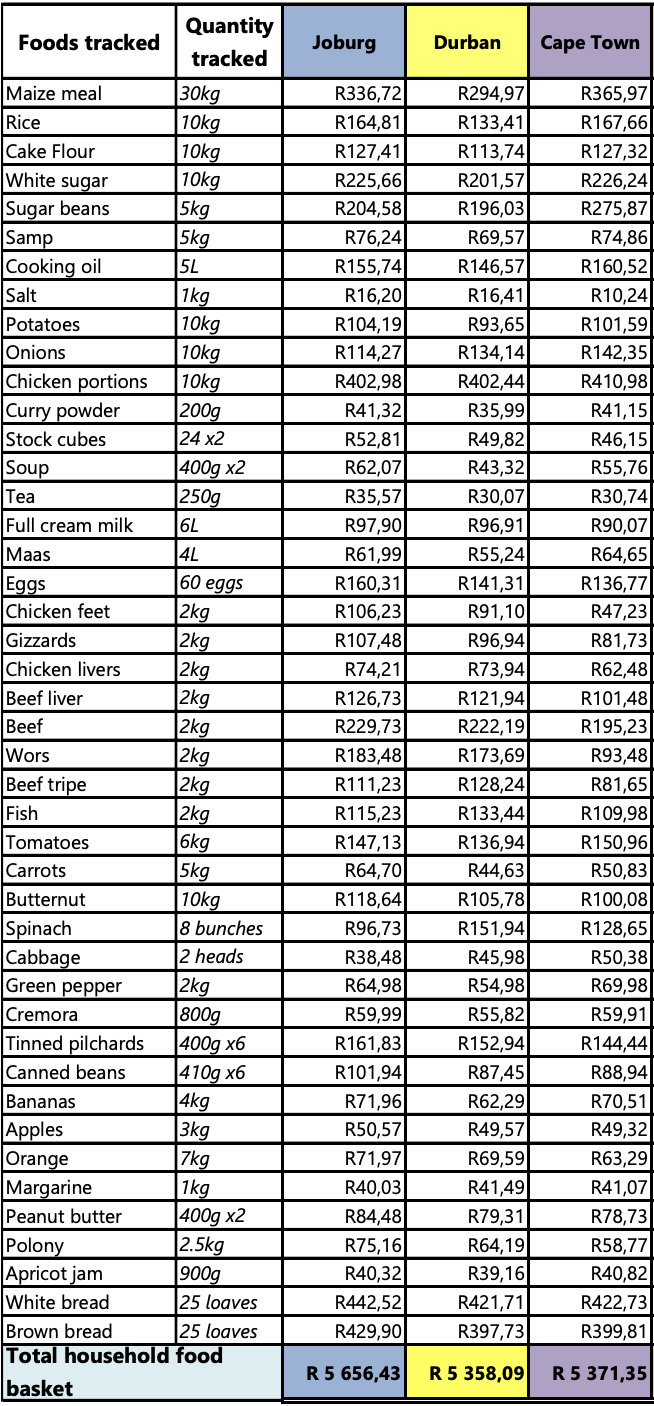
In July 2025, the household food basket cost R5,656.43 in Johannesburg, a 2.2% increase of R122.94 from the previous year.
This is also R7.58 more than the recorded basket price of R5,648.85 in June. Joburg’s basket price surpassed the national average by R213.71, making Johannesburg the most expensive metro for groceries.
The monthly data showing an increase in prices in Johannesburg means the cost of food continues to rise in 2025, as indicated by Stats SA’s data.
In comparison, Durban remained the cheapest city for groceries, although it still recorded an annual and month-on-month increase.
Durban’s food basket, recorded at R5,358.09, increased by R45.87 (0.9%) from R5,312.22 in June 2025.
The city’s annual increase was higher, recorded at 2.8% or R145.54 from R5,212.55 in July 2024. However, this is still R298.34 less expensive than Johannesdurg.
Meanwhile, Cape Town’s food basket has seen a significant annual increase, much higher than in Johannesburg and Durban.
Cape Town’s food basket decreased by R25.88 (0.5%) from R5,397.23 in June 2025 to R5,371.35 in July 2025.
However, Year-on-year, the Cape Town household food basket cost increased by a notable R338.30 (6.7%) from R5,033.05 in July 2024.
Despite the significant increases, Cape Town is still R285.08 cheaper than Johannesburg and R71.37 cheaper than the national average.
Food basket comparison between the three major cities











 Loading ...