

What South Africa’s official crime statistics don’t tell you


Theft of personal property is the most common crime affecting South African individuals, but around 70% of victims choose not to report the crime to the police.
According to Stats SA, crime remains one of the defining challenges of life in South Africa, cutting across geography, gender and economic status.
Whether in metropolitan centres or small rural towns, households and individuals continue to face the risk of break-ins, robberies, theft and other crimes that disrupt daily life.
Although police statistics capture reported offences, the Governance, Public Safety and Justice Survey (GPSJS) provides insight into both reported and unreported crime, giving a fuller picture of overall safety.
According to the latest GPSJS, when looking at individuals, theft of personal property was the most common crime in 2024/25.
1.2 million people were affected, down from 1.3 million in 2023/24. Stats SA said that most victims were males and people living in metro areas.
An estimated 1.3 million personal theft incidents occurred, affecting roughly 1.2 million individuals over the year.
That said, most victims chose not to report these crimes. 69% decided not to report, while 31% reported some or all incidents to the police.
Stats SA said consumer fraud showed a different trend, with incidents rising sharply from 552,000 in 2023/24 to 811,000 in 2024/25.
The statistics body did, however, note that the share of victims reporting to police increased from 30.7% to 34.9%.
When it comes to households, burglary has consistently been the most common crime experienced in South Africa, followed by home robbery.
Male-headed households and those living in KwaZulu-Natal province were the most affected.
Over the year (2024/25), an estimated 1.5 million housebreaking incidents occurred. This represents 5.7% of all households in the country.
However, housebreaking was one of the least reported household crimes to the police, with only 43% of affected households taking cases to the police, a similar proportion as the previous year.
This means that the most common form of crime facing households was not reported to police around 57% of the time.

How South Africans try to stay safe
The proportion of adults aged 16 and older who felt safe walking alone in their neighbourhoods during the day increased from 80,4% in 2023/24 to 81,0% in 2024/25.
In contrast, fewer South Africans reported feeling safe when walking after dark. Only 36.1% in 2024/25, up marginally from 34,9% the previous year.
Provincial differences were stark. Limpopo had the highest proportion of people who felt safe walking alone during the day (97.2%) and at night (64.2%).
Western Cape residents were the most likely to feel unsafe during the day (31.4%), while Mpumalanga had the highest share of those who felt unsafe at night (73.0%).
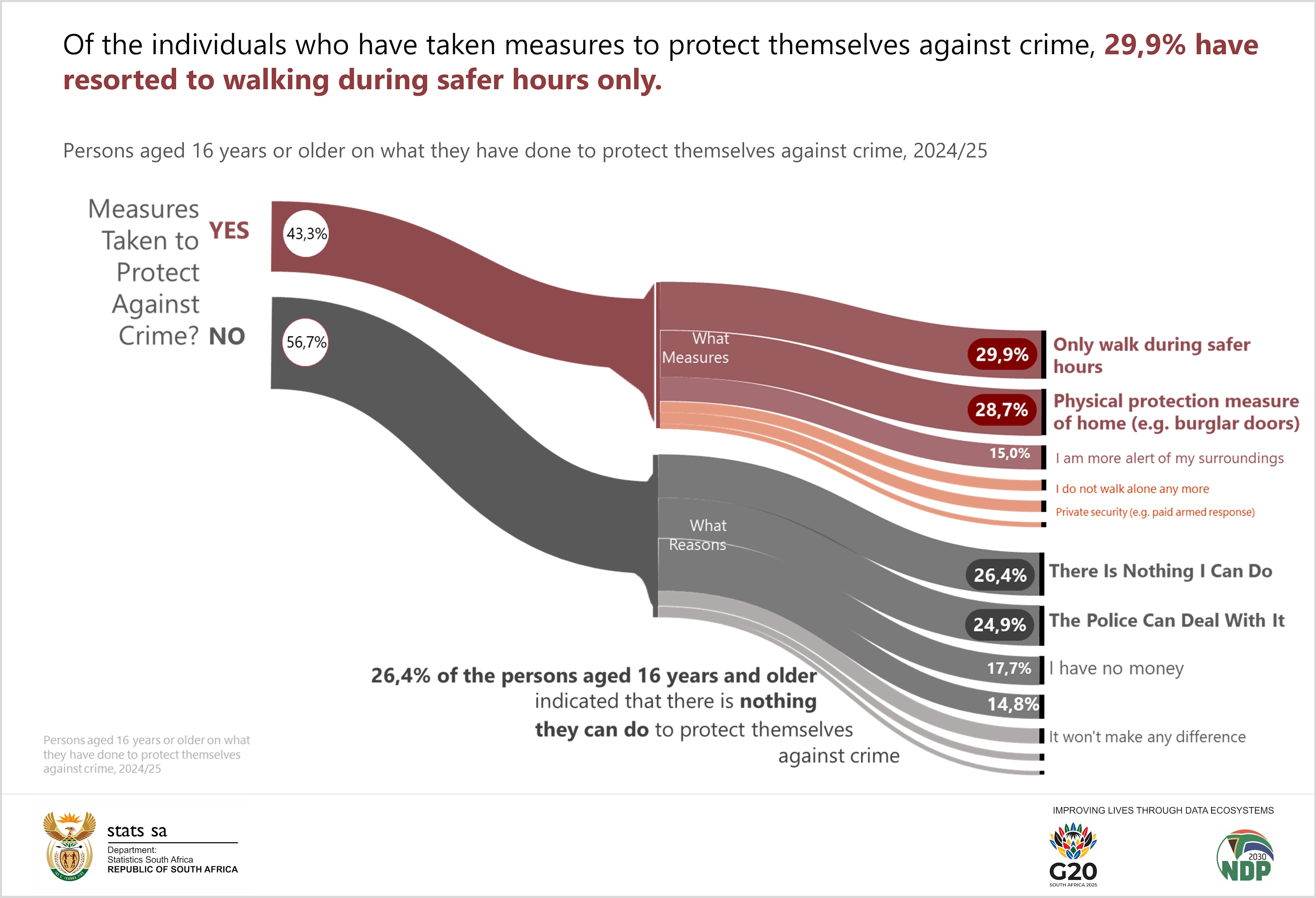
There has also been an increase in adults looking to protect themselves against crime. The share of people who did something to guard against crime rose from 39.9% in 2023/24 to 43.3% in 2024/25.
Walking only during safer hours was the most common precaution at 29.9%, followed by installing physical protection measures such as burglar doors at 28.7%.
Nearly 80% of surveyed individuals said these measures made them feel safer.


















 Loading ...