

Hammer blow to domestic workers in South Africa as households call it quits



The domestic work sector in South Africa has been dealt a severe blow as the number of people employed in households continues to fall.
SweepSouth’s latest Domestic Worker Pay and Working Conditions Report 2025 shows that almost 400,000 jobs have been lost in the past five years.
However, one of the main reasons for losing their job was a result of the family moving, with most of those who moved having emigrated overseas.
Other families are simply cutting back on spending.
SweepSouth CEO Lourandi Kriel said that prior to the Covid-19 pandemic, there were about 1.2 million domestic workers in South Africa, but this number has now dropped to just over 839,000 in the second quarter of 2025.
“So the decline in domestic workers is due to a multitude of factors. The economy hasn’t grown, and because of the tough economic conditions, some families can’t afford domestic help, and also some of them are probably emigrating,” Kriel explained.
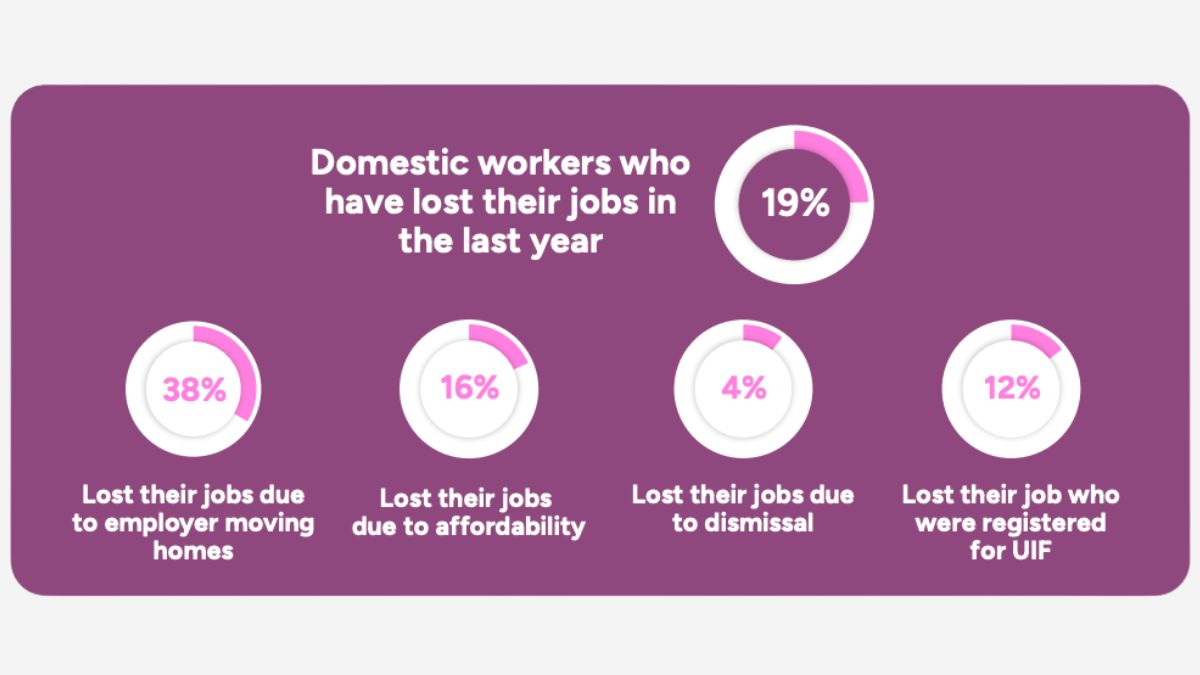
The report shows that 19% of domestic workers lost their jobs in the past financial year alone.
About 16% of job losses in 2025 were because employers could no longer afford to pay, down from 25% in 2023 and 2024.
However, more families are moving home, with nearly half of these households relocating overseas and over a third moving to different cities within South Africa.
Kriel said SweepSouth’s own platform has revealed another challenge. Whenever wages are increased to help workers keep pace with rising living costs, employers often respond by cutting back on domestic work.
“Any attempt to raise pay for domestics led to a decline in hiring. This means either the number of days a week is cut or a full-day engagement becomes a half-day job. For some families, it is just not affordable. Then they drop the service in its entirety.”
Domestic workers are also calling it quits
She added that changes in lifestyle have also contributed. “If you look at the middle to upper class that can afford a form of domestic work, salaries haven’t really increased.”
“This is one of the areas where households often cut. Now that some work from home, they do some of the chores themselves. So that’s very prevalent post-Covid.”
The impact of these shifts has been deeply felt by domestic workers, many of whom already face difficult working conditions.
Interestingly, due to the hard and deteriorating working conditions in South Africa, Kriel noted last month that increasing numbers of workers are now looking for opportunities abroad, where wages and job security are often better.
To help respond to these challenges, SweepSouth has been expanding its reach beyond cleaning services.
Kriel said the company is tapping into what she calls the “care economy,” which is expected to see huge growth in South Africa over the coming years.
“The childcare market in South Africa is expected to reach R103 billion by 2030, and elderly care R211 billion,” she said.
“These sectors employ large numbers of people, but many still work informally without job security or benefits. We want to create a pathway into this economy for young people and women.”
Part of this vision is to provide training and opportunities that extend beyond South Africa’s borders.
“We are taking young women from informal settlements, giving them skills and helping them gain experience, and ultimately opening doors to work in other countries, earn foreign currency, and build a better life,” Kriel said.
This shift has already resulted in the launch of eight new services, including elder care, nanny support, and a permanent placement agency to meet rising demand.
“Our end goal is to empower lives, create formal opportunities, and unlock the full potential of the care economy for South Africa. I believe we could become a global leader in caregiving,” Kriel added.
Still, she stressed that ordinary South Africans can also make a difference in the lives of the people who work in their homes.
“We need to move past purely transactional relationships. Talk to them, understand their circumstances, share resources you no longer use, or even help with groceries. Small acts can make a big difference.”

















 Loading ...