

The one province in South Africa where most municipalities are bankrupt


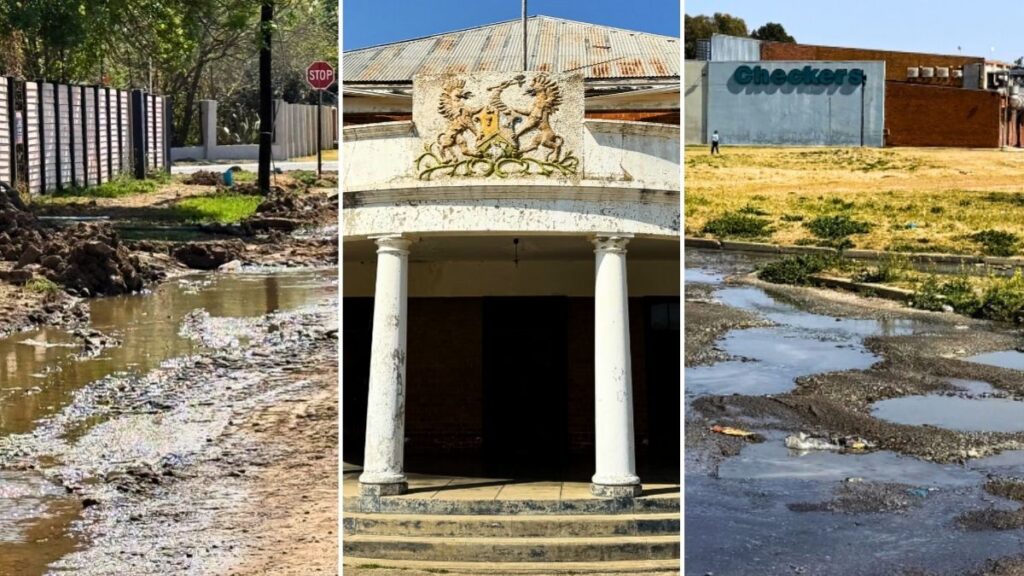
The Free State is arguably the worst-run province in South Africa, with the Auditor-General, Human Rights Commission, and political parties highlighting the province’s collapse through failures in governance, financial accountability, and service delivery.
The Auditor-General (AG) delivered a scathing assessment of Free State municipalities earlier this year.
The report painted a stark picture of municipal dysfunction. It shows that while there were small signs of progress in the past few years, any momentum has been lost.
The AG stated that municipalities in the Free State have become increasingly unstable, and their financial management has deteriorated to such an extent that many are no longer able to perform even their most basic duties.
Six municipalities failed to submit their financial statements in the 2023/24 financial year, reversing the earlier improvement where 83% had done so.
The Maluti-a-Phofung Local Municipality once again received a disclaimed audit opinion, reflecting chaotic leadership, weak controls, and an inability to present reliable financial records.
This collapse in administration is directly impacting daily life. Municipalities are failing to maintain their infrastructure, update asset registers, manage billing systems effectively, or plan and budget realistically.
The result is a rapid decline in the quality of essential services. In Mangaung, the incomplete Thaba Nchu wastewater treatment plant has meant that untreated sewage continues to flow into the environment, posing a growing health hazard.
Across the province, sewage spills, unsafe drinking water, and failing sanitation systems have become routine.
The AG noted that municipalities spent only 1.9% of their budgets on repairs and maintenance, far below the National Treasury’s recommended 8%.
This chronic underinvestment has accelerated the decay of infrastructure, from water pipelines to electricity grids and road networks.
Even where funds exist, they are not being used effectively. Despite increasing reliance on consultants, who cost municipalities over R66 million in 2023/24, financial statements still required major corrections.
Violations of constitutional rights

The AG has warned that municipalities are outsourcing work not to build internal capacity but merely to mask incompetence, while internal audit committees remain ineffective.
Financially, most municipalities in the province are bankrupt. In 2023/24, they collectively recorded net losses of R745 million. A staggering 81% can only sustain their operations for a month or less using their existing cash reserves.
Irregular expenditure has ballooned to R12.5 billion, and fruitless and wasteful expenditure has increased to R5.3 billion, largely due to interest accrued from late payments.
Unauthorised spending stands at R4.2 billion, while most councils adopted unfunded budgets despite clear warnings not to.
These failures are not merely administrative—they are violations of constitutional rights. The South African Human Rights Commission (SAHRC) launched a province-wide inquiry after being overwhelmed with service delivery complaints.
Commissioner Dr Henk Boshoff said the Commission receives roughly 16,000 complaints a year, with a significant number originating in the Free State.
What they uncovered was systematic neglect, crumbling infrastructure, severe water contamination, and widespread governance collapse.
At several municipalities, officials admitted that untreated sewage was being released into major rivers that supply water to millions of people.
Boshoff described this as a direct violation of constitutional and statutory obligations meant to protect the health and dignity of communities.
Municipalities have been gutted

He highlighted how municipalities have high vacancy rates in critical technical and managerial roles, often by design.
Instead of employing skilled engineers or financial managers, some municipalities rely on outsourced water tanker or infrastructure repair contracts.
This has led to what Boshoff described as collusion and corruption between officials and business interests.
In these cases, vacancies are deliberately left unfilled because politically connected contractors benefit from crisis conditions.
Water boards and electricity utilities are also under severe strain because municipalities are not paying their bills.
Boshoff warned that the Vaal Central Water Board could face bankruptcy due to municipal non-payment—a collapse that would have catastrophic consequences for the region’s supply.
Political parties have shared their criticism in response to these findings. The Freedom Front Plus stated that the province’s staggering municipal debt, estimated at R36 billion, is the direct result of decades of financial mismanagement under the ANC.
The party argued that municipalities are collecting only 55% of what they are owed for services and that underspending on infrastructure grants has compounded the crisis.
In the last financial year, Free State municipalities failed to spend almost R2.7 billion earmarked for service delivery improvements.
In response to the growing fallout, Deputy President Paul Mashatile visited the Free State to launch the “Clean Cities and Towns” programme in Matjhabeng near Welkom.
However, the Democratic Alliance (DA) dismissed the visit as political theatre and argued that it did nothing to address systemic collapse or hold those responsible accountable.
DA Free State leader Roy Jankielsohn said the province has been “gutted by ANC cadres whose greed, corruption, and incompetence have collapsed service delivery.”
Images of service delivery collapse across the Free State













 Loading ...