

Bad turn for anyone who loves to braai in South Africa


The latest Braai Index for February 2026 shows that year-on-year inflation for the braai basket is continuing to rise, marking an upward turn in inflation.
The silver lining in the data is that the inflation basket dropped marginally month-on-month, and remains muted year-on-year, in line with the South African Reserve Bank’s new 3% target.
However, the bad news is that the y/y rate is trending upwards, with the Foot and Mouth Disease outbreak still unresolved, and a key driver.
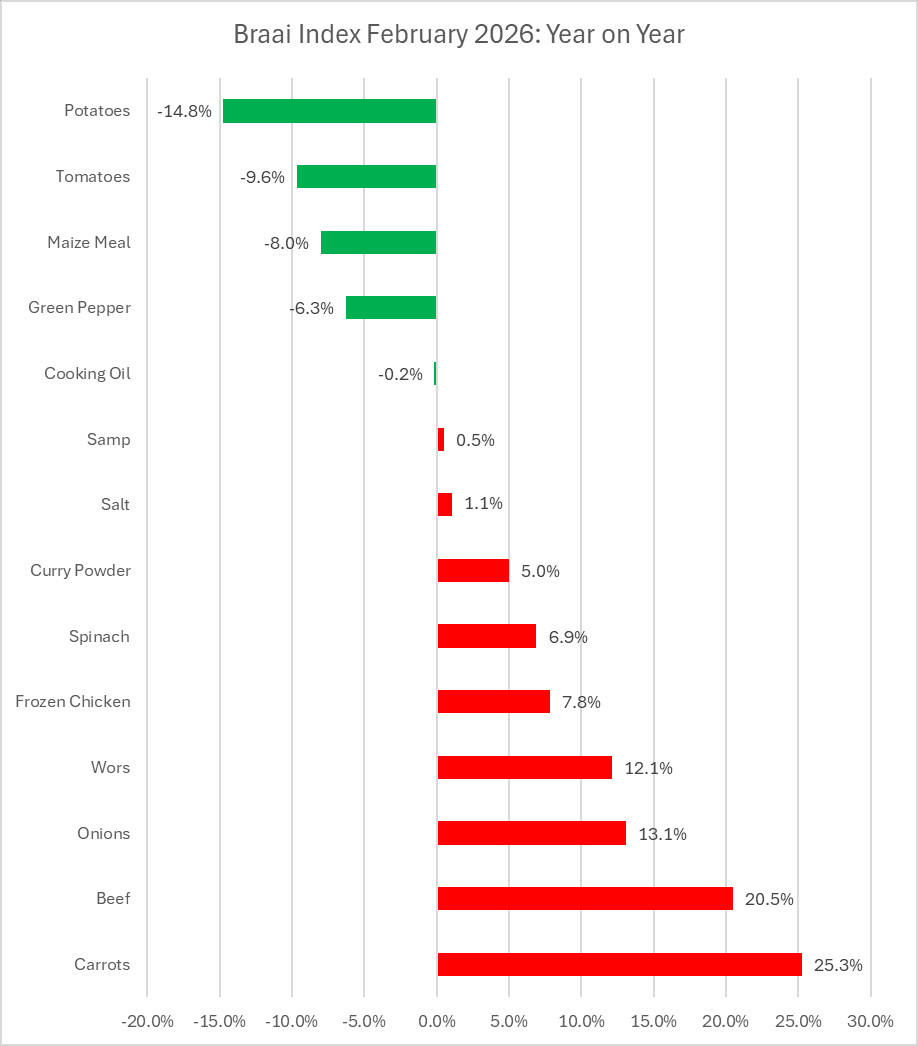
The index shows that the South African braai basket has increased 3% year-on-year, driven by increases for both the meat (beef and chicken) and veggie components.
Beef prices have risen 20.5% y/y, after recording a significant 19.3% y/y increase in January.
The Braai Index is compiled monthly by BusinessTech using pricing data from the Pietermaritzburg Equity Justice and Dignity (PMBEJD) group.
The PMBEJD’s data reflects real “on the ground” pricing across South Africa’s major provinces and includes the items found in the shopping baskets of the majority of South African households.
The index, in turn, tracks the prices of a selection of essential items typically used for a South African braai, offering a more focused view of inflation at the grill.
The index includes meat (beef, wors, chicken portions), vegetables (spinach, carrots, tomatoes, potatoes, onions, green pepper) and others (samp, maize, curry powder, salt).
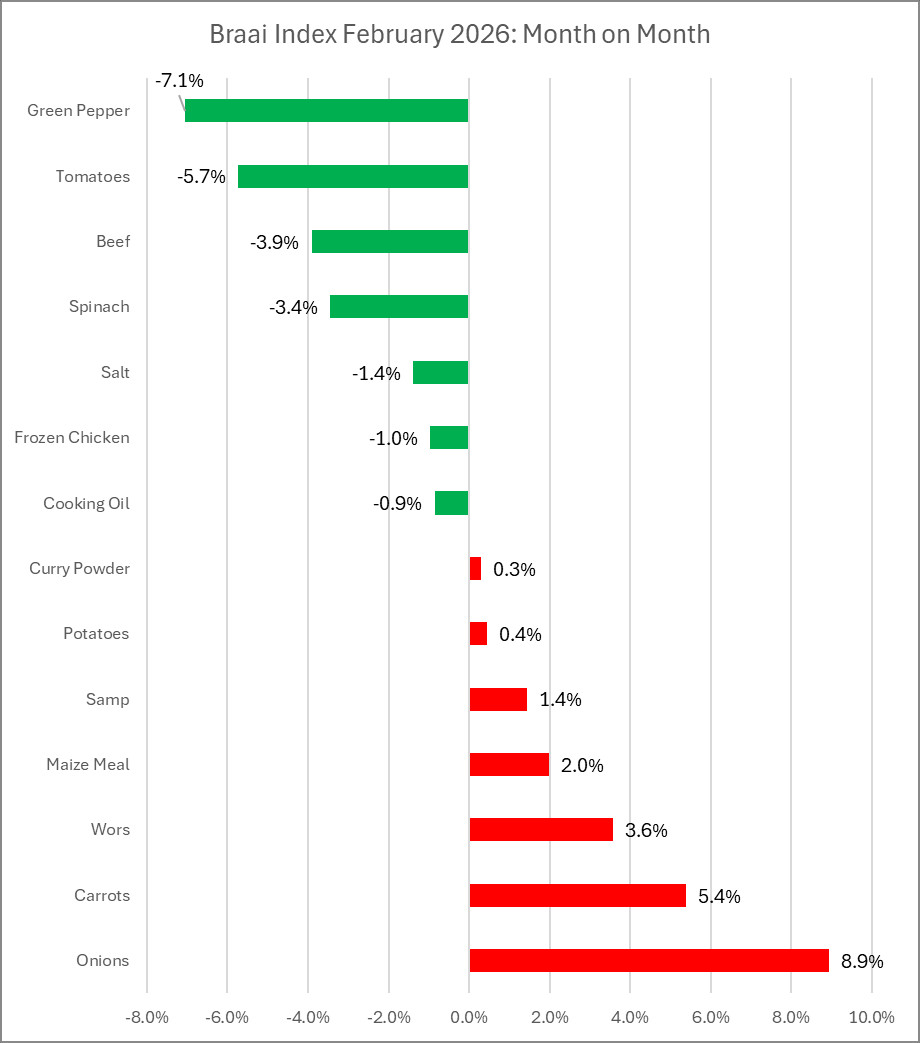
Between January and February 2026, prices dropped slightly, with proteins in the basket easing slightly.
However, year-on-year beef prices continue on a double-digit path, following the rising trend seen since the outbreak of Foot and Mouth Disease in April and May 2025.
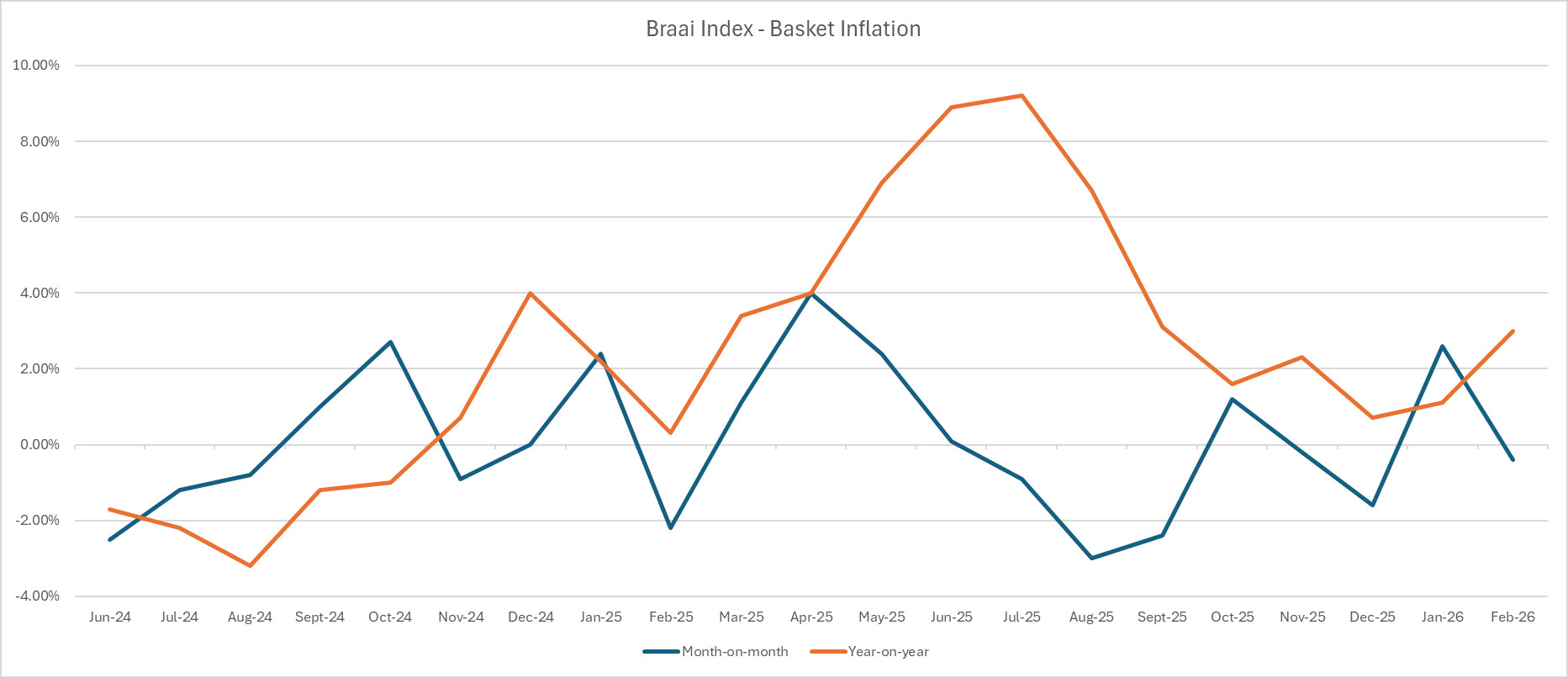
Month-on-month [-0.4%]
Year-on-year [+3.0%]
Meat price pain
The Braai Index is heavily influenced by two proteins: beef and chicken.
Other proteins, such as pork and lamb, are not tracked in the PMBEJD basket and thus do not feature on the index.
Producers of these proteins have criticised the data presented in the index, noting that braai affordability could differ greatly if consumers choose alternative proteins.
However, the beef industry is not the only industry facing strain, with producers warning that African Swine Fever (ASF) will hit pork prices in the coming months.
Warnings from the South African Pork Producers’ Organisation (SAPPO) noted that the piggeries in the Free State, North West, KwaZulu-Natal and north-east Pretoria have been hit by swine flu.
Farmers have also been warned to remain alert for Rift Valley Fever, following the diagnosis of livestock with the virus in November 2025.
While an outbreak has not occurred, heavy rainfall has sparked concerns about mosquitoes hatching en masse in livestock areas, which could spread the disease.
Rift Valley Fever is a viral zoonosis, affecting primarily domestic livestock; it causes abortion and death of the animals. The disease is spread by the bite of infected mosquitoes to susceptible animals.
According to the National Institute for Communicable Diseases (NICD), there have been several isolated outbreaks of the disease; however, a widespread RVF epidemic occurred in South Africa in 2010-2011.
The situation is being closely monitored, with the vaccination of at-risk animals strongly advocated.


















 Loading ...