

Warning for braai lovers in South Africa


The latest Braai Index for March 2026 shows that year-on-year inflation for the braai basket is continuing to rise, despite month-on-month prices easing.
However, the true battle lies ahead, with a massive R7 per litre hike to diesel prices in April threatening to send food inflation rocketing.
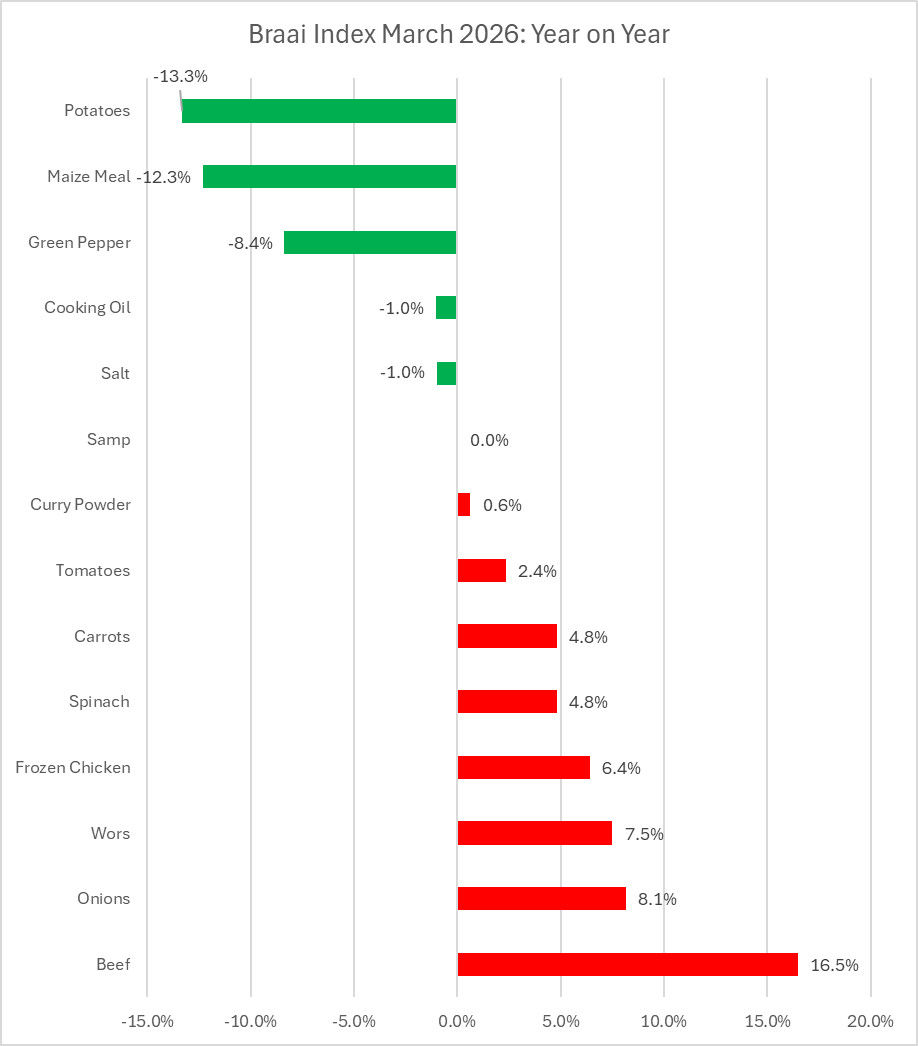
The March index shows that the South African braai basket has increased 1.1% year-on-year, driven by increases for both the meat (beef and chicken) and veggie components.
This is also far below the South African Reserve Bank’s inflation target of 3%, and the Food and Non-alcoholic Beverages (Food NAB) inflation tracked by Stats SA of 3.7% for February.
Beef prices have again risen by double digits, marking 16.5% y/y, following significant increases of 20.5% y/y and 19.3% y/y in February and January, respectively.
Earlier in the year, economists warned that beef prices were likely to continue rising through April 2026 as the country’s Foot and Mouth Disease outbreak runs its course.
The Braai Index is compiled monthly by BusinessTech using pricing data from the Pietermaritzburg Economic Justice and Dignity (PMBEJD) group. The index’s methodology was originated by Bloomberg.
The PMBEJD’s data reflects real “on the ground” pricing across South Africa’s major provinces and includes the items found in the shopping baskets of the majority of South African households.
The index, in turn, tracks the prices of a selection of essential items typically used for a South African braai, offering a more focused view of inflation at the grill.
The index includes meat (beef, wors, chicken portions), vegetables (spinach, carrots, tomatoes, potatoes, onions, green pepper) and others (samp, maize, curry powder, salt).
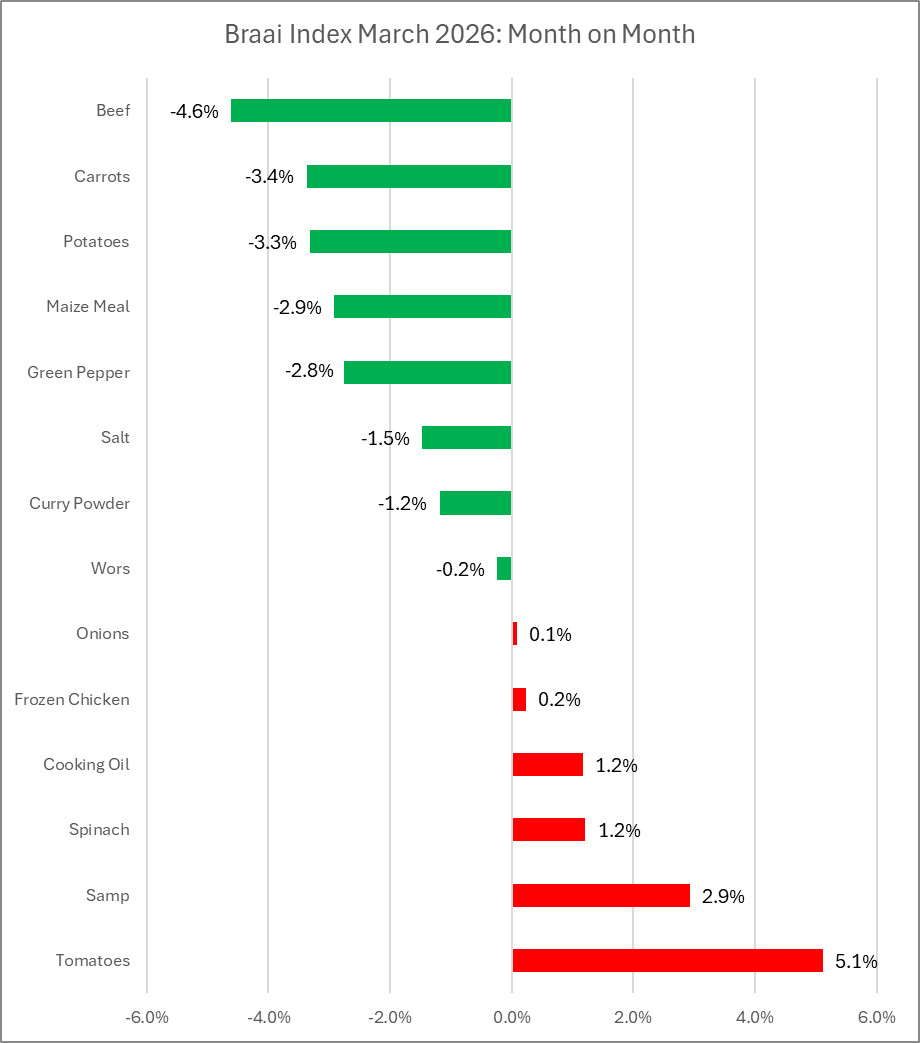
Between February and March 2026, prices dropped slightly, with beef showing the biggest drop. However, it is still a long way away from 2025’s pricing.
Because the index is based on PMBEJD data and the group does not include other protein types like pork or lamb, these alternatives are not included in the analysis.
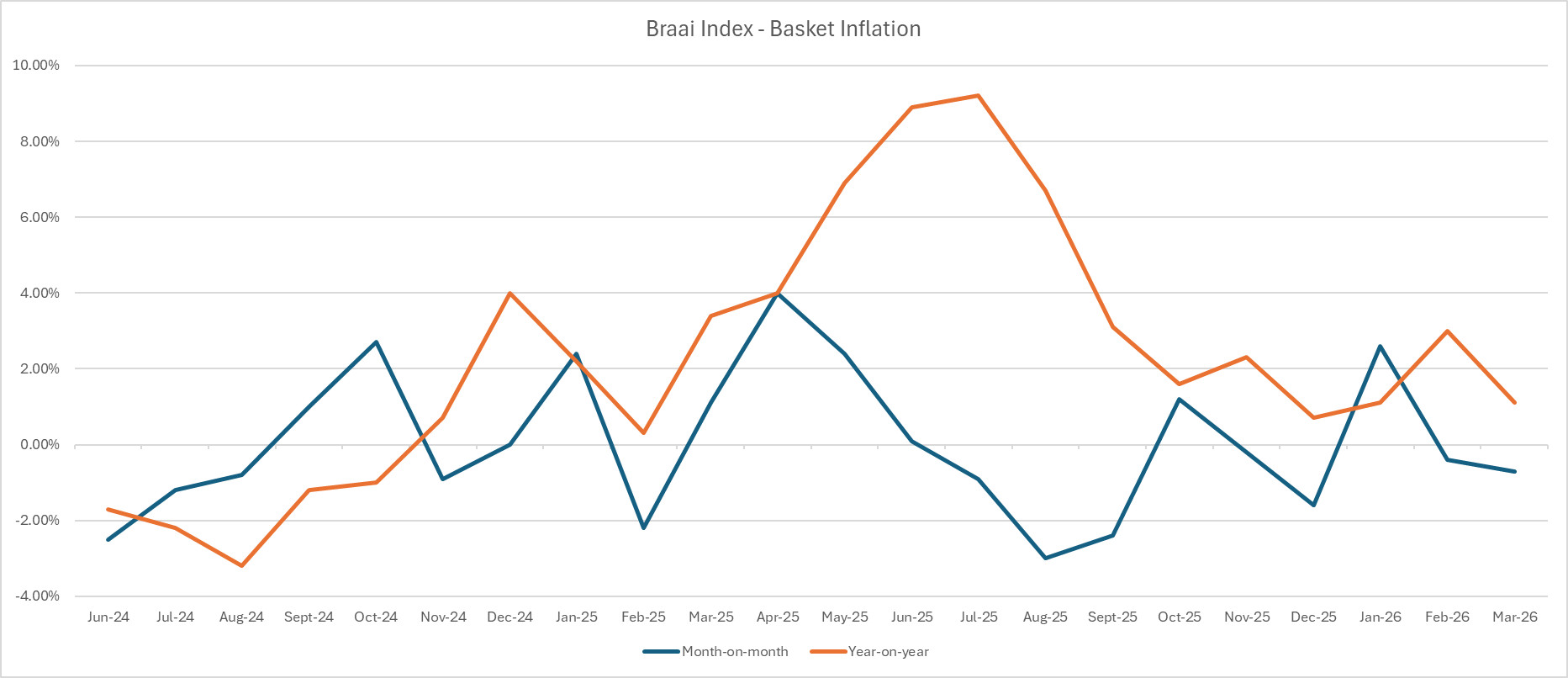
Month-on-month [-0.7%]
Year-on-year [+1.1%]
Food inflation surge is coming
While the index for March points to flat and contained inflation, consumers have been warned to brace for higher prices in the months ahead.
Because of the United States’ war against Iran in the Middle East, global energy markets have suffered a significant shock, sending fuel prices surging.
From 1 April, motorists saw petrol prices climb by R3.06 per litre, while diesel users—including industry—have seen prices surge past R7 per litre.
These prices are already projected to deliver an inflation shock for April, with economists expecting CPI to spike to around 4.5%, which will undoubtedly filter through the economy, including in food prices.
The real problem for consumers is that this is not a temporary shock; May is already building for another massive fuel price increase.
When taken with the already strained meat industry, the fuel price shock is likely to compound the problems and lead to even higher costs at the coals.
















 Loading ...