

Bad news for domestic workers in South Africa


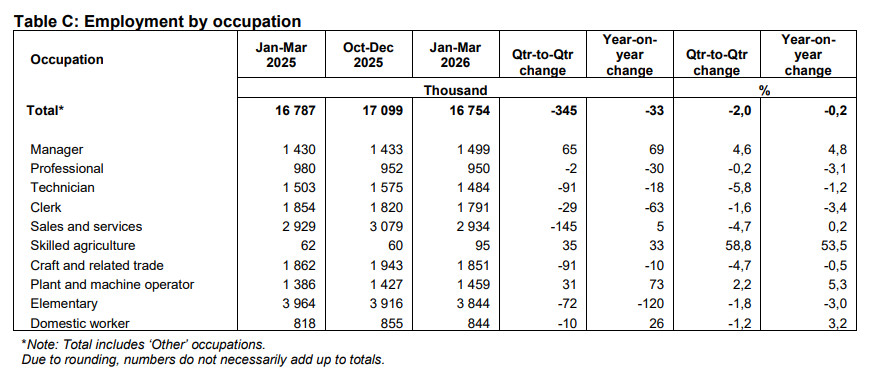
The latest employment data from Stats SA show that domestic worker jobs in the country have declined by 1.2% over the past quarter, resulting in the loss of 10,000 jobs.
The latest Quarterly Labour Force Survey (QLFS) for Q1 2026 shows that unemployment rose significantly in the last quarter, with over 300,000 people joining the ranks of the unemployed.
Between Q4 2025 and Q1 2026, seven of the ten industries saw significant job losses.
The largest decreases in employment were recorded in the Community and social services industry (206,000), followed by Construction (110,000), Transport (30,000) and Private households (28,000).
Employment increased in only three sectors: Manufacturing (38,000), followed by Mining (32,000) and Agriculture (10,000).
Notably, the loss of 28,000 jobs at private households stands out, as these are the primary employers of domestic workers.
Among domestic workers, 10,000 jobs were lost, bringing the total to around 844,000 positions nationwide.
One upside to the data is that the picture is somewhat brighter when looking at year-on-year numbers.
Between Q1 2025 and Q1 2026, domestic worker jobs increased 3.2%, showing a relatively healthier position from 818,000 positions a year ago.
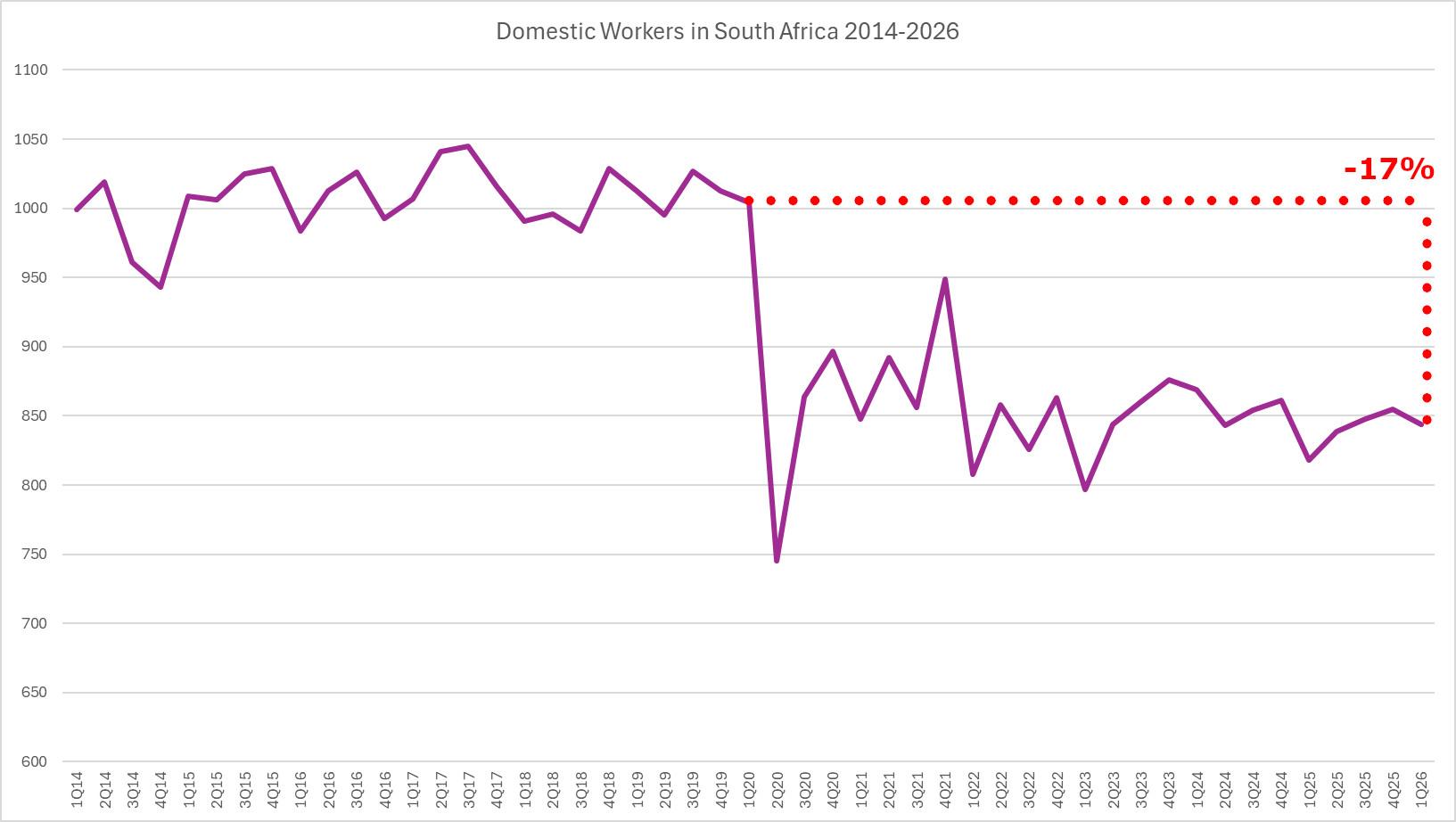
However, this comes with the caveat that domestic worker jobs are still among the few sectors in the country that have not recovered from the lows of the COVID-19 pandemic.
Put another way, job numbers in the sector would have to increase 17% just to reach pre-COVID levels, something that hasn’t been achievable in the three or so years since the pandemic ended.
Tracking the jobs data over that period, domestic worker positions haven’t moved higher than the 880,000 mark in almost four years.
This reflects a permanent loss of around 150,000 domestic worker jobs nationwide.
Pre-pandemic (Q4 2019), figures fluctuated around 1 million domestic workers. When factoring in the seasonal variations and potential base, groups like SweepSouth put the figure closer to 1.2 million.
Various reasons and explanations have been given to account for this, from strained household finances to emigration.
Domestic workers are in crisis
The latest employment data follows pleas during the Workers’ Day celebrations on 1 May for better working conditions and better representation for domestic workers in South Africa.
Speaking to the SABC, two of the only domestic worker unions in the country flagged poor conditions for these workers, despite the government’s concerted efforts to formalise and improve the sector.
According to the unions, there are approximately 1 million domestic workers in the country.
This figure deviated from official Stats SA data, but they said this is because many workers are informal and “exist in the shadows” of the economy.
Because of this, many workers simply cannot benefit from government initiatives to include their jobs in formal protections such as the Compensation Fund and the Unemployment Insurance Fund.
Even among more formal workers, some of these benefits escape them, with the unions adding that only 2% of domestic workers are represented by structured bodies and organisations.
Employers are also hesitant to formalise their work through proper contracts, wanting to avoid the administrative burdens that come with doing so.
For example, only an estimated 20% to 30% of workers are registered for UIF.
The strain on private households over the past few years has also severely impacted domestic workers.
Pinky Mashiane, the founder and president of the United Domestic Workers of South Africa (UDOWSA), said that approximately 20% of domestic workers lost their jobs in the 2023–2024 period due to economic pressures facing households.
Those who remained employed are subject to non-living wages, with many not even earning the National Minimum Wage of R30.23 per hour, the unions said.
The lack of protections, representation, formal employment and low wages all combine to make this class of worker exceptionally vulnerable to abuse, they said.
The unions said that the government needs to ramp up enforcement of the country’s labour laws to protect domestic workers.
However, almost more importantly, they said there needs to be a cultural shift among employers and households to view domestic workers with equality and humanity.
This would encourage employers to provide domestic workers with the same treatment and standards in their homes that they would expect in their own professional workplaces, they said.


















 Loading ...