

A desert town in South Africa where people make R23,100 a month has higher food prices than Cape Town, Joburg, and Durban


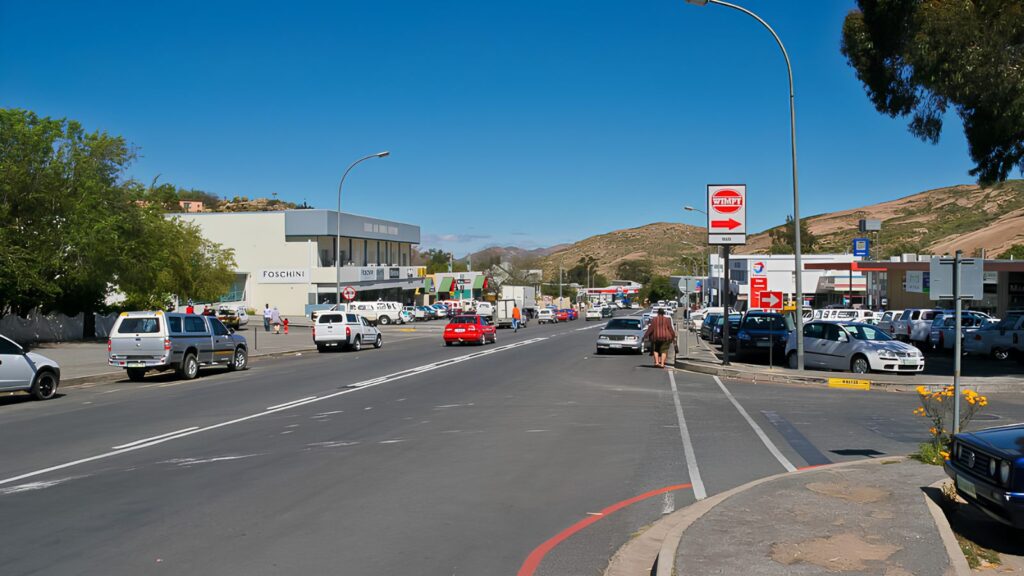
In June 2026, Springbok in the Northern Cape is the most expensive place among South Africa’s major towns and cities for groceries.
However, this is closely followed by Mthatha, Johannesburg, Mtubatuba, and Durban in KwaZulu-Natal.
This is according to data from the Pietermaritzburg Economic Justice and Dignity (PMBEJD) group, which tracks the cost of a household food basket across six towns and cities across South Africa.
The data is based on “on-the-ground” pricing for products across a variety of retailers in major cities, which serve as proxies for the provinces in question.
The PMBEJD report found that while 13 of the 44 tracked food items became cheaper or saw no increases year-on-year, the other 31 experienced price hikes, with eight items seeing double-digit inflation.
South Africa’s consumer inflation has dipped to 3.5% in January 2026, down from the 3.6% recorded in December.
According to the latest data from Stats SA, the CPI increased to 4.5% year-on-year in May 2026, up from 4.0% in April 2026. CPI increased by 0.7% month-on-month.
The Food NAB reading for May was 1.7%. Meat inflation cooled in May, recording an annual increase of 7.3% compared with April’s 9.4%. The monthly rate was -0.8%. Stewing beef prices dropped by 3.0% and beef mince by 2.4% between April and May.
The annual increase for these two products was 2.8% and 10.6%, respectively. Inflation for individual quick frozen (IQF) portions also decelerated, declining to 6.7% in May from 7.3% in April.
Looking at the longer-term tracking of the index, month-on-month inflation is currently trending higher, reflecting the continued inflationary pressure from the past few months.
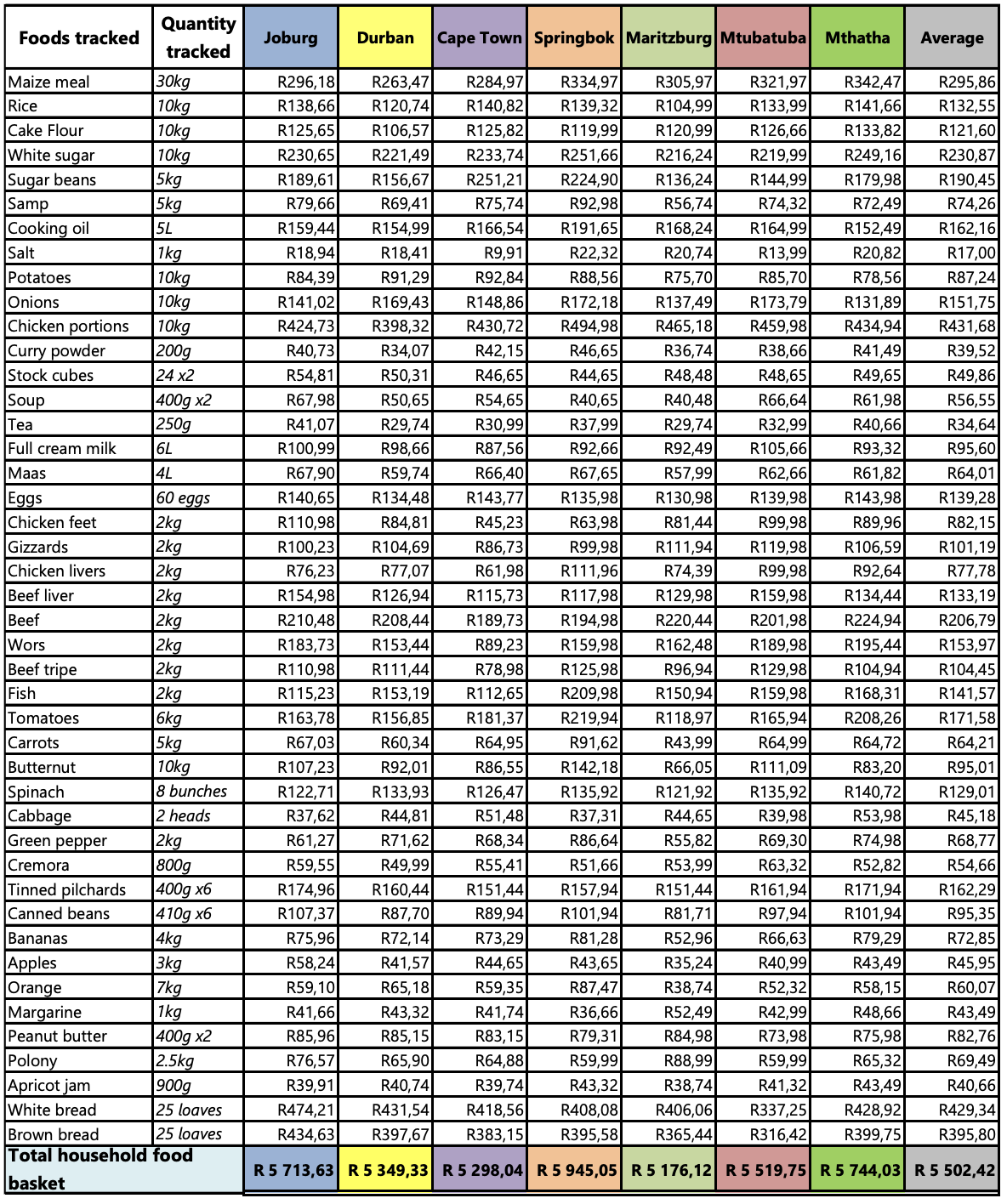
As of June 2026, the average cost of a household food basket in South Africa, comprising 44 essential items that reflect typical purchasing patterns, reached R5,502.42.
The cost of the average household food basket increased by R59.29 (1.1%) from R5,443.12 in June 2025. Month-on-month, the basket price increased by R23.15 compared to May 2026.
The msot expensive cities and towns
However, a breakdown of costs in each city shows that the change in food prices is greater in some areas than others.
In June 2026, the household food basket cost R5,945.05 in Springbok, a 3.0% increase of R172.62 from the previous year. This is also R133.98 more than the basket price of R5,811.08 in May.
Springbok’s basket price surpassed the national average by R442.63, making it the most expensive place for groceries.
Springbok is a town of the Namaqualand region in the northwest of the Northern Cape, nestled in a narrow valley.
It is surrounded by the high granite domes of the Klein Koperberge and serves as a lifeline for the vast, arid region around it.
The town, located roughly 570 km north of Cape Town on the N7 highway, is an essential stopover for people travelling to Namibia.
Because Namaqualand is so sparsely populated, Springbok serves as the major commercial district.
People from surrounding smaller towns, such as O’Kiep, Nababeep, Pofadder, Garies, and Port Nolloth, travel there to obtain their primary food and other supplies.
According to the latest tax statistics published by the South African Revenue Service (SARS), the municipality has only 7,898 registered taxpayers with an average taxable income of R278,259 a year, or roughly R23,188 a month.
That is lower than the Northern Cape’s average taxable income of roughly R307,687 annually, or about R25,640 per month.
Mthatha is the second most expensive city with a household basket price of R5,744.03, while Johannesburg is third at R5,713.63.
Maritzburg came in as the cheapest place to buy food, with its basket costing R5,176.12 in June 2026, due to a significant month-on-month decline of R122.51.
Cape Town also overtook Durban to become the second-cheapest city for groceries, recording further decreases compared to the year before.
Cape Town’s food basket, recorded at R5,298.04, decreased by R99.19 (1.8%) from R5,397.23 in June 2025.
Durban’s household food basket of R5,349.33 increased by R37.11 (0.7%) from R5,312.22 in June 2025, and by R64.86 (1.2%) from R5 284,48 in May 2026.
Food basket comparison of several cities in South Africa for June 2026













 Loading ...