

Chinese car brands in South Africa could be in trouble


Chinese car brands in South Africa could be facing a double blow as both local and international pressures threaten their competitive edge.
Domestically, the government is considering higher tariffs on imported vehicles, while in China, authorities are cracking down on the aggressive discount wars that have helped drive sales.
Together, these developments could force Chinese carmakers to raise prices, weakening the appeal of their affordable offerings.
Speaking at a conference on Wednesday, 11 August, Minister of Trade, Industry and Competition, Parks Tau, said the government is considering changing subsidies for locally manufactured vehicles and auto components to promote higher local content.
Additionally, the state is reviewing tariffs as cheaper cars from China and elsewhere flood the market, undercutting domestic manufacturing.
Tau warned that the influx of low-cost imports is straining South Africa’s automotive sector, which has already seen a significant decline.
“Decreasing sales of locally produced vehicles, along with new pressures of tariffs, will continue to pressure the auto industry, which has already suffered from job losses and plant closures,” he said.
He added that over the past two years, 12 companies have closed and more than 4,000 jobs have been lost in the sector.
South Africa’s automotive market, historically dominated by brands like Volkswagen, Toyota and Mercedes-Benz, produced 515,850 vehicles last year, far below the Automotive Masterplan 2035 target of 784,509.
At the same time, imports now account for 64% of all vehicle sales, while localisation of manufacturing remains stuck at 39%, far short of the 60% goal.
Adding to the pressure is the recently imposed US tariffs, which are cutting into South Africa’s R28.7 billion automotive export market.
The industry directly employs 115,000 people, including over 80,000 in component manufacturing, but many of those jobs are at risk as foreign competition intensifies.
BMW Group South Africa CEO Peter van Binsbergen highlighted the threat and noted that imports have been eroding the sales of locally manufactured vehicles to the point where the industry faces a potential “existential crisis.”
He stressed that while domestic car sales have risen, the value of imports has far outpaced this growth, undermining local production.
“We are looking to react to this, and we need to join forces with the government to address it,” Van Binsbergen said.
Pressure back home
The National Association of Automotive Component and Allied Manufacturers (NAACAM) CEO Renai Moothilal agreed that the government needs to take more protective measures.
He said there is space in the sector to increase tariffs on vehicles and components used in assembly, and pointed to other countries that have acted to shield their industries.
He cited Goodyear’s exit from local manufacturing as an example of how cheaper imports can make domestic operations unsustainable. “There is a definite need to relook at our domestic tariffs,” he added.
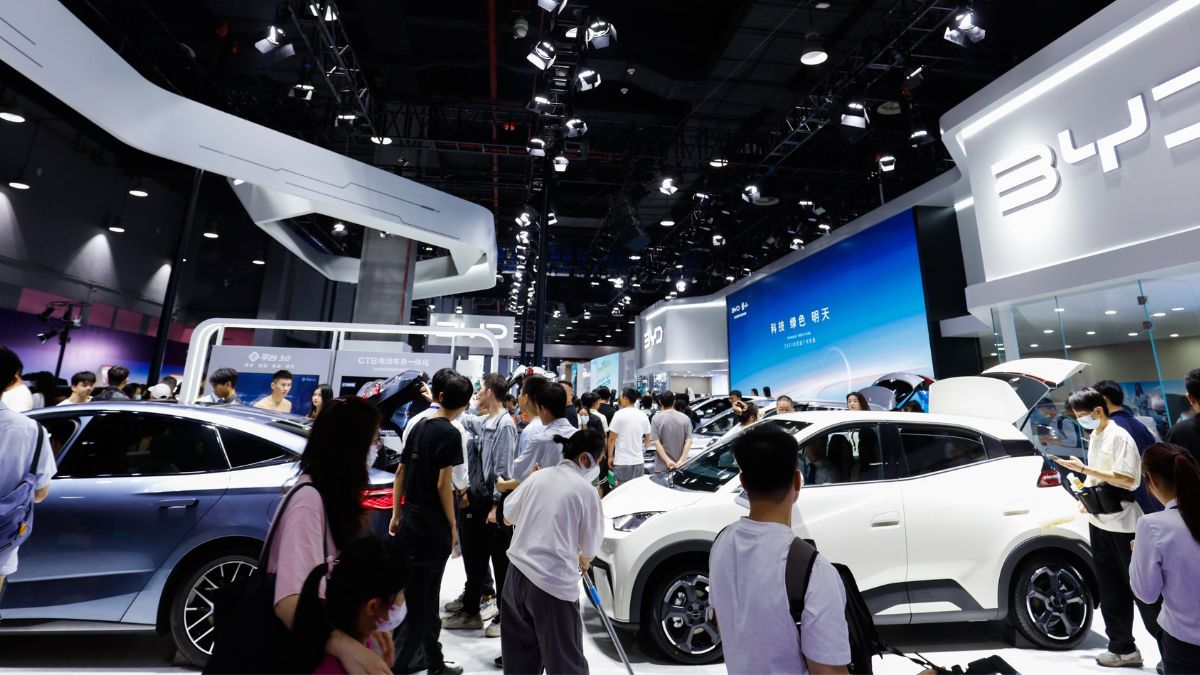
For Chinese car brands, higher South African tariffs would compound the developments unfolding at home.
In their home market, Beijing has tightened control over a price war that has helped many Chinese manufacturers gain ground internationally.
Authorities are concerned that relentless discounting, particularly in the electric vehicle (EV) market, is unsustainable and risks pushing smaller companies into bankruptcy.
The Passenger Car Association (PCA) reported that only 17 car models in China had price cuts in July, down from 23 a year earlier.
While this marks progress in ending the so-called “involution”, a destructive cycle of hyper-competition, it is also slowing sales.
Overall retail car sales in China fell to 1.8 million units in July, down 12% from June. Year-on-year growth slowed to 6.3%, well below the double-digit gains earlier this year.
PCA Secretary General Cui Dongshu said the clampdown on price wars will ultimately benefit the industry by encouraging manufacturers to improve quality instead of relying on deep discounts.
“Anti-involution is a huge benefit to the industry. Upstream enterprises can instead focus on improving quality, satisfying customer demands and not compete on low pricing,” he said.
In early June, the Chinese government summoned major EV makers, including BYD, to Beijing, ordering them to self-regulate and stop offering “unreasonable discounts.”
Authorities have also moved against dealer commission schemes linked to auto loans, which allowed dealers to fund discounts from bank kickbacks. The removal of this incentive has further slowed sales.
Despite the pullback in price promotions, Cui remains optimistic about the outlook for next year, noting that there may be a rush of buyers before China’s vehicle purchase tax exemption is halved from 10% to 5% in 2025.
The combined effect of these developments could be significant for South Africa.
If local tariffs rise and Chinese manufacturers are unable to maintain their aggressive pricing due to domestic restrictions, their vehicles could lose the affordability advantage that has made them popular in recent years.














 Loading ...