

Most South Africans can’t afford to buy new cars


Vehicle ownership tenure in South Africa has increased significantly, largely due to the prevailing economic difficulties faced by many households, which make purchasing a new car unattainable.
A study conducted by the Automobile Association (AA) reveals that over 90% of South Africans are driven by financial constraints to extend the lifespan of their vehicles, with numerous cars remaining operational well beyond the decade mark.
Furthermore, data from We Buy Cars corroborates this trend, indicating that the majority of vehicles sold are 10 years old or older.
According to the Motor Industry Workshop Association (MIWA), a division of the Retail Motor Industry Organisation (RMI), this development underscores the growing need for motorists to adopt a more proactive approach to vehicle maintenance and safety standards.
“Modern vehicles are built to last much longer than in the past, but longevity is entirely dependent on proper maintenance,” said National Chairman of MIWA Dewald Ranft.
“The reality is that many South Africans are delaying servicing or ignoring minor issues because of financial pressure, but postponing maintenance often leads to far more expensive repairs later on,” he said.
International reports show that with proper care and regular servicing, modern vehicles can easily exceed 200,000 kilometres and remain reliable for over a decade.
However, this reliability requires drivers to be disciplined about preventative maintenance.
“There is a huge difference between ‘keeping a car longer’ and ‘maintaining a car properly for longer’,” said Ranft.
According to Ranft, neglecting oil changes, ignoring warning lights, or delaying tire replacements might save money in the short term, but the long-term financial consequences can be significant.
He suggested several points to abide by, that could enhance the lifespan of a vehicle:
- Follow the manufacturer’s recommended service schedule.
- Regularly replace the oil and filters.
- Frequently check tyre pressure and wheel alignment.
- Monitor brake wear and inspect suspension components.
- Pay attention to the cooling system and battery condition.
- Address warning lights immediately.
- Use quality parts, oils, and fluids.
- Have your vehicle inspected regularly by a reputable, accredited workshop.
Ranft said that the road conditions in South Africa are putting additional strain on older vehicles.
He noted that poor road surfaces, potholes, and rising traffic congestion are speeding up the deterioration of suspension systems, tyres, steering components, and brakes.
The inflation impact
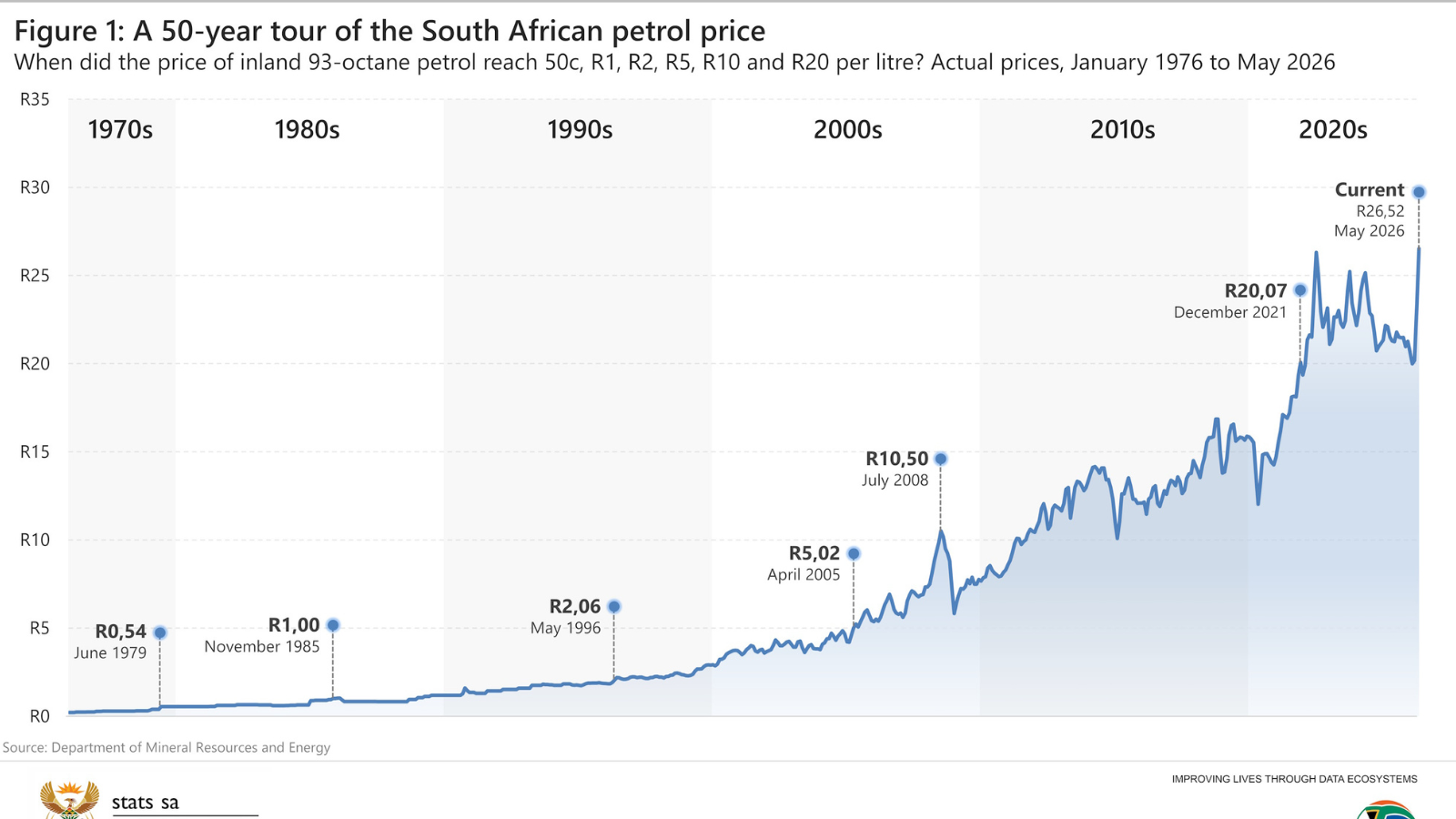
Historical data from Statistics South Africa reveal that historical fuel shocks have consistently been a primary driver of overall economic inflation, significantly diminishing the purchasing power of the local currency.
The value of money has changed dramatically over the decades. A 10-cent increase in 1980 might seem trivial today, but in today’s terms, that 10 cents would be equivalent to R3.74.
This means that past generations experienced the impacts of rising prices just as acutely as motorists do today.
In January 1985, a rapid depreciation of the rand resulted in a staggering 39.4% increase in fuel prices.
Economists immediately warned that this would have ripple effects extending from motorists and farmers to commuters facing higher transport fares, ultimately driving up food inflation.
These predictions proved to be accurate, as by May of that year, South Africa’s overall inflation rate soared to 16.1%.
A similar situation unfolded in October 1990 during the Gulf War, when oil supply disruptions caused another severe price surge.
Stats SA reported that overall inflation reached 15.3%, although it would have been a more manageable 14.3% if petrol prices had remained stable.
Whether influenced by the sudden shocks of the 20th century or by gradual, consecutive hikes, history shows that as fuel prices rise, the cost of everyday living quickly follows suit.

















 Loading ...