

Rise of retirement property in South Africa


South Africa’s retirement property market is small yet vital, with increasing demand for dedicated retirement communities across the country.
This is according to new research from property data analytics company Lightstone, which highlights that while most seniors currently reside in homes that they purchased earlier in life, the demand for purpose-built retirement communities is on the rise.
The formal retirement property market in South Africa, accommodating ~44,000 households, represents a small but significant and increasing segment of the country’s housing landscape.
“This trend is driven by a growing senior population, changing lifestyle preferences, and increasing financial security among older adults,” said Lightstone.
Hayley Ivins-Downes, Managing Executive Real Estate at Lightstone, said that their data shows that of the country’s ~5.45 million residential properties (excluding social housing), approximately one-third is owned by people over 60.
A quarter of these owners bought their properties after they turned 60, with 44,000 of these properties are in formal retirement villages, “which suggests they are targeted at the upper end of the market.”
Properties owned by >60
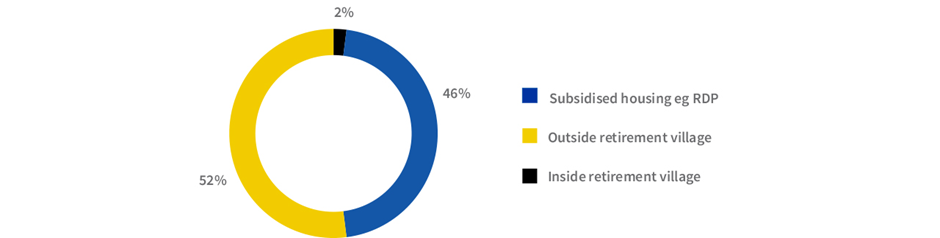
According to Lightstone research, ownership of the > over-60s is split between subsidised housing (1.3 million), non-retirement housing (1.5 million), and formally registered commercial retirement homes (44 000).
Lightstone identified around 650 retirement complexes in South Africa – either Estates or Sectional Schemes.
Approximately 350 complexes consist of properties registered at the Deeds Office, totaling 44,000 units, while around 300 entities are registered as a single property but are owned or managed by social services.
Together, these 650 entities represent fewer than 100,000 units and at most 125,000 individuals, which is a small fraction of the over five million people aged 60 and older.
“The 350 complexes containing units registered at the Deeds Office account for 44,000 properties, of which 33 000 are privately owned and 11 000 are owned by companies or trusts,” said Ivins-Downes.
“These properties house anything between 44,000 to 88,000 people, assuming one or two people live in each property. More than half of the properties are valued at more than R1.5 million,” she added.
Value and age of properties
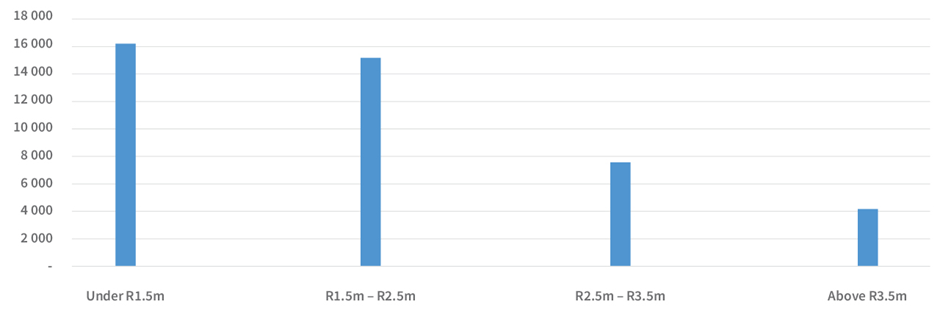
Ivins-Downes said that “the data clearly shows that while many South Africans over 60 own their homes, there’s a significant gap in the availability of formal retirement housing options.”
“While we have identified around 650 retirement complexes, these only accommodate a small percentage of the senior population [which] highlights the need for more diverse and accessible retirement housing solutions, particularly in the affordable segment.”
Additionally, approximately 13% of the stock was developed after 2020, just over 25% were built before 2000, and the balance was built in between.
Lightstone said that around 35% (15,000 properties), are in Estates (gated communities with a shared access/exit gate), and 65% (29,000) are in Sectional Schemes.
Sales over the last five years
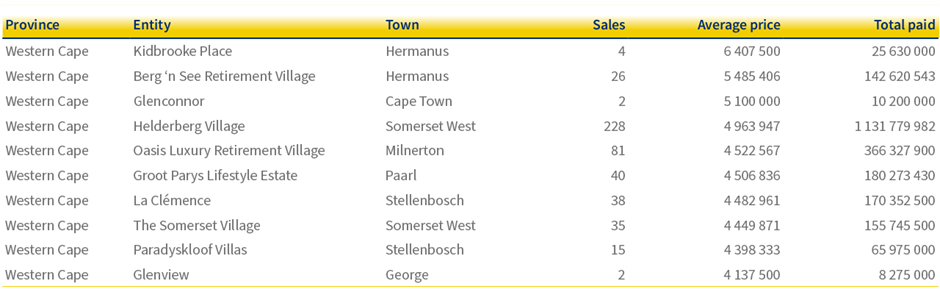
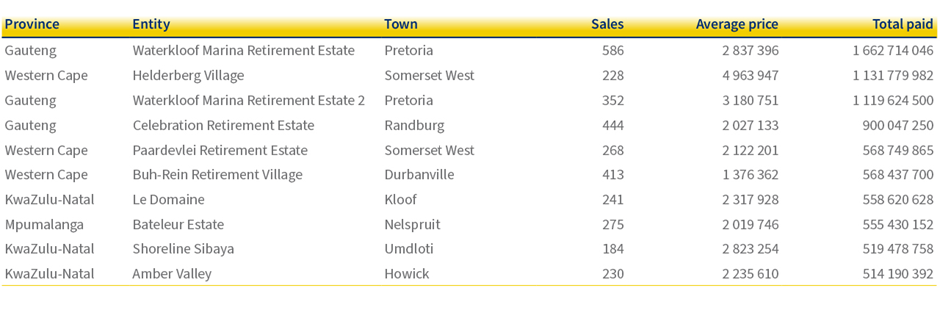
Over the past five years, more than R28 billion has been spent on more than 15,000 properties at an average price of R1.9m in retirement complexes (see four tables below).
While sales have mostly occurred in Gauteng, Western Cape and KwaZulu-Natal, the Western Cape has had the highest average sales prices.
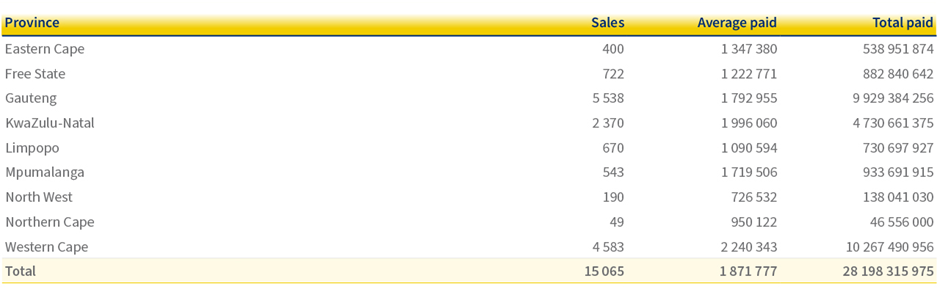
Highest sales volumes over the last five years
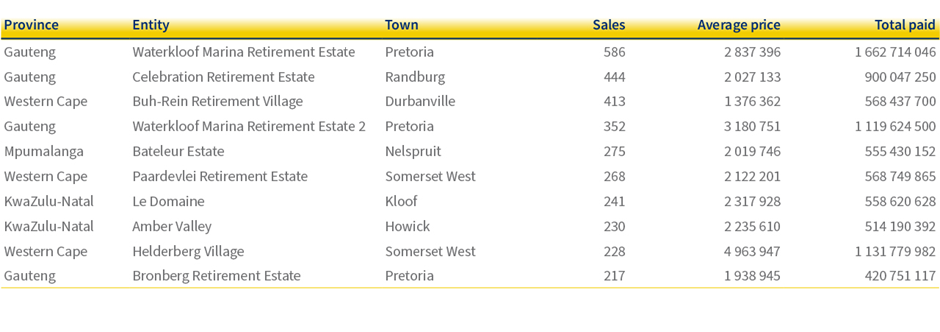
Highest average price over the last five years
Highest total sales value over the last five years
Non-retirement properties owned by >60yr olds
Ivins-Downes adds that the majority of the 1.5 million non-retirement properties owned by >60yrs olds, (which excludes subsidised units) are Freehold, followed by Sectional Schemes and then Estates.
“Interestingly, though, buyers who were 60 or older when they bought their retirement homes opted for Estates or Sectional Schemes in greater numbers, while those who bought when they were younger preferred Freehold properties, reflecting the overall pattern in the property market,” she said.
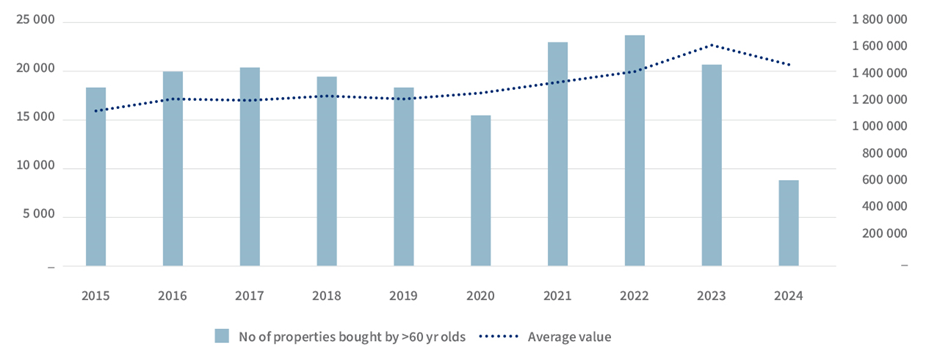
“Sales volumes and average prices paid have been consistent over the past 10 years, other than the Covid fall in 2020,” said Lightstone.
Transactions by >60yr olds
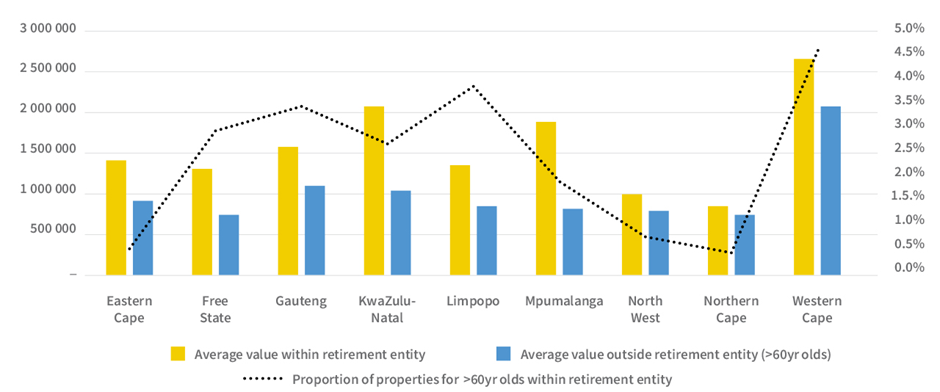
A provincial comparison of retirement properties vs non-retirement properties owned by people over 60
Lightstone said that the average value of properties within retirement villages is consistently higher than the value of homes outside retirement villages, which shows the limited number of homes within these retirement entities.
The Western Cape leads the way in terms of retirement properties followed by Limpopo, Gauteng and KwaZulu-Natal.
Read: The one South African town where property values more than tripled in 10 years
















 Loading ...