

Some good news for South Africa


Despite the global economic uncertainty caused by the global trade environment, purchasing managers have seen an uptick in sentiment across South Africa.
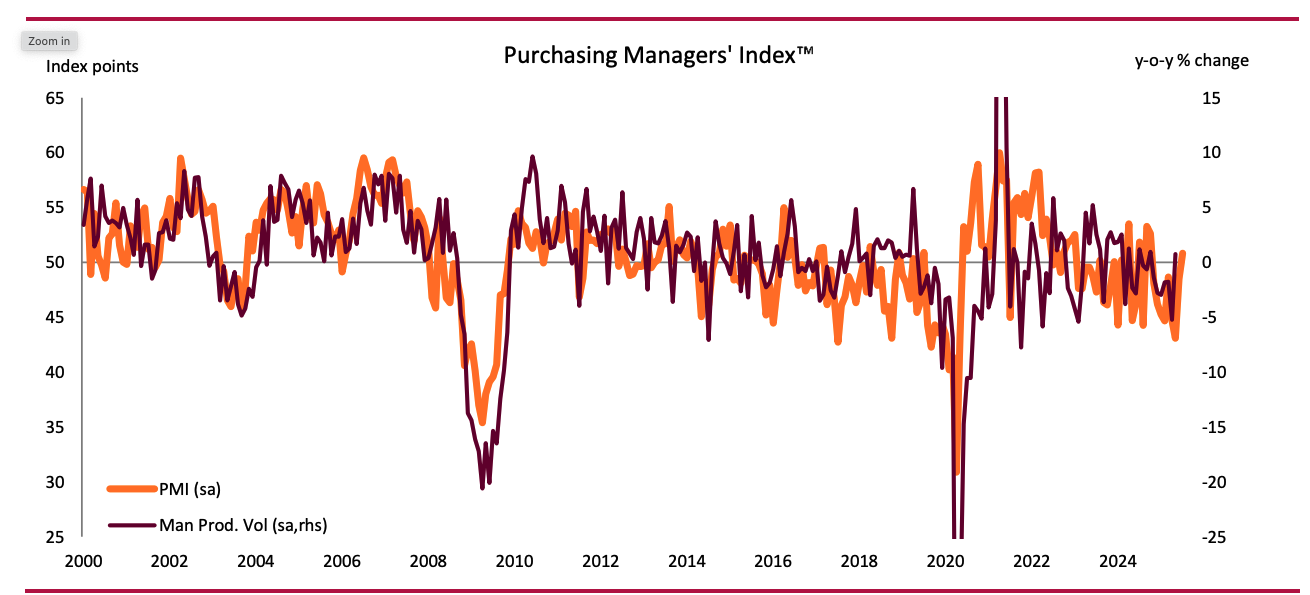
The seasonally adjusted Absa Purchasing Managers’ Index (PMI) rose above the 50-point mark and recorded an expansion for the first time in nine months.
The index increased by 2.3 points to 50.8 in July, which is above the 50 expansionary territory last seen in October 2024. The increase was driven by a relatively strong recovery in demand.
New sales orders increased by 9.7 points to 55.9 in July, recording a third straight month of improvement and signalling a much stronger recovery in demand at the start of the third quarter.
Export sales also showed a significant increase, even though they are still at a low level. Manufacturers remain cautious amid regulations and ongoing trade negotiations.
US President Donald Trump has signed off on 30% tariffs for South African goods, which are set to become effective on 7 August 2025.
This is expected to hurt the agriculture and manufacturing sectors most, and knock off about 0.2% off South Africa’s GDP growth.
Nevertheless, the improvement in demand fostered an uptick in production, which led to the business activity index increasing by 5.2 points to 47.1 points in July.
The supplier deliveries index also improved by 1.4 points to 56.4 in July due to the strong uptick in new orders, which usually lead to longer delivery times and some delays.
Although there was a strong recovery in demand and production, the employment index declined by 6 points in July, reaching 43.7, reversing gains made in June.
Absa and the Bureau for Economic Research said that the weak employment level may be due to the slow recovery in activity, which remains in contractionary territory.
This signals that manufacturers may wait for a stronger demand recovery before increasing their staff numbers.
The purchasing price index also jumped by 1.2 points in July, highlighting growing cost pressures amid higher input materials prices. This included higher fuel prices in July.
“The positive news is that, despite the uptick in the index, the current levels remain the second-lowest in over eight years,” said Absa.
“Furthermore, despite heightened global uncertainty, the rand stayed below R18/$ for July.”
The index tracking expected business conditions dropped to 56.4 in July from 62.5 in June.
“Although still above the 50-neutral level, the direction of the index suggests that manufacturers are faced with an increasingly volatile and challenging trading environment on both the global and domestic front.”
| Index | May | June | July |
|---|---|---|---|
| Business activity | 43.5 | 41.9 | 47.1 |
| New sales orders | 38.3 | 46.1 | 55.9 |
| Employment | 40.0 | 49.7 | 43.7 |
| Inventories | 44.7 | 49.9 | 51.1 |
| Supplier deliveries* | 49.0 | 55.1 | 56.4 |
| Purchasing prices* | 60.4 | 58.1 | 59.3 |

















 Loading ...