

South African households nailed by rates and taxes as inflation shoots up


Annual consumer price inflation was up 0.5 percentage points to 3.5% in July 2025, driven higher by significant increases in rates and taxes, and rising food prices.
This is up from 3.0% y/y in June. Headline inflation was also up 0.9% month-on-month.
The main contributors to the annual inflation rate were food and non-alcoholic beverages (Food NAB) and housing and utilities.
Food NAB has been ticking higher throughout the year, with meat and vegetables in particular showing double-digit inflation for the month.
However, the housing and utilities segment is the outlier, moving up to 4.3% y/y as various municipal rates and taxes were lifted, piling pressure onto households.
Tariffs for water supply increased by 12.1% in 2025, significantly higher than 2024’s rise of 7.5%, recording the sharpest increase since 2018 when tariffs jumped by 12.9%.
Electricity climbed by 10.6% in 2025, lower than the 11.5% recorded in 2024 and lower than the 11.3% increase provided by Nersa for bulk sales from Eskom to municipalities.
Refuse collection and sewage removal tariffs were added to the inflation basket this year. Refuse collection rose by 6.6% and sewage removal by 6.5%.
In additition to the usual rates and taxes, the Cities of Tshwane and Cape Town also introduced new levies and taxes which added even more pressure to households.
Both of these new levies are being challenged in court, but in the meantime, the added pricing pressure is being reflected on utilities bills and also feeding through in the inflation data.
Fuel prices increased by 2.6% between June and July, following four months of decline. The monthly rise in July lifted the annual rate for fuel from -11.2% in June to -5.5% in July.
CPI inflation is likely to rise towards 4.0% y/y by the end of this year but then ease back down again, towards 3.5% y/y by the middle of 2026.
| Rate | Joburg | Cape Town | eThekwini | Tshwane |
| Electricity | 12.7% | 7.2% | 12.7% | 10.2% |
| Water and Sanitation | 13.9% | 4.5% | 12.9% | 13.0% |
| Refuse removal | 6.6% | 7.4% | 7.0% | 4.6% |
| Property rates | 4.6% | 8.0% | 6.5% | -4.0% |
Food prices continue to climb
The other major contributor to inflation, Food NAB, continued to rise in July, increasing from 5.2% y/y in June to 5.7% y/y in July.
Meat, vegetables and ‘other food’ fuelled the uptick. Meat, specifically beef, remains the main driver.
The annual rate for meat accelerated to 10.5% in July, extending a strong upward trend that began in February.
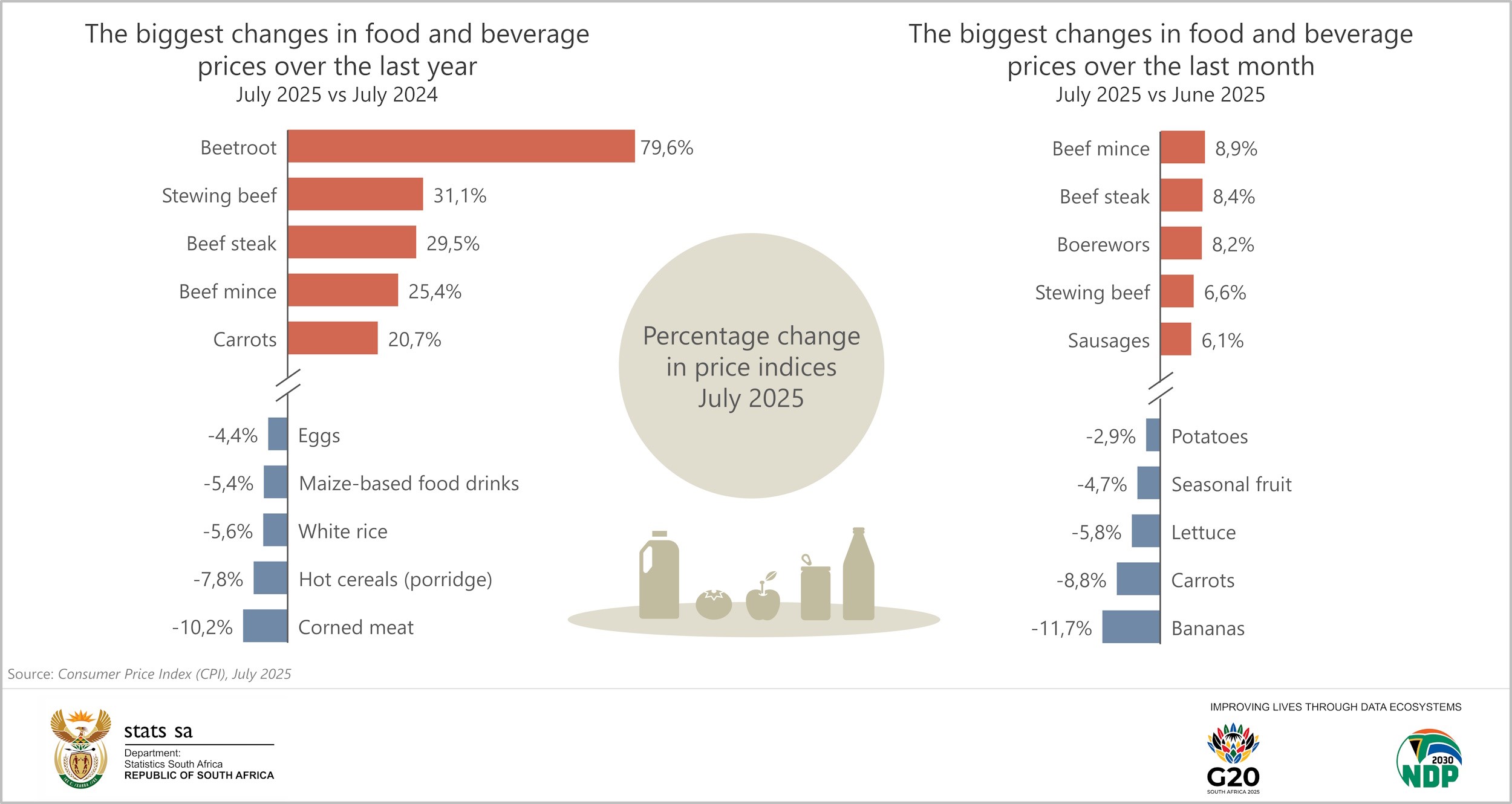
On average, beef prices increased by 28.8% over the past 12 months and by 7.6% between June and July.
The average price for stewing beef was R94.80 in July 2024, climbing to R123.87 per kilogram in July 2025. Beef mince rose from R102.95 to R126.79 over the same period.
Meat prices are under pressure following the outbreak of foot and mouth disease at South Africa’s largest feed lot. Experts say prices should eventually normalise, but the short-term spike was not unexpected.
Vegetable inflation also quickened further to an annual 14.6% from 13.6% in June.
According to Investec chief economist Annabel Bishop,food prices are impacted by global agricultural prices, which are priced in US dollars, and so are affected by the exchange rate.
Although high annual rates were recorded for carrots (+20.7%), lettuce (+17.5%) and tomatoes (+13.7%), prices for these products declined between June and July.
Carrots recorded the most significant monthly decline with a drop of 8.8%.
Most items in the miscellaneous group ‘other food products’ were more expensive than a year ago. Those that recorded rates exceeding Food NAB inflation include salad dressing (+6.7%), vinegar (+6.6%), mixed spices (+6.2%) and soup powder (+5.9%).
All other Food NAB categories recorded softer annual rates.
Inflation for hot beverages cooled for a third straight month to 8.9% in July, down from a peak of 17.5% recorded in August last year.
Some good news on the coffee front. Instant coffee prices declined slightly between June and July, pulling the annual rate down to its lowest level since January 2024.
Prices for cappuccino sachets decreased for a second consecutive month.
The dairy and eggs category remained in deflationary territory. Several products are cheaper than a year ago, including maize-based food drinks, eggs, and certain milk varieties.
Prices for cheese, however, continue to rise. Gouda is 7.2% and cheddar 5.5% more expensive than a year ago.















 Loading ...