

South Africa’s household wealth has dropped to the same levels as 2014


South African households in 2017 have roughly the same level of wealth as they did in 2014 – having lost three years of wealth accumulation in a struggling economy.
This is according to the latest Momentum/Unisa Household Wealth Index for the first quarter of 2017.
The report shows that the combined real net value of all the goods households own (including residential property) and the money they saved and invested increased marginally in Q1 2017 compared to Q4 2016.
However, the real value of households’ net wealth was lower compared to a year ago (Q1 2016), and was at the same level as three years ago (Q1 2014).
“This means that households lost three years of wealth accumulation. The consequences of this loss of real net wealth are far reaching, negatively affecting the economy and every household in the country,” the group said.
The index showed that the real value of household net wealth increased marginally in Q1 2017 compared to Q4 2016 – to R6,994.8 billion from R6,959.8 billion. This represents a 2.0% growth rate when measured at an annualised quarter to quarter growth basis.
However, it is 1.3% or R91.3 billion lower than a year ago.
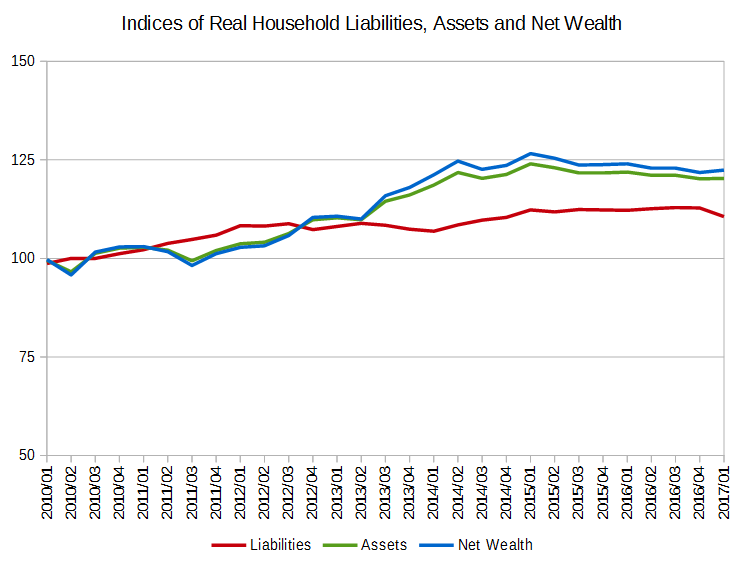
2010 is used as the base year
“The small quarterly increase occurred for lots of right and some “wrong” reasons,” Momentum said.
On a macro level the right reason is because the real value of households’ assets increased to R8,370.2 billion – from R8,362.8 billion in Q4 2016. This is 0.4% higher than in Q4 2016.
The main reason for the increase in the real value of household assets can be attributed to a better performance of their financial assets, which mainly is invested in retirement funds.
For instance, the real JSE All Share Index increased by an annualised quarter to quarter growth rate of 2.1% between Q4 2016 and Q1 2017.
However, despite the quarterly increase, the real value of household assets was still R111.5 billion lower than a year ago (Q1 2016) – and roughly at the same level as in Q3 2014.
Shrinking, or slow-growing real household net wealth, results in less confidence and more financially vulnerable consumers. This in turn causes slower economic growth and job creation, while it also slows the pace of transformation.
It also means that households’ standard of living will be lower than it could have been during their working life and in retirement. It also inhibits their ability to improve their financial wellness, the researchers said.
On the positive side, the index shows that assets, and the real value of households’ liabilities – which should be subtracted from their assets to obtain their net wealth – declined in Q1 2017 compared to both a quarter ago (Q4 2016) and a year before (Q1 2016).
“This indicates that households are reducing the extent of their indebtedness, which is positive for wealth accumulation. In this respect the ratio of household liabilities to their disposable income shows a decline to 73.9% in Q1 2017 from above 75% in Q4 2016 and almost 76% in Q1 2016,” Momentum said.


















 Loading ...