

South Africa kisses over 2,400 millionaires goodbye


The latest Africa Wealth Report for 2025 shows South Africa has lost thousands of millionaires over the last ten years.
According to the report, Africa’s millionaire population is projected to grow by 65% over the next decade.
Today, the continent is home to 25 billionaires, 348 centi-millionaires (individuals with more than $100 million in investable assets), and 122,500 millionaires, defined as people with assets of over $1 million.
“This is a remarkable transformation from the late 20th century, when there were only a few billionaires and many African economies were in long-term decline,” the report noted.
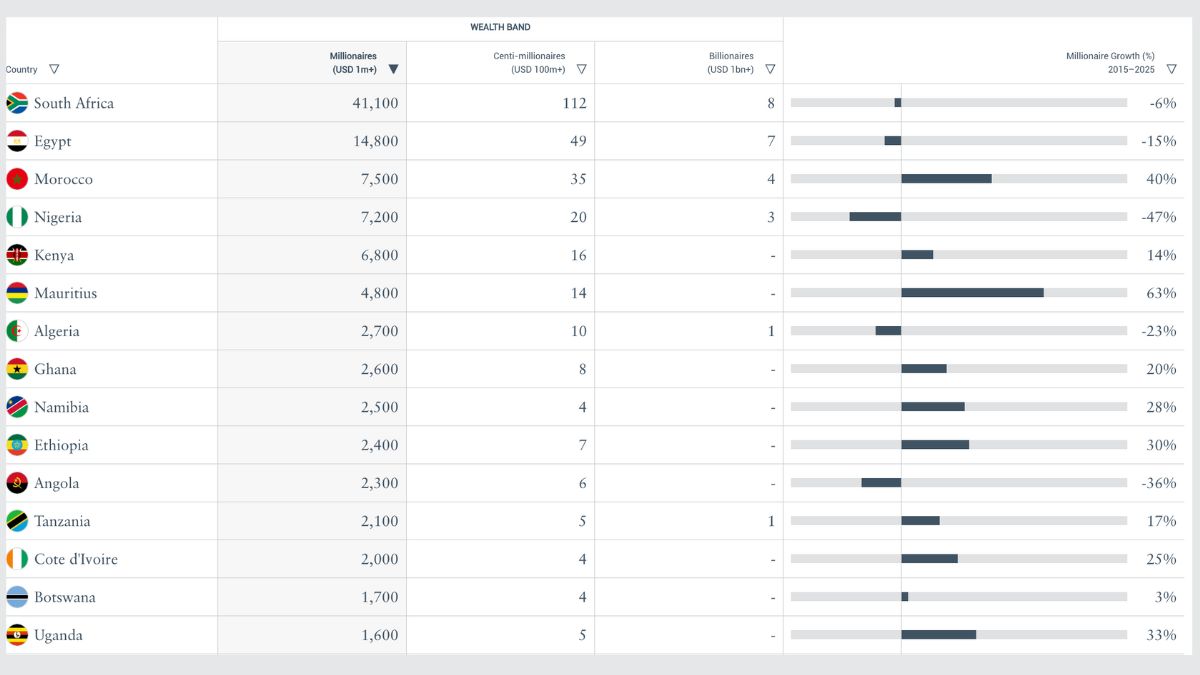
South Africa remains the largest wealth market on the continent, with 41,100 millionaires, including 112 centi-millionaires and eight billionaires.
This accounts for 34% of Africa’s millionaire population, or roughly equal to the wealth base of the next five wealthiest countries.
Egypt comes in second with 14,800 millionaires, followed by Morocco with 7,500, Nigeria with 7,200, and Kenya with 6,800.
Together, these five markets represent 63% of Africa’s millionaires and 88% of its billionaires.
However, the overall picture for South Africa is not as rosy as it first appears. Over the past decade, the country has seen a 6% decline in high-net-worth individuals (HNWIs), losing 2,466 US-dollar millionaires.
By contrast, Mauritius has recorded the continent’s strongest growth in wealthy individuals, with a 63% increase driven by political stability, tax efficiency, and a thriving residence-by-investment program.
Rwanda has posted a 48% rise, Morocco 40%, while Nigeria’s millionaire population has contracted sharply by 47%, alongside declines in Angola (36%) and Algeria (23%).
The reasons behind South Africa’s millionaire exodus are varied but follow a familiar pattern globally.
Wealthy individuals tend to move to safe-haven countries, which are places with strong security, stability, and insulation from major economic and political crises.
Popular destinations include Australia, Switzerland, Monaco, Singapore, the UAE, New Zealand, Malta, and Mauritius.
For South African millionaires, key concerns include safety and security, rising levels of crime and violence, and the quality of education and healthcare.
Surprising twist in sentiment towards South Africa
Despite South Africa’s challenges, the report also highlighted the country’s resilience and enduring attractiveness for affluent individuals.
While safety remains its Achilles heel, wealthy communities are often able to insulate themselves and still enjoy a high quality of life.
The country’s major metro areas boast modern infrastructure, world-class amenities, and a lifestyle that compares with top global cities.
Cape Town, for example, was voted the “Best City in the World” for the seventh time in 11 years in the 2025 Telegraph Travel Awards.
South Africa also enjoys a strategic advantage due to its central time zone, which enables real-time business engagement with markets across the Americas, Europe, the Middle East, and Asia.
On the global stage, the country is not directly involved in major geopolitical conflicts, offering relative stability at a time when parts of the world are gripped by war and instability.
The country’s financial system is another pillar of strength. Despite volatile politics, it is underpinned by a strong constitution and robust regulatory framework.
Its banking system is well-capitalised, globally connected, and widely respected. The Johannesburg Stock Exchange remains one of the largest and most sophisticated in emerging markets, with two-thirds of listed companies driven by international assets or revenues rather than purely domestic dynamics.
Commenting on Africa’s broader trajectory, Nontobeko Ndhlazi, Group Chief Financial Officer at WIPHOLD, said the continent’s youthful population is a key advantage.
“The full potential of this social dividend, where approximately half of Africa’s youth are women, holds immense possibilities,” she said.
“African women, particularly those in rural areas, play a crucial role in the broader agricultural sector. Many have developed an inherent understanding of environmental sustainability, making them de facto environmental managers.”
For Jean Paul Fabri, Chief Economist at Henley & Partners, Africa’s wealth boom is both a signal and a test. “It signals that despite challenges, wealth is being created and retained in key markets,” he said.
“But it also tests the continent’s ability to turn private wealth growth into broad-based economic transformation.”
He added that for Africa, the goal is not merely to count millionaires but to build a wealth ecosystem where prosperity is self-reinforcing.
“This is where opportunity expands, capital circulates locally, and the continent becomes not just a participant but a leader in the global wealth story.”


















 Loading ...