

Where South Africans go when they move cities


New data published by FNB shows the inter-provincial repeat home buying trends among South Africans. The data is used to understand the migratory patterns between regions in the country, and perceptions of economic opportunity, lifestyle and other factors.
FNB’s latest Property Barometer notes that the Western Cape continues to far outperform the other 8 provinces in terms of its ability to attract repeat home buyers from other provinces and retain its own.
Deeds Office data provides an opportunity to gain an indication of a region’s attractiveness by trying to quantify the migration of repeat property buyers between regions, in this case between provinces.
FNB said it identifies all purchases by individuals where there is a corresponding sale by the same individual within 6 months either side of the purchase.
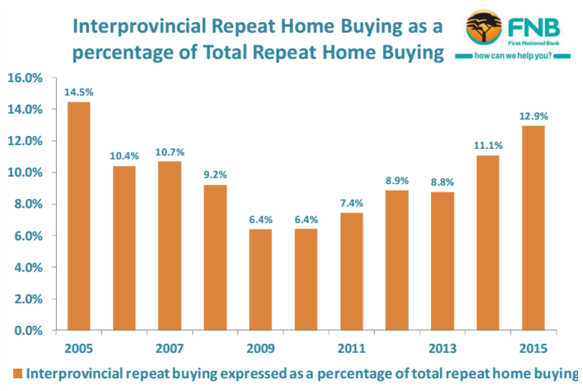
The bulk of these repeat buying transactions are within the same province, but a portion of these purchases, 12.9% in 2015, were in a province other than where the corresponding sale took place, the bank said.
This figure represents its estimate of the year’s inter-provincial re-location rate or, alternatively put, the ‘repeat buyer semi-gration’ rate. FNB stressed that it isn’t an exact science, as some holiday property buying may slip through, while aspirant 1st time buyers who have re-located do not get included into this figure.
“Nevertheless, we believe it to be a good indicator of a large portion of ‘semi-gration’ flows,” said John Loos, household and property sector strategist at FNB.
The inter-provincial repeat buyer migration picture shows 2015 to have been another year of increase in the rate of migration. From 11.1% of total repeat property buying being estimated to be inter-provincial repeat buying in 2014,the estimate rose to 12.9% in 2015.
This is significantly higher than the 6.4% lows reached around 2008/9 just after the recession.
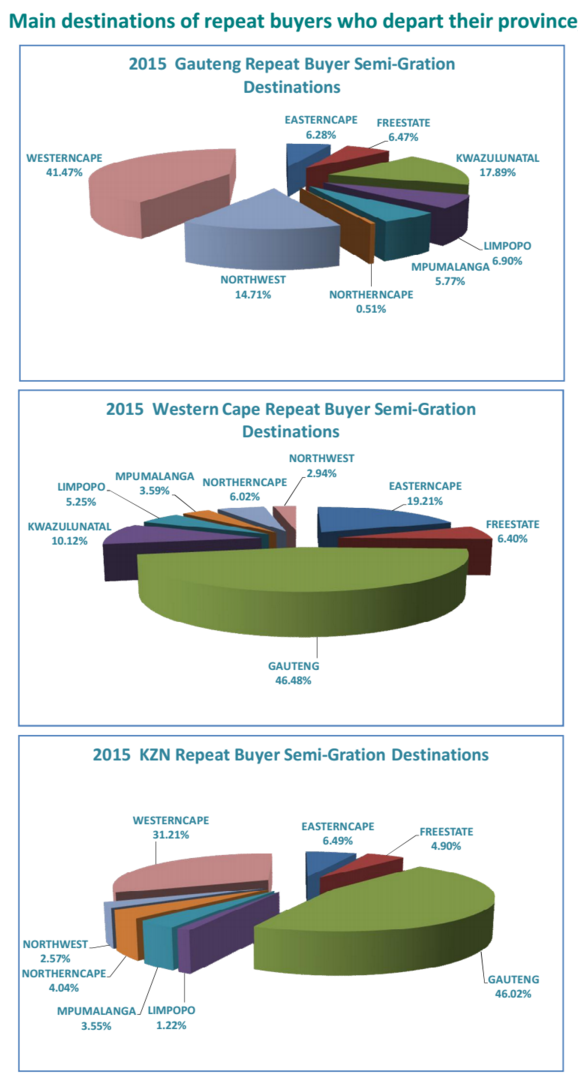
FNB pointed to a structural change within the country’s make-up and the emergence of the Western Cape as an ‘economic powerhouse’. ‘Such a structural change has been taking place in recent years, with the Western Cape having greatly enhanced its relative appeal,” Loos said.
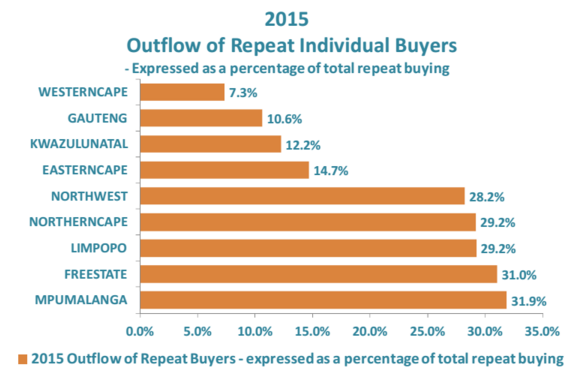
The Western Cape has the lowest percentage of repeat buyers leaving the province, at 7.3%. It also boasts the strongest net inward migration rate of repeat buyers from other provinces.
The province’s economy is the 2nd largest in South Africa after Gauteng, and according to Globalinsight estimates over the 10 years from 2005 to 2014, it also had the fastest average annual economic growth rate, slightly higher than Gauteng.
In addition, the City of Cape Town and surrounding areas has the benefit of a perceived high quality lifestyle compared to many other of SA’s cities, Loos said.
Net Inflow of Repeat Property Buyers to the Western Cape measures 12.2% of the province’s repeat buying, having accelerated steadily since 2009, and now dwarfing the net migration rates of the other 8 provinces.
In defense of Gauteng, Loos noted that a percentage of departures of repeat buyers are for non-work related reasons – retirement and lifestyle. This suggests that Gauteng may lose less active skilled labour than meets the eye.
More South Africa
Rich white millionaires are fleeing South Africa
The world’s ultra-rich are moving to these 8 cities
The best city for house price growth: Durban vs Cape Town vs Joburg

















 Loading ...