

Why South Africa should be worried about the “Brexit”


Economist Peter Attard Montalto says that, while he isn’t banking on a British exit from the European Union – South Africa will definitely be affected should it come to pass.
According to the Nomura economist, markets, investors and local participants are thinking about one risk more than any other at the moment – what a ‘Brexit’ vote would mean and the chances of it happening.
The UK is expected to hold a referendum on 26 June to decide on whether the nation will remain in the European Union or leave and move forward as a wholly independent state.
Proponents of the move argue that an exit from the EU would allow the UK to regain sovereignty and focus on its own local issues, and mitigate many problems associated with immigration while saving millions of pounds.
Opponents of the exit argue that member benefits of the Union and access the to the common market outweigh many of the issues that come with membership.
Nomura holds the view that there is a 25% probability that Britain will exit the EU, but it acknowledges that the vote might be close. Notably, the firm says that an exit would be a negative move for the UK., and economies linked to it.
“We would not particularly buy the risk of strong economic contagion into the Eastern Europe, Middle East and Africa (EEMEA) region on a Brexit vote,” it said.
Obviously an exit vote would have a bigger impact on the UK markets – with Nomura seeing a 2% drop in GDP if it happens. But such an outcome would also have negative impact on economies linked to the UK, wiping between 0.1 and 0.7 percentage points from expected growth rates, depending on how tied up the economies are.
“We expect the maximum growth impact of 0.7 percentage points on the Czech Republic
from trade on a Brexit vote at worst, down to only 0.1 percentage point for Russia, which on all fronts seems least affected,” the group said.
According to Attard Montalto, along with Russia, South Africa’s growth would also be impacted by about 0.1 percentage point – though this impact is slightly more unpredictable.
And with GDP growth already hovering around only 0.6%, any drop is a drop the country can ill-afford.
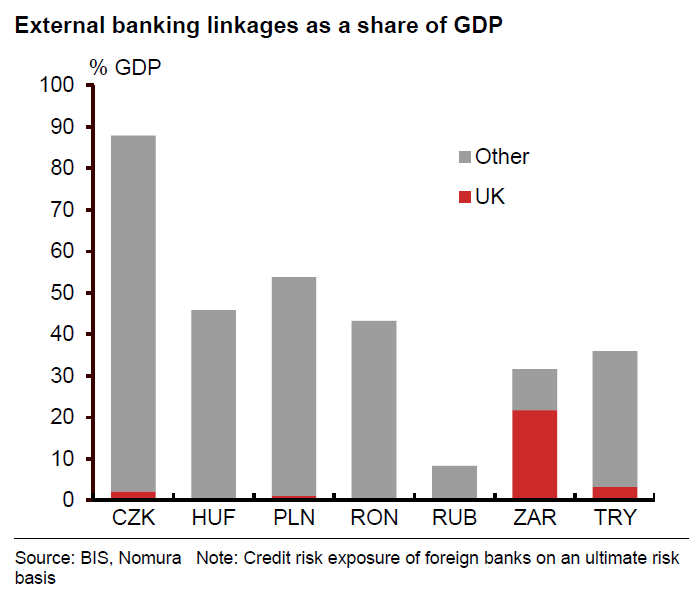
“Looking at UK banks’ credit risk exposure to EEMEA, we find that UK banks have a very small exposure in percentage of GDP terms and the share of total foreign exposure to EEMEA markets,” he said.
However, South Africa has the largest exposure at 21.7% of GDP, thanks to Barclays
and Old Mutual linkages from London. With Barclays’ exit and Old Mutual’s restructuring, however, this exposure should ultimately be smaller.
Other areas that place South Africa at risk are a “significant share of remittances from the UK”, as well as its trade links with the nation – though this factor is one of the lowest of the EEMEA regions covered in the analysis, above Russia.

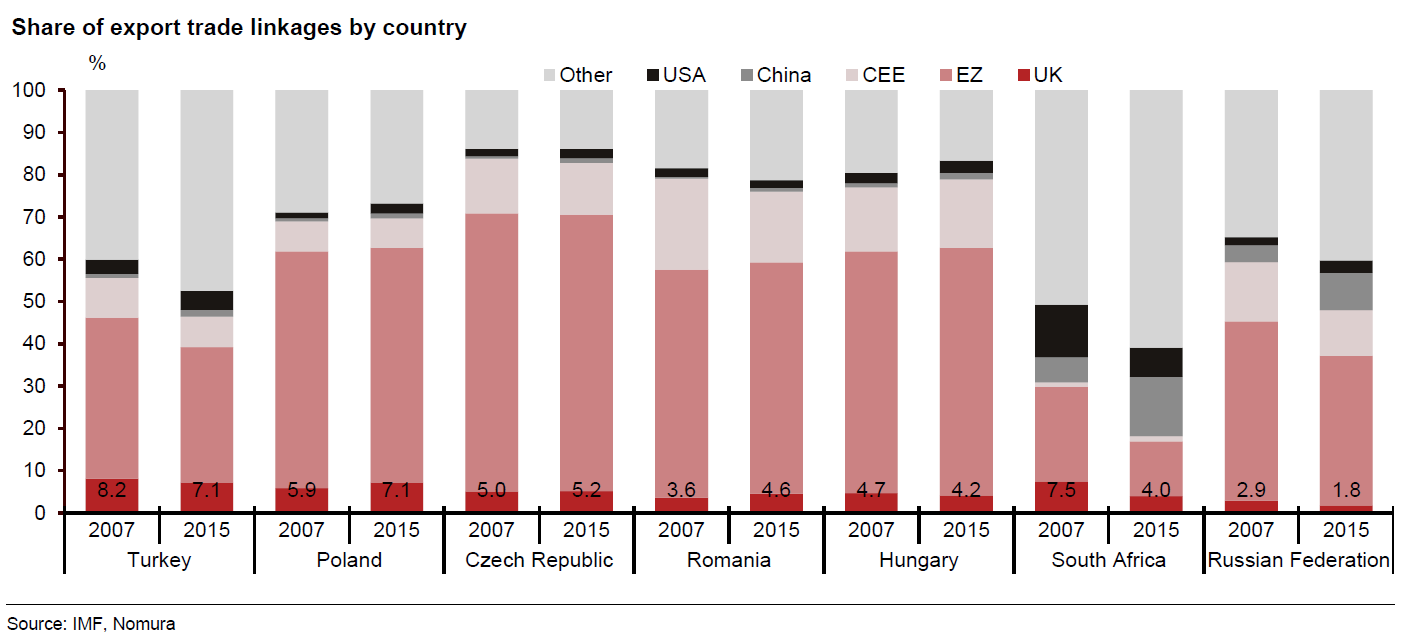
“Broadly, we find that countries have limited potential impact from direct financial
contagion from the UK – though South Africa should be watched,” the group said.
More on the SA economy
South Africa’s economy sinks to third largest in Africa
Plans in place to boost South Africa’s economy
Why the rand punches above the weight of South Africa’s economy
“Secret” rating downgrade can crush South Africa’s economy: researchers

















 Loading ...