

Changes expected in SA spending habits this Christmas


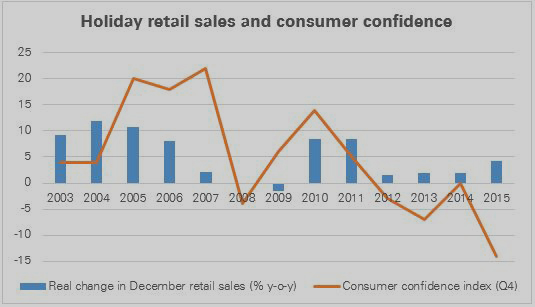
KPMG says that December spending in South Africa is likely to be relatively subdued following a turbulent 2016.
Its forecast comes after research by the Bureau for Economic Research (BER) indicated that confidence among local retailers was in the negative for a sixth consecutive quarter during Q4 2016.
The BER’s index of retailer confidence declined from 43 in Q3 2016 to 34 during the fourth quarter – any reading below 50 indicates that a majority of retailers were pessimistic about trading conditions at the time. The bureau reported challenging conditions in the market for semi-durable and durable goods due to “new (and stricter) regulations for the granting of in-store credit”.
Consumer confidence is currently under pressure from a myriad of factors including elevated inflation, a recent rise in interest rates, weak economic growth pressuring employment and household income, and an unsettled domestic political environment.
Therefore, the outlook for holiday sales during the coming holiday season is justifiably not upbeat.
So what exactly will South Africans be spending their money on this festive season?
Wholesale and retail activity currently accounts for around 15% of GDP, with domestic companies slowly making way to an increasing international presence. Retail will still see a rise over December however, as local schools and the majority of businesses close down.
In December 2015 this was reflected by retail sales of just over R100 billion, almost 30% higher than in the preceding month. This was roughly in line with the average month-on-month jump seen since 2002.
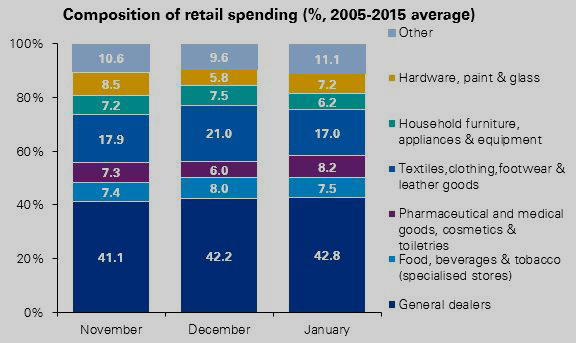
In a normal (November) month during the period 2005-2015, South Africans spend 17.9% of their retail expenditure at stores selling textiles, clothing, footwear and leather goods.
This increases to 21% during December as holidaymakers spend more time in shops and in geographies (e.g. coastal areas) where they would not normally access these shops.
Expenditure on food, beverages and tobacco increased from 7.4% of expenditure to 8%, while stores specialising in the sale of hardware, paint and glass see their share of total retail spending decline from 8.5% to just 5.8%. This is attributed to the fact that many South Africans travel during December and spend less time in their own homes.
During December 2015, stories supplying goods for do-it-yourself (DIY) activities sold around R5.9 billion worth of goods compared to R6.6 billion during the preceding month.
This was the only category of spending that declined (-11.6%) between November and December last year, with all other stores seeing on aggregate an increase in expenditure during the holidays.
Spending on textiles, clothing, footwear and leather goods spiked by 47.4% m-o-m to R21.9 billion last December while expenditure at stores specialising in food, beverages and tobacco jumped by 41.6% m-o-m to R7.9 billion.
Spending on apparel and nutrition during December last year would also have contributed to a 31.3% m-o-m rise in spending at general dealers to R44 billion.














 Loading ...