

The retail job paying nearly R50,000 a month in South Africa


In the Business and Management sector, South Africans can earn nearly R50,000, with almost half of the candidates lacking a degree.
This is according to the recently released Career Junction Employment Insights Report, which highlights employment activity during the last quarter of 2026.
The Career Junction Employment Insights Report analyses supply and demand trends in the online job market, illustrating the dynamics of online labour in South Africa.
Within the Business & Management sector, the Business Development Manager is identified as one of the most in-demand roles in South Africa, with a monthly salary range of R35,830 to R46,511.
For other in-demand roles, such as a Business Development Consultant, the salary ranges from R19,016 to R33,948, while a Store Manager in the Business Development sector can expect to earn between R19,426 and R28,412.
The talent pool for Business and Management candidates revealed that 62.3% of candidates under this sector are classified as Employment Equity (EE) candidates.
Employment Equity (EE) candidates are individuals from designated groups who are historically disadvantaged or underrepresented in the workplace.
These groups can include women, people with disabilities, racial and ethnic minorities, and others.
Employment equity initiatives aim to promote fair treatment and equal opportunities in hiring, promotion, and retention, which aim to ensure that these candidates have a fair chance in the job market.
The report indicated that candidates tend to stay in their jobs for an average of 3 years and 10 months. Nearly half (49.9%) of these candidates are willing to relocate for job opportunities.
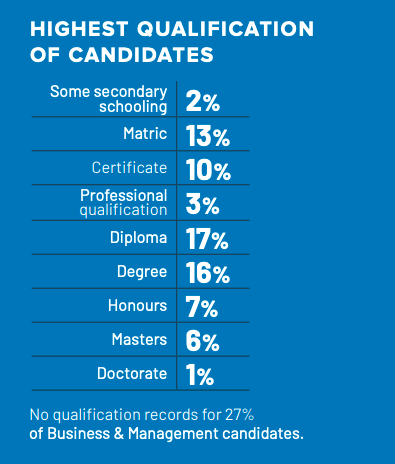
When it comes to educational qualifications, 45.4% of candidates hold a tertiary qualification, while 27% have no qualification records. The report highlights that many of the candidates do not have a degree.
Only 17% of candidates have a diploma, while 16% hold a degree. 13% have completed their matriculation (Matric), and 10% have obtained a certificate.
Seven percent hold an honours degree, and six percent have earned a master’s degree.
Three percent of candidates have a professional qualification, while two percent have completed some secondary schooling. Only one percent of candidates hold a doctorate.
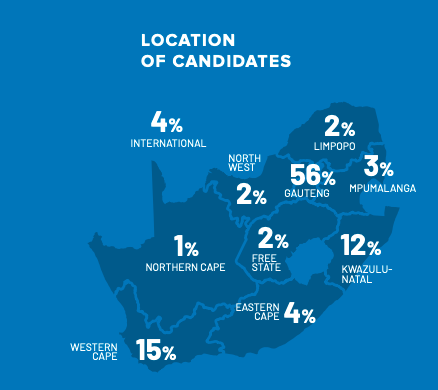
Although the candidates are located in various provinces of South Africa, most are concentrated in Gauteng (56.2%).
The distribution of candidates across other regions is 15% in the Western Cape, 12% in KwaZulu-Natal, 4% in the Eastern Cape, and 4% internationally.
Smaller percentages are found in Mpumalanga (3%), Limpopo (2%), North West (2%), Free State (2%), and Northern Cape (1%).
Lowest take-home pay in two years

In June 2026, South African salary earners experienced a slight increase in their nominal net salaries; however, rising inflation continued to lower their purchasing power.
This is according to the latest PayInc Net Salary Index, which monitors the average nominal net salaries of approximately 2.1 million employees in South Africa.
According to the Index, real take-home pay has dropped to its lowest level in about two years. This decline is placing additional pressure on consumer spending and economic growth.
“The average nominal net salary increased to R21,598 in June 2026, up 0.4% from May,” said PayInc Head of Stakeholder Engagement Shergeran Naidoo.
“However, salaries were only 0.5% higher than a year ago, highlighting the subdued pace of earnings growth.”
PayInc reported that the slight increase in nominal salaries does not accurately reflect the challenges many South African households are facing.
The first half of 2026 has been particularly challenging for salary earners. While nominal net salaries rose by 1.5% over this six-month period, real net salaries actually fell by 2.1%.
“Although salary earners are taking home marginally more in rand terms, inflation continues to outpace wage growth, steadily reducing their purchasing power,” said Independent Economist, Elize Kruger.
In June, the PayInc Net Salary Index decreased by 0.3% in real terms from May and by 3.6% year-on-year, resulting in an average real net salary of R20,198, the lowest level recorded in approximately two years.


















 Loading ...