

The best and worst areas in Joburg for house price growth


Research conducted by FNB, using deeds office data, finds that residential regions in Joburg are still showing real house price decline, with those areas priced at the low-end performing marginally better than properties priced at the high-end.
The lender’s third quarter 2017 Gauteng Metro and Major Council House Price Indices continued to show rates of growth below general economy-wide consumer inflation, pointing to ongoing price decline in real terms (when adjusted for consumer price inflation), and likely improvement in housing affordability when considering house price inflation relative to income inflation.
FNB said that the City of Joburg’s major regions’ show ‘mediocre growth everywhere’, with the former township region of Soweto showing the highest growth.
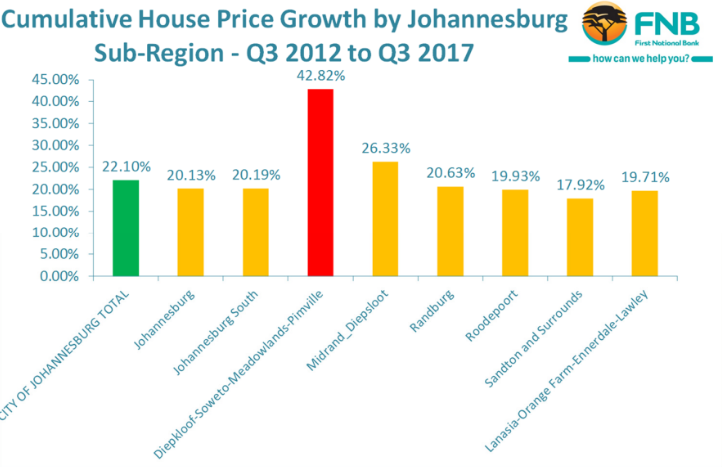
“There are no strong outperforming regions in Gauteng of late,” said FNB property strategist John Loos. “Over the past five years, the lowest income region, i.e. the former “township” region of Diepkloof-Soweto-Meadowlands-Pimville has shown the strongest cumulative growth of 42.82%, with the Midrand-Diepsloot region a distant second with 26.33% cumulative growth.
“At the weak end, the highest priced region of ‘Sandton and Surrounds’ has grown the slowest growth off the highest base, i.e. 17.92%,” he said.
More recently, Loos said that the Diepkloof-Soweto-Meadowlands-Pimville region remains the highest estimated house price growth region at 4.28% year-on-year in the third quarter of 2017. However, this price growth rate itself is weak, negative in real terms, and only slightly above the other low end region of Lenasia-Orange Farm-Ennerdale-Lawley, at 4.04%.
“Nevertheless, this would suggest that the City of Joburg lower price markets are a little stronger, and the high end weaker, with the most expensive “Sandton and Surrounds” end measuring a very slight -0.1% year-on-year price decline,” the strategist said.
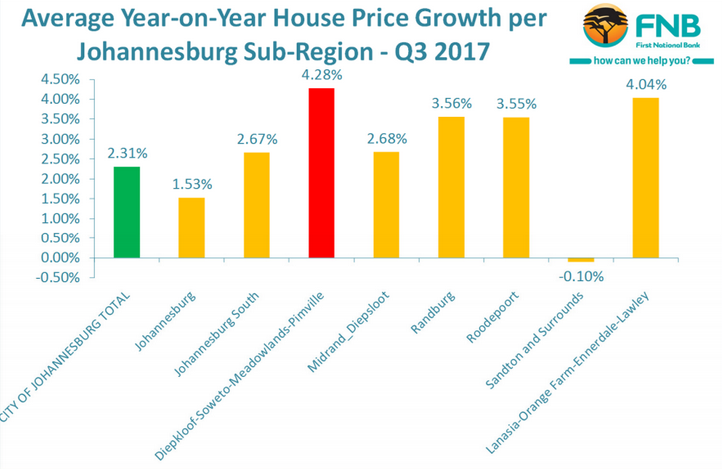
FNB said that although the Gauteng residential markets don’t show any great strength at present, there appears to be a broad pattern of low-priced sub-regions performing a little better than the high-priced end.
“This appears to tie in with what the FNB Estate Agent Survey tells us regarding first time buyer levels in Gauteng’s Metros, i.e. that in the 2017 year-to-date, estimated 1st time buying in Greater Joburg was 26.62% of total home buying, and 24.3% in Tshwane, both percentages being relatively strong and above the national average of 20.26%,” Loos said.
“Solid first time buying in the province may be a key source of support for the low end of the housing market.”
He said that at the high priced end in each metro, on the other hand, confidence in the country’s economic future can be a reason for buyer caution amongst higher income groups, while it is also arguably about the high running and transaction costs related to higher value homes that comes with municipal rates and tariffs rising at rates well-above general inflation in recent years, and higher transfer duty brackets at the high end.
“However, while the low priced end appears to be stronger than higher up the price ladder, broadly speaking, it is by no means very strong either,” Loos said.
Read: How much Joburgers are paying to move to Cape Town’s lifestyle estates

















 Loading ...